Key takeaways
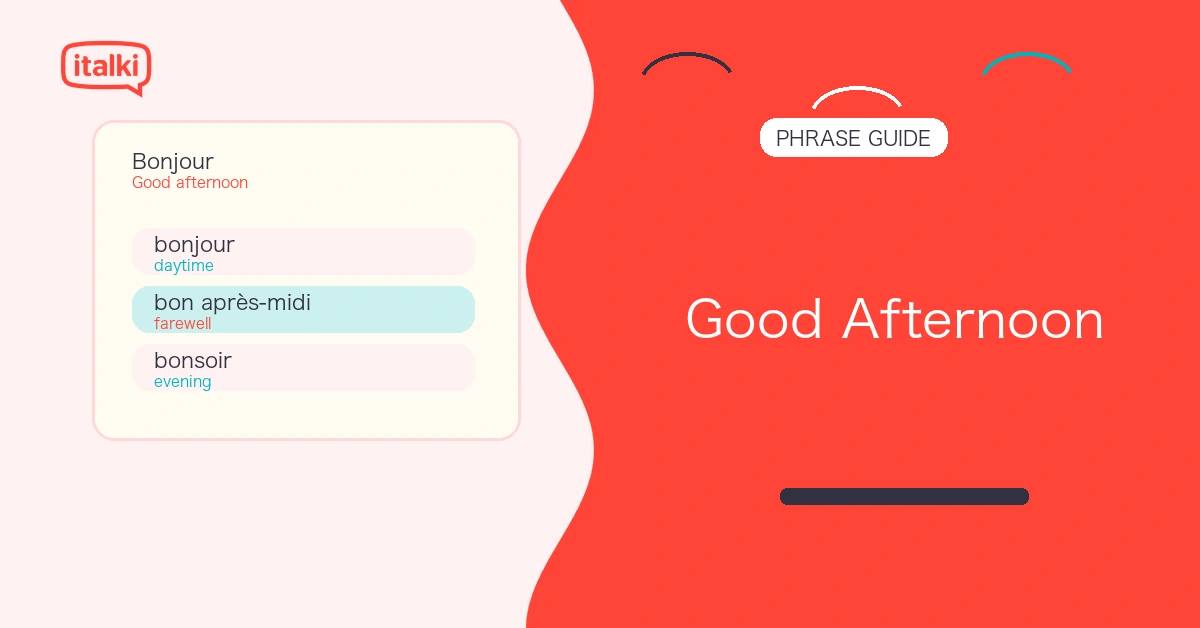
- French does not have a dedicated greeting that precisely means “good afternoon.” Bonjour is used throughout the day.
- Bon après-midi is not a greeting; it is a farewell used when someone is leaving for the afternoon.
- Bonne journée (have a good day) is used when parting, not when arriving.
- Bonsoir (good evening) takes over from Bonjour in the early evening, typically around 6pm or when the sun sets.
- The boundary between Bonjour and Bonsoir is flexible and partly depends on the time of year and local habit.
This guide answers a question that trips up most French learners: if you want to say “good afternoon” as a greeting in French, what do you say? The answer is not what you expect, and understanding why opens up the full French greeting system.
With 15+ years helping 10M+ learners, italki connects you with French tutors who can walk you through the greeting system in real conversational practice, so the timing and usage feel natural rather than calculated.
Why there is no “good afternoon” greeting in French English greets people with good morning, good afternoon, and good evening as time-specific arrivals. French divides the day differently: Bonjour (literally “good day”) covers the entire daytime period from morning through the early evening. There is no equivalent of “good afternoon” as an arrival greeting.
When you walk into a French café at 3pm and the server says Bonjour!, this is not a mistake or an anachronism. Bonjour is the correct greeting for that time of day. The afternoon is part of Bonjour territory.
| Situation | English phrase | French phrase |
|---|---|---|
| Arriving at 9am | Good morning | Bonjour |
| Arriving at 2pm | Good afternoon | Bonjour |
| Arriving at 6pm | Good evening | Bonsoir |
| Leaving during the day | Have a good day | Bonne journée |
| Leaving in the afternoon | Have a good afternoon | Bon après-midi |
| Leaving in the evening | Have a good evening | Bonne soirée |

Find Your Perfect Teacher
Build real French confidence with personalized lessons from a teacher who can help with speaking, exam prep, grammar, and pronunciation.
Book a trial lesson
Bonjour: the all-day greeting
Bonjour is both a greeting and a social obligation. In French daily life, particularly in smaller interactions (shops, offices, lifts), failing to say Bonjour when entering or approaching someone is considered rude. It signals basic courtesy and acknowledgement of the other person. Pronunciation: bohn-ZHOOR. The “on” is a nasal vowel with no English equivalent; it sounds like the “on” in the word “bon” spoken through your nose.
| Context | Example |
|---|---|
| Entering a shop | Bonjour! (as you walk in) |
| Greeting a colleague | Bonjour, Marie. |
| Meeting someone new | Bonjour, je m’appelle [Name]. |
| Answering the phone (professional) | Bonjour, [Company Name], comment puis-je vous aider? |
| Greeting a neighbour | Bonjour Madame / Monsieur |
Bonsoir: the evening greeting
Bonsoir (good evening) is the greeting that replaces Bonjour in the evening. The transition happens roughly around 6pm, though it shifts with the season: in summer, when daylight extends to 9pm or 10pm, some people say Bonjour until later. In winter, Bonsoir may start at 5pm. The transition is not strict. In practice, the moment someone says Bonsoir to you is the moment Bonjour is finished for the evening. French speakers read the ambient cues (daylight, time, the season) and switch naturally.
| Time (approximate) | Greeting |
|---|---|
| Morning through midday | Bonjour |
| Afternoon | Bonjour |
| Early evening (around 6pm) | Bonsoir (transition zone) |
| Evening and night | Bonsoir |
| Before sleeping | Bonne nuit |
Find Your Perfect Teacher
Build real French confidence with personalized lessons from a teacher who can help with speaking, exam prep, grammar, and pronunciation.
Book a trial lesson
Farewells: Bon après-midi, Bonne journée, Bonne soirée
French greetings and farewells work differently. The “bon/bonne [period]” phrases are almost exclusively used when saying goodbye:
| French | English | When used |
|---|---|---|
| Bonne journée | Have a good day | Farewell, daytime |
| Bon après-midi | Have a good afternoon | Farewell, mid-afternoon |
| Bonne soirée | Have a good evening | Farewell, evening |
| Bonne nuit | Good night | Farewell, bedtime |
If someone says Bonne journée to you, the natural response is Merci, vous aussi (thank you, you too) or simply Merci, bonne journée! Using Bon après-midi as a greeting when you arrive somewhere is the key error this guide is designed to prevent. It would be like saying “have a good day” when walking into a room: it makes no sense as an arrival phrase.
Salut: the informal greeting
Salut (hi / bye) is the informal equivalent of Bonjour between friends, family members, and peers. It can be used as both greeting and farewell, at any time of day:
- Salut, ça va? (Hi, how are you?)
- Salut, à bientôt! (Hi / Bye, see you soon!)
Using Salut with a stranger, a superior, or in a formal context is inappropriate in French and would come across as presumptuous or rude. Learn to navigate formality levels with a French tutor through role-playing scenarios.
Find Your Perfect Teacher
Build real French confidence with personalized lessons from a teacher who can help with speaking, exam prep, grammar, and pronunciation.
Book a trial lesson
The greeting system at a glance
| French | English | Use case |
|---|---|---|
| Bonjour | Hello / Good day | Universal daytime greeting (arrival) |
| Bonsoir | Good evening | Evening greeting (arrival) |
| Salut | Hi | Informal, friends and family |
| Bonne journée | Have a good day | Daytime farewell |
| Bon après-midi | Have a good afternoon | Afternoon farewell |
| Bonne soirée | Have a good evening | Evening farewell |
| Bonne nuit | Good night | Nighttime farewell / before sleeping |
| Au revoir | Goodbye | Neutral farewell, all contexts |
Learn faster with personal guidance from 30,000+ expert tutors trusted by over 10 million learners worldwide.Book a trial lesson today.
Find Your Perfect Teacher
Build real French confidence with personalized lessons from a teacher who can help with speaking, exam prep, grammar, and pronunciation.
Book a trial lesson
FAQ
Is Bonjour rude to say in the afternoon?
No. Bonjour is the correct daytime greeting and is never rude to use in the afternoon. The idea that “good morning” and “good afternoon” should be separate greeting words does not apply in French. Saying Bonjour at 4pm is exactly what native French speakers do, and it is fully appropriate. Why do French speakers sometimes say Bonjour twice in the same conversation? If a French speaker says Bonjour when entering a space and then encounters someone new in the same space shortly afterward, they will say Bonjour again to the new person. The greeting is person-specific, not space-specific: you greet each person individually. In a small office or a bakery with multiple staff, a French person might say Bonjour several times in quick succession to different people. Can I say “Bonne après-midi” instead of “Bon après-midi”? No. Après-midi is grammatically masculine (le après-midi), so the correct adjective is bon (masculine) rather than bonne (feminine). Bon après-midi is correct. Some French speakers treat après-midi as feminine in informal speech, but the standard form uses bon. You will see both in usage, but bon après-midi is what style guides recommend.
Want to learn a language at italki?
Here are the best resources for you!