Key takeaways
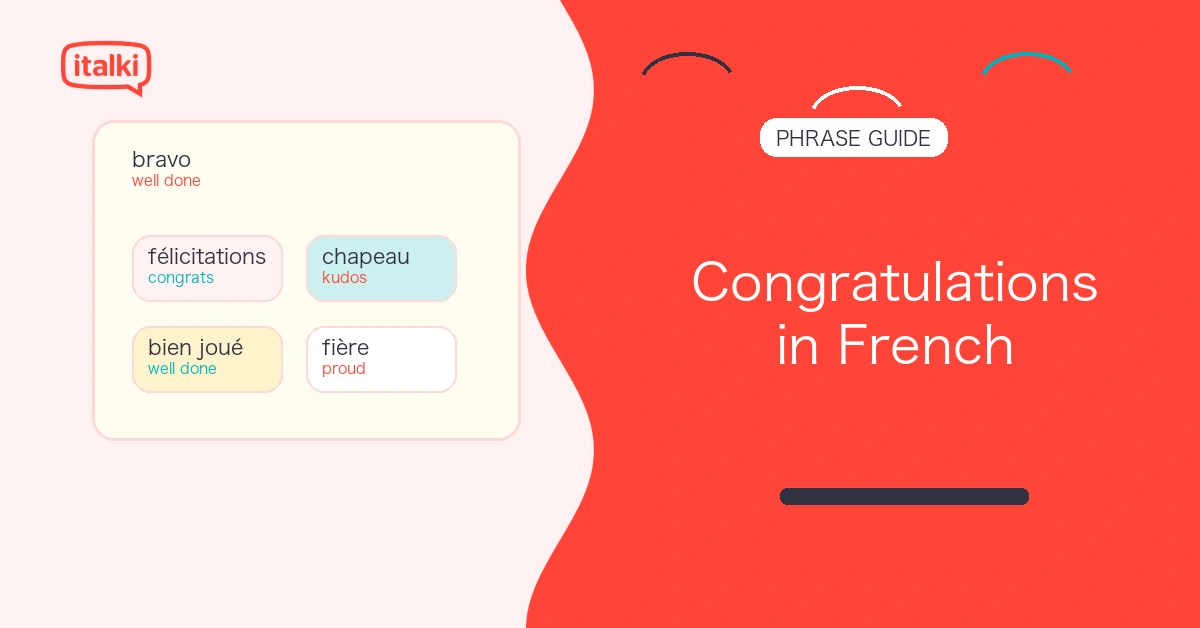
- Félicitations is the direct French equivalent of congratulations and works in almost any context, written or spoken, formal or informal. It is the safest and most universally appropriate option.
- Bravo is used widely in French and carries slightly more warmth and enthusiasm than félicitations. It is not limited to performances: saying bravo for a job promotion, a good exam result, or a life achievement is completely natural.
- Several expressions focus on the effort behind the achievement rather than the achievement itself: tu l’as bien mérité (you really deserved it), bien joué (well played/done), and chapeau (hat off to you) all acknowledge the work it took to get there.
- Context changes which expression sounds most natural. Je suis si fier/fière de toi (I am so proud of you) belongs in close personal relationships; toutes mes félicitations belongs in formal written congratulations. Knowing which expression fits which situation is as important as knowing the phrase itself.
Knowing how to congratulate someone in French opens the door to some of the most meaningful moments in conversation: celebrating a friend’s promotion, responding to a colleague’s success, or acknowledging a significant personal achievement.
The range of French expressions for congratulations is wider than many learners realize, and each one carries its own tone and context. italki connects learners with French tutors who can help you practice these expressions naturally and develop the cultural sensitivity to know which phrase fits which moment.
This guide covers 9 natural ways to say congratulations in French, with context, tone, and example sentences for each.
Find a French tutor online to practice expressing congratulations and other social expressions in natural French conversation.

Find your perfect teacher
Build real French confidence with personalized lessons from a teacher who can help with speaking, exam prep, grammar, and pronunciation.
Book a trial lesson
Félicitations
Register: Universal, formal and informal Pronunciation: fay-lee-see-tah-SYOHN
Félicitations is the standard French word for congratulations and the most direct equivalent of the English congratulations. It is a plural noun used as an exclamation and works across virtually all situations where congratulations are appropriate.
Example sentences:
- Félicitations pour ton mariage. (Congratulations on your wedding.)
- Félicitations, tu as réussi ton examen. (Congratulations, you passed your exam.)
- Félicitations à toute l’équipe. (Congratulations to the whole team.)
You can also say félicitations pour + the reason: félicitations pour ta promotion (congratulations on your promotion), félicitations pour la naissance de votre bébé (congratulations on the birth of your baby).
When in doubt, félicitations is always the right choice. It is never wrong in any context.
Bravo
Register: Informal to semi-formal, warm and enthusiastic Pronunciation: bra-VOH
Bravo in French functions very similarly to bravo in English but is used more broadly. While in English bravo is often reserved for artistic performances, in French it is a natural expression of admiration and approval for any achievement, large or small.
Example sentences:
- Bravo, c’est exactement ce qu’il fallait faire. (Bravo, that’s exactly what needed to be done.)
- Bravo pour ton courage. (Well done for your courage.)
- Bravo à toi. (Well done to you.)
Bravo can stand alone as a single exclamation or be followed by pour (for) + the reason. It is warmer and more spontaneous-feeling than félicitations and is often the first word that comes out in a moment of genuine enthusiasm.
Find your perfect teacher
Build real French confidence with personalized lessons from a teacher who can help with speaking, exam prep, grammar, and pronunciation.
Book a trial lesson
Chapeau
Register: Informal, admiring, slightly idiomatic Pronunciation: sha-POH
Chapeau (hat) is an idiomatic expression meaning hat off to you or kudos. It derives from the gesture of removing one’s hat as a sign of respect and admiration. It is informal and carries a sense of genuine, slightly surprised admiration: you use chapeau when someone has done something impressive that you genuinely admire.
Example sentences:
- Chapeau, je n’aurais pas cru que c’était possible. (Hat off to you, I wouldn’t have thought it was possible.)
- Vraiment, chapeau. C’était une performance remarquable. (Truly, hats off. That was a remarkable performance.)
- Chapeau l’artiste. (Hats off to the artist / Kudos to the performer.)
Chapeau is not used in formal written contexts: it belongs in spoken conversation and informal messages. It signals genuine personal admiration and carries more emotional weight than bravo in many contexts.
Bien joué
Register: Informal, warm, versatile Pronunciation: byaN zhoo-AY
Bien joué literally means well played and comes from sports contexts, but it has moved into general use for any achievement. It can be used sincerely to congratulate someone on a smart move or outcome, and it can also be used sarcastically. Context determines the tone.
Sincere examples:
- Bien joué pour la négociation. (Well done on the negotiation.)
- Tu as bien géré ça, bien joué. (You handled that well, nice work.)
Sarcastic example:
- Ah, bien joué, tu as encore oublié les clés. (Oh, great job, you forgot the keys again.)
In sports contexts, bien joué is the standard compliment for a good play or match result. For sports congratulations specifically, bien joué is often more natural than félicitations.
Find your perfect teacher
Build real French confidence with personalized lessons from a teacher who can help with speaking, exam prep, grammar, and pronunciation.
Book a trial lesson
Tu l’as bien mérité
Register: Informal to semi-formal, sincere and personal Pronunciation: too la byaN may-ree-TAY
Tu l’as bien mérité (you really deserved it) focuses on the work and effort behind the achievement rather than just the outcome. It is the expression to use when you want to acknowledge that the person’s success was earned, not luck.
Example sentences:
- Ce poste, tu l’as bien mérité. Tu as travaillé si dur. (You really deserved this position. You worked so hard.)
- Tu l’as bien mérité après tout ce que tu as traversé. (You really deserved it after everything you went through.)
- Félicitations. Tu l’as vraiment bien mérité. (Congratulations. You truly deserved it.)
This expression often follows félicitations or bravo as a second sentence that deepens the congratulation. On its own, it works best when the person knows you are aware of the effort they put in.
Je suis si fier/fière de toi
Register: Intimate, personal, emotional Pronunciation: zhuh swee see fyair duh twa
Je suis si fier de toi (masculine speaker) or je suis si fière de toi (feminine speaker) means I am so proud of you. This expression belongs in close personal relationships: parents talking to children, close friends, partners. Using it with someone you do not know well or in a professional context sounds overly intimate.
Example sentences:
- Je suis tellement fière de toi, maman. (I am so proud of you, mom.)
- Je suis si fier de toi pour cette réussite. (I am so proud of you for this achievement.)
- On est tous fiers de toi. (We are all proud of you.)
Note the agreement: fier (masculine speaker), fière (feminine speaker). This is a common error because the pronunciation difference between fier and fière is subtle.
Find your perfect teacher
Build real French confidence with personalized lessons from a teacher who can help with speaking, exam prep, grammar, and pronunciation.
Book a trial lesson
C’est formidable / c’est fantastique
Register: Informal, enthusiastic, positive Pronunciation: say for-mee-DABle / say fan-tas-TEEK
These expressions convey genuine enthusiasm about the achievement or news. They focus on the achievement itself rather than directly addressing the person’s effort.
Example sentences:
- Tu as décroché le poste ? C’est formidable. (You got the job? That’s wonderful.)
- Vous avez gagné ? C’est fantastique, félicitations. (You won? That’s fantastic, congratulations.)
- C’est vraiment formidable, je suis si content (e) pour toi. (That’s truly wonderful, I’m so happy for you.)
C’est formidable is slightly warmer and more personal than c’est fantastique, though both are genuinely positive. You can combine either with félicitations for a fuller congratulation: C’est fantastique, félicitations.
Je te félicite / je vous félicite
Register: Semi-formal, direct, personal Pronunciation: zhuh tuh fay-lee-SEET / zhuh voo fay-lee-SEET
Je te félicite (informal, singular) and je vous félicite (formal, or plural) mean I congratulate you. This is a more explicit and slightly more formal construction than simply saying félicitations, because it involves the first-person I and addresses the person directly.
Example sentences:
- Je vous félicite pour cette nomination. (I congratulate you on this nomination.)
- Je te félicite, c’est une belle réussite. (I congratulate you, it’s a beautiful achievement.)
- Permettez-moi de vous féliciter chaleureusement. (Allow me to congratulate you warmly.)
Permettez-moi de vous féliciter (allow me to congratulate you) is the most formal register, appropriate for official speeches, written communications, and professional ceremonies.
Find your perfect teacher
Build real French confidence with personalized lessons from a teacher who can help with speaking, exam prep, grammar, and pronunciation.
Book a trial lesson
Toutes mes félicitations
Register: Formal, written, ceremonial Pronunciation: toot may fay-lee-see-tah-SYOHN
Toutes mes félicitations means all my congratulations and is a warmer, more emphatic version of félicitations. It is especially common in formal written contexts: congratulatory cards, professional emails, and formal speeches.
Example sentences:
- Toutes mes félicitations pour votre mariage. (All my congratulations on your wedding.)
- Je vous adresse toutes mes félicitations pour votre promotion. (I send you all my congratulations on your promotion.)
- Toutes mes félicitations à vous et à votre famille. (All my congratulations to you and your family.)
In a formal card or letter, toutes mes félicitations is the natural closing phrase after a longer congratulatory message. It is never awkward in formal contexts and signals sincerity and warmth.
Which expression to use when
| Situation | Best expression |
|---|---|
| General congratulations, any context | Félicitations |
| Spontaneous enthusiasm | Bravo |
| Genuine admiration for something impressive | Chapeau |
| After a game, competition, or clever move | Bien joué |
| Acknowledging hard work behind a success | Tu l’as bien mérité |
| Close personal relationship (parent, partner, close friend) | Je suis si fier/fière de toi |
| Responding enthusiastically to good news | C’est formidable / C’est fantastique |
| Semi-formal direct congratulation | Je te/vous félicite |
| Formal written card or speech | Toutes mes félicitations |
Find your perfect teacher
Build real French confidence with personalized lessons from a teacher who can help with speaking, exam prep, grammar, and pronunciation.
Book a trial lesson
Congratulations for specific occasions
Different life events also have specific phrases in French.
Wedding: Félicitations pour votre mariage. / Toutes mes félicitations aux mariés. (All my congratulations to the newlyweds.)
Baby: Félicitations pour la naissance de votre bébé. / Tous mes voeux de bonheur pour votre petite famille. (All my wishes of happiness for your little family.)
Graduation / exam: Félicitations pour ton diplôme. / Tu l’as bien mérité, bravo. (You deserved it, bravo.)
Promotion / new job: Félicitations pour ta promotion. / Je suis si heureux/heureuse pour toi. (I’m so happy for you.)
Birthday (note: not congratulations): In French, birthdays are greeted with joyeux anniversaire (happy birthday), not félicitations. Using félicitations for a birthday is an error: félicitations is for achievements, not annual events. For more everyday celebration language, French greetings covers common ways to open and respond in social situations.
Practice with a tutor
Congratulating someone naturally in a new language requires more than knowing the words: it requires knowing the social register, the cultural norms around expressing admiration, and the ability to follow up with genuine conversation about the achievement. A French tutor can help you practice these expressions in realistic scenarios, respond authentically to good news, and develop the cultural fluency that makes French feel natural rather than scripted.
italki’s 30,000+ expert tutors include native French speakers from France, Belgium, Switzerland, and Canada who can bring real cultural context into their lessons. Trusted by over 10 million learners worldwide, the platform lets you find a tutor who fits your schedule and speaking goals. Book a trial lesson and practice the social expressions that make your French feel genuinely human.
Find your perfect teacher
Build real French confidence with personalized lessons from a teacher who can help with speaking, exam prep, grammar, and pronunciation.
Book a trial lesson
FAQ
What is the most common way to say congratulations in French?
Félicitations is the most universally appropriate and commonly used word. It works in formal and informal contexts, in speech and in writing, and is understood by all French speakers. If you only learn one expression, félicitations covers the full range of situations.
Is bravo French or English?
Bravo originated in Italian and entered both French and English. In French, it is used more broadly than in English: it expresses approval and admiration for any achievement, not just artistic performances. French speakers say bravo for a passed exam, a good business deal, or a successful project, not only for stage performances.
How do you say I’m proud of you in French?
Je suis fier(e) de toi. The adjective fier agrees with the speaker’s gender: fier if the speaker is masculine, fière if the speaker is feminine. Je suis très fier(e) de toi (I am very proud of you) or je suis si fier (e) de toi (I am so proud of you) are common intensified forms.
Can you say félicitations for a birthday in French?
No. Félicitations is for achievements and significant life events: a graduation, a promotion, a marriage, the birth of a child. For a birthday, French speakers say joyeux anniversaire (happy birthday). Using félicitations for a birthday sounds incorrect.
What is the difference between félicitations and toutes mes félicitations?
Félicitations alone is the direct, universally appropriate exclamation. Toutes mes félicitations (all my congratulations) adds a warmer, more emphatic tone and is particularly common in formal written contexts: congratulatory cards, emails, and speeches. In everyday speech, félicitations is more natural; in writing, toutes mes félicitations signals extra warmth and formality.
Want to learn a language at italki?
Here are the best resources for you!