Key takeaways
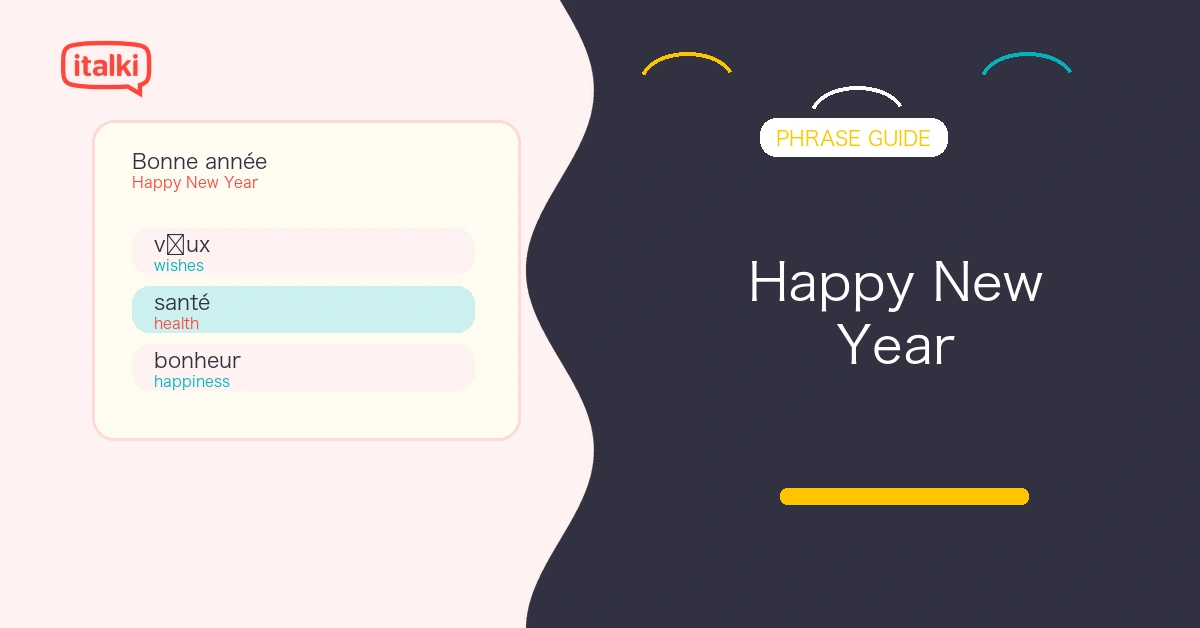
- “Happy New Year” in French is Bonne Année, pronounced “bun ann-ay.”
- The fuller greeting Bonne Année et Meilleurs Voeux (Happy New Year and best wishes) is common in both spoken and written contexts.
- French New Year greetings are typically exchanged through mid-January; wishing someone a happy new year in late January or even early February is accepted in French culture.
- The formal version Nous vous souhaitons une excellente Nouvelle Année is used in professional emails and official communications.
- French also uses Bonne et Heureuse Année (Good and Happy New Year) as a slightly warmer, more personal alternative.
You are at a dinner, a call with a French colleague, or writing a message to a French friend on New Year’s Eve, and you want to say something beyond the obvious.
French New Year wishes have a warmth and a formula to them that goes beyond two words, and knowing a few variations means the difference between a flat greeting and one that sounds like you know the language.
With 30,000+ expert tutors across 150+ languages, italki connects you with French tutors who can practice seasonal greetings and conversational French with you, including the cultural context that makes a greeting feel genuine rather than translated.

Find Your Perfect Teacher
Build real French confidence with personalized lessons from a teacher who can help with speaking, exam prep, grammar, and pronunciation.
Book a trial lesson
Core expressions for “Happy New Year” in French
| French | English | Register |
|---|---|---|
| Bonne Année! | Happy New Year! | Standard, universal |
| Bonne et Heureuse Année! | Good and Happy New Year! | Warm, personal |
| Meilleurs Voeux! | Best Wishes! | Formal and informal |
| Bonne Année et Meilleurs Voeux! | Happy New Year and Best Wishes! | Full standard greeting |
| Joyeuse Année! | Joyful New Year! | Less common, warm |
Bonne Année is the everyday standard. Meilleurs Voeux works on its own and is often used in written form on cards. The combined Bonne Année et Meilleurs Voeux is the greeting that covers both the event and the wish, and it is appropriate everywhere from a text message to a professional email. Immerse yourself in these phrases with an online French tutor through real conversation practice.
Written greetings: cards, texts, and emails
For a friend (informal text or message):
- Bonne Année! Que cette nouvelle année t’apporte tout ce que tu désires. (Happy New Year! May this new year bring you everything you wish for.)
- Je te souhaite une super Nouvelle Année! (I wish you a great New Year!)
- Bonne Année! J’espère qu’on se verra bientôt. (Happy New Year! I hope we see each other soon.)
For a family member:
- Bonne et Heureuse Année à toi et à toute ta famille! (Good and Happy New Year to you and your whole family!)
- Tous mes voeux de bonheur pour cette Nouvelle Année. (All my wishes of happiness for this New Year.)
- Que cette année te comble de joie. (May this year fill you with joy.)
For a colleague or professional contact:
- Nous vous souhaitons nos meilleurs voeux pour la Nouvelle Année. (We wish you our best wishes for the New Year.)
- Je vous souhaite une excellente année [year] pleine de succès. (I wish you an excellent [year] full of success.)
- Meilleurs voeux pour l’année [year]. (Best wishes for [year].)
- Bonne Année et plein succès dans vos projets. (Happy New Year and success in your projects.)
Learn formality levels with a French tutor online for your specific professional contacts.
Find Your Perfect Teacher
Build real French confidence with personalized lessons from a teacher who can help with speaking, exam prep, grammar, and pronunciation.
Book a trial lesson
Pronunciation guide
| French | Phonetic guide | Notes |
|---|---|---|
| Bonne Année | bun ann-ay | The “ne” in Bonne links to the “A” in Année |
| Meilleurs Voeux | may-yur vuh | Silent “x” in voeux |
| Heureuse | uh-ruhz | Silent “e” at the end |
| Joyeuse | zhwah-yuhz | The “oy” sounds like “wah” |
| Nous vous souhaitons | noo voo soo-ay-ton | The “h” in souhaitons is silent |
The liaison between Bonne and Année (bun + ann-ay, making the n link the two words) is something many learners miss when speaking. Getting this right makes the greeting sound natural rather than word-by-word. Perfect your pronunciation with a French tutor on italki by practicing these seasonal phrases.
Seasonal vocabulary
| French | English |
|---|---|
| le Nouvel An | New Year (the new year event) |
| la Nouvelle Année | the New Year (the new year period) |
| le réveillon du Nouvel An | New Year’s Eve celebration |
| les feux d’artifice | fireworks |
| le champagne | champagne |
| les voeux | wishes |
| la résolution | resolution |
| le bilan | review / assessment (of the year) |
| l’année prochaine | next year |
| l’année passée / dernière | last year |
Find Your Perfect Teacher
Build real French confidence with personalized lessons from a teacher who can help with speaking, exam prep, grammar, and pronunciation.
Book a trial lesson
Cultural customs around New Year in France
In France, the New Year celebration on December 31 is called le réveillon du Nouvel An. It typically involves a formal dinner with friends or family, champagne at midnight, and fireworks or the televised Paris celebrations. A distinctive French custom is that wishes for the new year are extended throughout the month of January. Meeting a colleague or friend in the first two weeks of January without exchanging Bonne Année would feel slightly odd. Some French people extend wishes through the end of January. Sending a belated Bonne Année card in the first week of January is completely normal and appreciated. In professional contexts, the first working meeting of the year often includes a brief Bonne Année exchange with everyone present before getting to business. Voeux de Bonne Année is also the standard subject line for new year professional emails sent in early January. For other French holiday greetings and expressions, the guide to Merry Christmas in French covers Joyeux Noël and the seasonal vocabulary used in December, which pairs naturally with the New Year greetings in this guide. Write warm seasonal greetings with confidence. With French teachers on italki, practice the phrases that show language care.Book a trial lesson today and focus on contextually appropriate greetings for professional and personal contacts.
Find Your Perfect Teacher
Build real French confidence with personalized lessons from a teacher who can help with speaking, exam prep, grammar, and pronunciation.
Book a trial lesson
FAQ
When exactly should I stop wishing people a happy new year in French?
There is no official cutoff, but the accepted period is roughly through January. The first half of January is when the greeting is most natural and expected. Into the third week of January it starts to feel slightly late, and by February most French people have moved on. If you see someone for the first time in the year in mid-January, Bonne Année is still the right opening. If it is February, a brief “j’espère que la nouvelle année commence bien pour vous” (I hope the new year is starting well for you) is a softer way to acknowledge the season has passed. Is “Bonne Année” capitalized? Yes, in most formal and published French, both “Bonne” and “Année” are capitalized when used as a standalone greeting (Bonne Année!). When used within a sentence as a noun phrase, only “Année” tends to be capitalized when referring to the New Year event: “Je vous souhaite une bonne et heureuse Nouvelle Année.” The capitalization signals that you are referring to the New Year specifically rather than a generic good year. What is the difference between Meilleurs Voeux and Tous mes Voeux? Meilleurs Voeux (Best Wishes) and Tous mes Voeux (All My Wishes) are both used for seasonal greetings. Meilleurs Voeux is slightly more formal and is the standard on printed cards. Tous mes Voeux is warmer and more personal in tone: “all my wishes” suggests the sender is giving everything they have in terms of good feeling. Both are appropriate for new year greetings; the choice is stylistic.
Want to learn a language at italki?
Here are the best resources for you!