Key takeaways
- Introducing yourself in French follows a predictable structure: name, origin, location, profession or study, and a connecting phrase that opens the conversation.
- The 10 phrases in this guide cover the full arc of a French self-introduction in both formal and informal settings, from je m’appelle to c’est un plaisir de vous rencontrer.
- French introductions require register awareness: tu (informal) and vous (formal) signal the relationship, and choosing the wrong one creates immediate awkwardness.
- Practicing an introduction out loud with a French tutor, rather than reading through a phrase list, builds the fluency and confidence to deliver it smoothly in a real conversation.
The first 30 seconds of meeting someone in French determine the register of the entire conversation that follows. Whether you use tu or vous, how you phrase your reason for being somewhere, and whether you close with the right polite formula all carry social weight.
For learners, the stress of a first introduction in French can cause blank-mind moments even when the phrases are known from study.
Real fluency in self-introduction comes from having the phrases so well rehearsed that they are automatic, leaving mental bandwidth for listening and responding. italki connects French learners with native French tutors who can help you build that automaticity through real conversations rather than scripted drills.
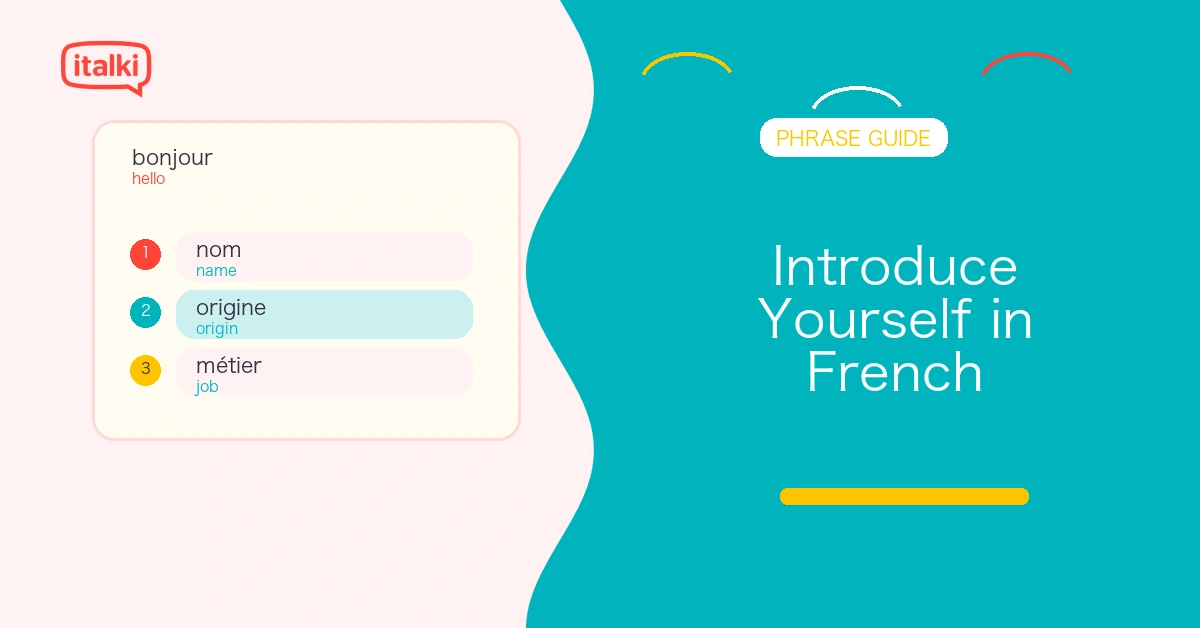
This guide covers 10 essential phrases for introducing yourself in French, with pronunciation notes, formal and informal variations, and usage context for each.
Work through these 10 phrases with a French tutor online who can adjust your register, pronunciation, and delivery for your specific situation.

Find your perfect teacher
Build real French confidence with personalized lessons from a teacher who can help with speaking, exam prep, grammar, and pronunciation.

Formal vs. informal introductions in French
Before the 10 phrases, one distinction makes every French introduction easier: the tu vs. vous choice.
Tu is informal. Use it with friends, classmates, people your own age in casual settings, and children.
Vous is formal. Use it with strangers, people older than you (unless they invite informality), professional contacts, service staff, and anyone in an official context.
The rule of thumb: when in doubt, start with vous. A native speaker who wants informality will suggest switching: On peut se tutoyer si tu veux (We can use tu if you like). Starting with tu when vous was expected is harder to recover from.
This guide provides both forms where they differ.
Phrase 1: saying your name
Formal and informal: Je m’appelle [Name]. Pronunciation: zhuh mah-PEL
This is the most natural and universal way to state your name in French. It translates literally as I call myself [Name]. It works in every context, formal or informal.
Alternative: Mon nom est [Name]. Pronunciation: mohn nohm eh
Mon nom est is slightly more formal and appears more often in written introductions than spoken ones. In a job application letter or a very formal meeting, Mon nom est sounds appropriate. In everyday conversation, Je m’appelle is more natural.
Common mistake to avoid: Do not translate the English pattern My name is [Name] directly as Ma name est [Name]. This is not French. The verb s’appeler (to be called, to be named) is the correct structure, not a possessive with nom in informal speech.
Find your perfect teacher
Build real French confidence with personalized lessons from a teacher who can help with speaking, exam prep, grammar, and pronunciation.
Phrase 2: describing who you are
Formal: Je suis [profession / nationality / role]. Informal: Je suis [profession / nationality]. Pronunciation: zhuh swee
Je suis covers profession, nationality, and general identity. French does not use an indefinite article before profession: Je suis médecin (I am a doctor), not Je suis un médecin. This is a grammar rule that English speakers frequently get wrong.
| Context | Example |
|---|---|
| Nationality | Je suis américain(e). / Je suis japonais(e). |
| Profession | Je suis enseignant(e). (I am a teacher.) |
| Role | Je suis étudiant(e). (I am a student.) |
| Status | Je suis retraité(e). (I am retired.) |
Gender agreement: Nationality adjectives and many profession nouns agree in gender. Américain (masculine), américaine (feminine). Enseignant (masculine), enseignante (feminine). Some professions are invariable (the same for both genders) or use the same form: médecin is used for both genders, though médecine refers to medicine as a field.
Phrase 3: giving your age
Formal and informal: J’ai [number] ans. Pronunciation: zhay [number] ahN
French expresses age with avoir (to have) rather than être (to be). This is one of the most common grammar errors for English speakers: I am 30 years old becomes J’ai 30 ans (I have 30 years), not Je suis 30 ans.
Example sentences:
- J’ai vingt-cinq ans. (I am twenty-five years old.)
- J’ai trente et un ans. (I am thirty-one.)
Note on number pronunciation: vingt (20) is pronounced VAN with a nasal vowel. trente et un uses et (and) between tens and one: you always say trente et un, quarante et un, cinquante et un, etc. For other combinations, the numbers join directly: vingt-deux, trente-cinq, quarante-huit.
Find your perfect teacher
Build real French confidence with personalized lessons from a teacher who can help with speaking, exam prep, grammar, and pronunciation.
Phrase 4: where you are from
Formal and informal: Je viens de [city / country]. Pronunciation: zhuh VYEN duh
Je viens de translates as I come from and is the most natural way to state your origin. The preposition after de changes depending on whether the country name is masculine, feminine, or begins with a vowel.
| Country type | Preposition | Example |
|---|---|---|
| Feminine country (most -e endings) | de | Je viens de France. / Je viens d’Espagne. |
| Masculine country | du | Je viens du Japon. / Je viens du Brésil. |
| Plural country | des | Je viens des États-Unis. |
| City | de | Je viens de Tokyo. / Je viens de New York. |
Common countries:
- Feminine: la France, l’Espagne, l’Allemagne, l’Italie, la Chine, la Corée
- Masculine: le Japon, le Brésil, le Canada, le Maroc
- Plural: les États-Unis, les Philippines
Phrase 5: where you live
Formal and informal: J’habite à [city]. / J’habite en [country]. Pronunciation: zhah-BEET ah / zhah-BEET ahN
J’habite (I live) uses à before a city and the same country prepositions as phrase 4 (en for feminine countries, au for masculine, aux for plural).
| Context | Preposition | Example |
|---|---|---|
| City | à | J’habite à Paris. / J’habite à Londres. |
| Feminine country | en | J’habite en Italie. |
| Masculine country | au | J’habite au Japon. |
| Plural country | aux | J’habite aux États-Unis. |
Alternative: Je vis à [city]. (I live in [city].) This uses the verb vivre (to live) and sounds slightly more sophisticated. Both are correct.
Find your perfect teacher
Build real French confidence with personalized lessons from a teacher who can help with speaking, exam prep, grammar, and pronunciation.
Phrase 6: what you do for work
Formal: Je travaille comme [profession] / en tant que [profession]. Informal: Je suis [profession]. or Je travaille dans [industry]. Pronunciation: zhuh trah-VIE kohm / zhuh trah-VIE dahN
Je travaille comme introduces a professional role clearly. Je travaille dans introduces the industry without specifying the exact role, which is useful when the job title does not translate directly.
| Example | Translation |
|---|---|
| Je travaille comme comptable. | I work as an accountant. |
| Je travaille dans la finance. | I work in finance. |
| Je travaille dans l’éducation. | I work in education. |
| Je suis en poste chez [company]. | I am employed at [company]. |
| Je travaille en tant qu’ingénieur(e). | I work as an engineer. |
Formal context note: In a professional meeting or job interview, en tant que (in the capacity of) sounds more precise than comme and fits higher-stakes introductions.
Phrase 7: what you study
Formal and informal: Je suis étudiant(e) en [subject]. Pronunciation: zhuh swee ay-tew-DYAHNT ahN
Je suis étudiant(e) en introduces your field of study. The subject follows directly without an article: Je suis étudiant en droit (I study law), not en le droit.
| Example | Translation |
|---|---|
| Je suis étudiant(e) en médecine. | I study medicine. |
| Je suis étudiant(e) en langues. | I study languages. |
| Je prépare un master en gestion. | I am completing a master’s in management. |
| Je fais un doctorat en linguistique. | I am doing a PhD in linguistics. |
| Je suis en deuxième année de licence. | I am in my second year of a bachelor’s degree. |
Note on gender: Étudiant is masculine, étudiante is feminine. This agreement is important in French and is one of the most visible markers of grammatical accuracy in self-introductions.
Find your perfect teacher
Build real French confidence with personalized lessons from a teacher who can help with speaking, exam prep, grammar, and pronunciation.
Phrase 8: how long you have been learning French
Formal and informal: J’apprends le français depuis [X] mois / ans. Pronunciation: zhah-PRAHN luh FRAHN-say duh-PUI
Depuis in French expresses an ongoing action that started in the past and continues to the present. It pairs with the present tense in French, where English would use the present perfect continuous (I have been learning for X months).
| Example | Translation |
|---|---|
| J’apprends le français depuis six mois. | I have been learning French for six months. |
| J’apprends le français depuis deux ans. | I have been learning French for two years. |
| Je parle un peu français. | I speak a little French. |
| Mon niveau est intermédiaire. | My level is intermediate. |
| Je suis encore débutant(e). | I am still a beginner. |
Grammar note: The phrase depuis + present tense is one of the first constructions that confuses English speakers because English uses a past tense (I have been learning) while French uses the present (j’apprends). Understanding French tenses clarifies why: depuis frames the action as still ongoing, which French treats as present rather than past.
Phrase 9: what languages you speak
Formal and informal: Je parle [language(s)]. Pronunciation: zhuh PARL
Language names in French are masculine: le français (French), l’anglais (English), l’espagnol (Spanish), l’italien (Italian), l’allemand (German), le japonais (Japanese), le mandarin (Mandarin).
When stating what you speak, the article is dropped: Je parle français or Je parle anglais, not Je parle le français.
| Example | Translation |
|---|---|
| Je parle anglais couramment. | I speak English fluently. |
| Je parle un peu espagnol. | I speak a little Spanish. |
| Je suis bilingue. | I am bilingual. |
| Ma langue maternelle est le coréen. | My mother tongue is Korean. |
| Je parle couramment trois langues. | I speak three languages fluently. |
Fluency qualifiers:
- couramment: fluently
- couramment avec un accent: fluently with an accent
- un peu: a little
- assez bien: fairly well
- pas encore bien: not yet well
Find your perfect teacher
Build real French confidence with personalized lessons from a teacher who can help with speaking, exam prep, grammar, and pronunciation.
Phrase 10: A polite closing phrase
Formal: C’est un plaisir de vous rencontrer. / Ravi(e) de vous rencontrer. Informal: Ravi(e) de te rencontrer. / Enchanté(e). Pronunciation: say uhn PLAY-zeer duh voo rahN-KOHN-tray / rah-VEE duh voo rahN-KOHN-tray
Enchanté(e) (enchanted, delighted) is the most common single-word closing phrase for introductions. It agrees in gender: men say enchanté, women say enchantée (though in spoken French the two sound identical).
| Context | Phrase | Translation |
|---|---|---|
| Formal | C’est un plaisir de vous rencontrer. | It is a pleasure to meet you. |
| Formal | Je suis ravi(e) de faire votre connaissance. | I am delighted to make your acquaintance. |
| Neutral | Enchanté(e). | Delighted / Pleased to meet you. |
| Informal | Ravi(e) de te rencontrer. | Glad to meet you. |
| Informal | Super de te connaître. | Great to meet you. |
A handshake accompanies formal introductions in French professional settings. In informal social settings, the la bise (cheek kiss) is common between people who know each other, but at a first meeting between strangers in a professional context, a handshake is standard.
Putting the full introduction together
Here is a complete French self-introduction combining all 10 phrases, in a formal setting:
Bonjour. Je m’appelle [Name]. Je suis [nationality / profession]. J’ai [age] ans. Je viens de [city/country], mais j’habite à [current city] depuis [X] ans. Je travaille comme [profession] dans [industry]. J’apprends le français depuis [X] mois. Je parle [languages] couramment. C’est un plaisir de vous rencontrer.
And in an informal setting with a peer:
Salut, je m’appelle [Name]. Je suis [nationality]. J’ai [age] ans. Je viens de [city], mais j’habite à [city] maintenant. Je travaille dans [field] / je suis étudiant(e) en [subject]. J’apprends le français depuis [X] mois. Ravi(e) de te rencontrer.
The formal version uses vous throughout. The informal uses tu forms (te in the last phrase) and opens with Salut instead of Bonjour.
The best way to make this introduction feel natural is to practice it in a real conversation where the other person responds naturally, asks follow-up questions, and uses the register you set. That back-and-forth is where introduction fluency is actually built.
With 30,000+ expert tutors on italki, trusted by over 10 million learners worldwide, you can find a French teacher who specializes in spoken fluency and practical conversation. Book a trial lesson and spend the first session delivering this introduction, then having a real conversation from there.
Find your perfect teacher
Build real French confidence with personalized lessons from a teacher who can help with speaking, exam prep, grammar, and pronunciation.
FAQ
Should I use tu or vous when introducing myself in French?
Default to vous in any formal or professional context and with people you do not know. Switch to tu only when the other person invites it or when the context is clearly informal (young peers, casual social setting). Starting with vous and being invited to use tu is socially smooth. Starting with tu when vous was expected is harder to walk back.
How do I say my profession in French if there is no direct translation?
Describe your role in terms the other person can follow: Je travaille dans [industry] / Je m’occupe de [function]. If you have a specific title that translates awkwardly, use the English term in your sentence and follow with a short French explanation: Je suis UX designer, c’est-à-dire que je travaille sur l’expérience des utilisateurs en ligne (I am a UX designer, meaning I work on users’ online experience).
Is enchanté used in France and other French-speaking countries?
Enchanté is widely used across France, Belgium, and Switzerland. In Quebec, enchanté is less common in everyday informal speech; content de te rencontrer or ravi de te voir fits better. If you are learning for a specific French-speaking region, confirm the local preference with a tutor from that region.
How do I introduce myself in French in an email?
Open with Je me permets de me présenter (I take the liberty of introducing myself) or Permettez-moi de me présenter (Allow me to introduce myself). Follow with Je suis [Name], [profession / role]. This is the standard structure for a cold introduction via email in a professional French context.
What do I say if I do not understand a response during an introduction?
Pardon, pourriez-vous répéter plus lentement ? (Sorry, could you repeat more slowly?) in a formal context, or Désolé(e), tu peux répéter ? in an informal one. Do not pretend to understand and nod, since the conversation will quickly move to a topic where the misunderstanding matters. French speakers generally appreciate the direct request to repeat.
Want to learn a language at italki?
Here are the best resources for you!