Key takeaways
- French follows a subject-verb-object (SVO) base, but negation, pronouns, adverbs, and adjective placement shift words into positions that feel unfamiliar to English speakers.
- Adjective position changes meaning in French: un homme grand (a tall man) vs. un grand homme (a great man), so memorizing “before or after” is not enough.
- Object pronouns sit before the conjugated verb (Je le vois), not after it the way English does, and stacking two pronouns requires a fixed order.
- Word-order errors are hard to spot in your own writing, so the fastest fix is live correction from a native speaker, whether in a 1-on-1 French lesson or by posting sentences for feedback.
- How does basic French sentence structure work?
- How do you form negative sentences in French?
- Where do adjectives go in a French sentence?
- How do you ask questions in French?
- Where do object pronouns go in French sentences?
- How do adverbs fit into French word order?
- What changes in complex and compound French sentences?
- Which word-order mistakes come straight from English?
- FAQ
How does basic French sentence structure work?
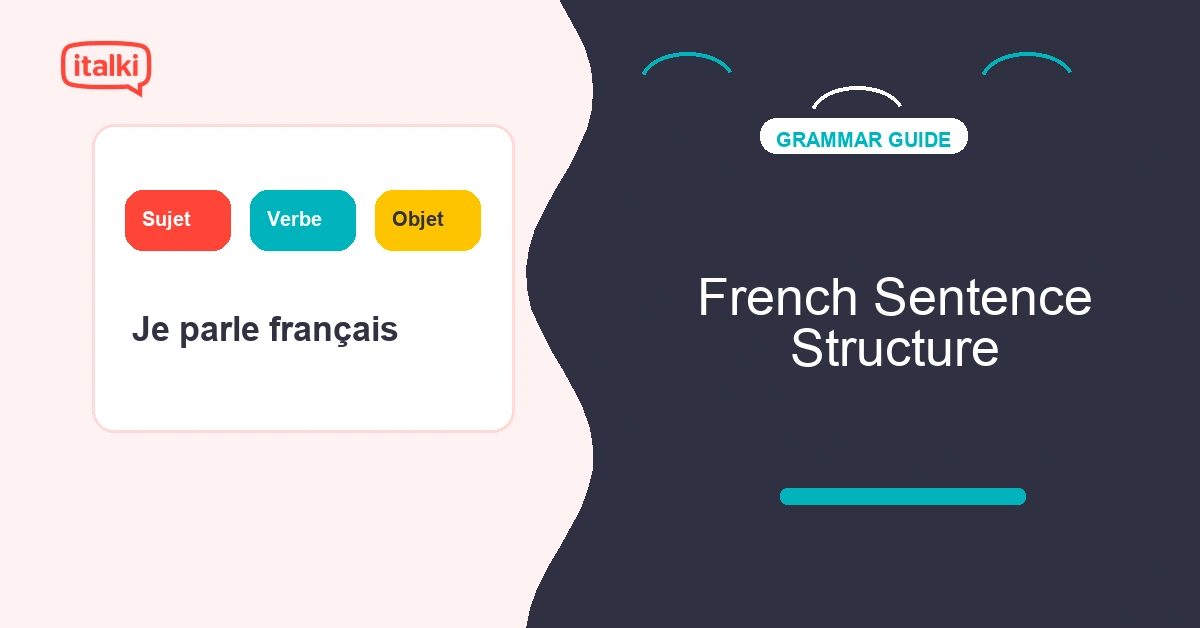
The default French sentence follows a subject + verb + object/complement pattern, the same skeleton as English. French follows subject-verb-object (SVO) order, so this base order is the standard starting point. In declarative statements you keep the subject before the verb, even when the rest of the sentence shifts.
Simple SVO examples:
| French | English | Structure |
|---|---|---|
| Marie mange une pomme. | Marie eats an apple. | Subject + verb + direct object |
| Le chat dort sur le canapé. | The cat sleeps on the couch. | Subject + verb + prepositional phrase |
| Nous regardons un film. | We are watching a movie. | Subject + verb + direct object |
| Tu écris une lettre à Paul. | You are writing a letter to Paul. | Subject + verb + direct object + indirect object |
Notice the last example. When both a direct object (une lettre) and an indirect object (à Paul) appear as full noun phrases, the direct object comes first, then the indirect object introduced by à. English often reverses this: “You are writing Paul a letter.” That reversal does not work in French.
Subject position is strict in statements. In English you might say “Yesterday came the rain.” French does not invert subject and verb in declarative sentences this way. You say Hier, la pluie est arrivée, keeping the subject before the verb even when a time expression opens the sentence.
If you have a solid grasp of basic French words, the SVO frame is where you start building real sentences from vocabulary.

Find Your Perfect Teacher
French becomes easier when you can practice the examples, get correction, and hear how a real speaker would say it.

How do you form negative sentences in French?
French negation wraps around the conjugated verb with a two-part structure: ne sits before the verb and the second element follows it. The most common pair is ne…pas, but other pairs change the meaning completely.
Core negation patterns:
| Negation pair | Meaning | Example | English |
|---|---|---|---|
| ne…pas | not | Je ne comprends pas. | I do not understand. |
| ne…jamais | never | Elle ne mange jamais de viande. | She never eats meat. |
| ne…rien | nothing | Nous ne voyons rien. | We see nothing. |
| ne…plus | no longer | Il ne travaille plus ici. | He no longer works here. |
| ne…personne | nobody | Je ne connais personne. | I know nobody. |
| ne…que | only | Il ne boit que de l’eau. | He only drinks water. |
Where exactly does ne go? Always directly before the conjugated verb. If the verb starts with a vowel, ne contracts to n’: Je n’aime pas le café.
Compound tenses shift the position of pas. In the passé composé, ne…pas wraps the auxiliary (avoir or être), not the past participle:
- Je n’ai pas mangé. (I did not eat.) The past participle mangé sits outside the negation.
- Elle n’est pas arrivée. (She did not arrive.)
Tricky case: negation with personne. Unlike pas, rien, and jamais, the word personne goes after the past participle in compound tenses: Je n’ai vu personne. (I saw nobody.) Putting personne right after the auxiliary (Je n’ai personne vu) is wrong.
Spoken French often drops ne. In casual conversation, you will hear Je sais pas instead of Je ne sais pas. This is standard in speech but incorrect in writing and formal contexts. When a tutor corrects your written exercises, they will insist on the full ne…pas; when you practice conversation, dropping ne sounds more natural.
Understanding how French grammar handles negation across tenses prevents the most common structural errors in both writing and speech, and a tutor can tell you when dropping ne sounds natural versus when it sounds sloppy.
Find Your Perfect Teacher
French becomes easier when you can practice the examples, get correction, and hear how a real speaker would say it.
Where do adjectives go in a French sentence?
Most French adjectives follow the noun they describe, which is the opposite of English. But a group of common short adjectives precede the noun, and some adjectives change meaning depending on position. This three-way system of adjective placement is one of the most error-prone areas for English speakers.
Adjectives that follow the noun
The default position. Color, shape, nationality, religion, and most descriptive adjectives sit after the noun:
- une voiture rouge (a red car)
- un livre intéressant (an interesting book)
- une femme française (a French woman)
- une table ronde (a round table)
Adjectives that precede the noun (BANGS)
A common mnemonic is BANGS: Beauty, Age, Number, Goodness, Size. These adjectives typically go before the noun:
| Category | Adjectives | Example | English |
|---|---|---|---|
| Beauty | beau, joli | une belle maison | a beautiful house |
| Age | jeune, vieux, nouveau | un vieil ami | an old friend |
| Number | premier, dernier, deuxième | la première fois | the first time |
| Goodness | bon, mauvais, gentil | un bon repas | a good meal |
| Size | petit, grand, gros, long | une petite rue | a small street |
Adjectives that change meaning by position
This is where French sentence structure gets genuinely tricky. For a closed set of adjectives, the same word means different things before and after the noun:
| Adjective | Before noun | After noun |
|---|---|---|
| ancien | mon ancien professeur (my former teacher) | un bâtiment ancien (an old/historic building) |
| cher | mon cher ami (my dear friend) | un restaurant cher (an expensive restaurant) |
| grand | un grand homme (a great man) | un homme grand (a tall man) |
| propre | ma propre chambre (my own room) | une chambre propre (a clean room) |
| seul | la seule raison (the only reason) | une femme seule (a lonely/alone woman) |
| pauvre | le pauvre homme (the poor, pitiful man) | un homme pauvre (a financially poor man) |
Memorizing just “before or after” misses these meaning shifts. When you write mon ancien appartement, you mean the apartment you used to live in. When you write un appartement ancien, you mean a historic or old-style apartment. Getting them backwards changes your entire sentence, and it is the kind of error you rarely catch alone.
Describing objects and people aloud to a French teacher online surfaces these placement and agreement slips in real time, while you are still forming the sentence.
Find Your Perfect Teacher
French becomes easier when you can practice the examples, get correction, and hear how a real speaker would say it.
How do you ask questions in French?
French has three ways to form questions (intonation, est-ce que, and inversion), and each belongs to a different register. Using the wrong one does not create a grammar error, but it can sound oddly formal in a café or too casual in a business email.
Intonation (informal, spoken)
Keep the statement word order and raise your voice at the end:
- Tu viens ce soir ? (You’re coming tonight?)
- Il a fini ? (He finished?)
This is the most common form in everyday spoken French. It requires no structural change at all.
Est-ce que (neutral, versatile)
Add est-ce que before a statement. The word order after it stays SVO:
- Est-ce que tu viens ce soir ? (Are you coming tonight?)
- Est-ce qu’il a fini ? (Has he finished?)
This form works in both speech and writing and is the safest choice for learners who are unsure about register.
Inversion (formal, written)
Swap the subject pronoun and verb, connecting them with a hyphen:
- Viens-tu ce soir ? (Are you coming tonight?)
- A-t-il fini ? (Has he finished?)
Notice a-t-il: French inserts a -t- between two vowels for pronunciation. This happens with third-person singular forms ending in a vowel: Parle-t-elle français ? (Does she speak French?)
Inversion with noun subjects adds an extra pronoun. If the subject is a noun rather than a pronoun, French keeps the noun in place and adds a pronoun after the verb:
- Marie vient-elle ce soir ? (Is Marie coming tonight?)
- Le train est-il arrivé ? (Has the train arrived?)
You cannot say Vient Marie ce soir? That structure does not exist in modern standard French.
Question words and their position
When you add an interrogative word (où, quand, pourquoi, comment, combien, qui, que/qu’est-ce que), it goes at the beginning, and the rest follows one of the three patterns above:
| Question word | Intonation | Est-ce que | Inversion |
|---|---|---|---|
| Où (where) | Tu habites où ? | Où est-ce que tu habites ? | Où habites-tu ? |
| Quand (when) | Tu pars quand ? | Quand est-ce que tu pars ? | Quand pars-tu ? |
| Pourquoi (why) | Tu pleures pourquoi ? | Pourquoi est-ce que tu pleures ? | Pourquoi pleures-tu ? |
| Combien (how much/many) | Ça coûte combien ? | Combien est-ce que ça coûte ? | Combien cela coûte-t-il ? |
With intonation questions, the question word often moves to the end in casual speech (Tu habites où ?). With est-ce que and inversion, it always opens the sentence.
Register is hard to judge from a textbook, since the line between casual and formal lives in how natives actually speak. This is one of those moments to bring to an French language tutor: role-play the same question in casual, neutral, and formal French until each version feels automatic, instead of defaulting to one form for every situation.
Find Your Perfect Teacher
French becomes easier when you can practice the examples, get correction, and hear how a real speaker would say it.
Where do object pronouns go in French sentences?
Object pronouns are the single biggest word-order difference between French and English. In English, “I see him” keeps the pronoun after the verb. In French, the object pronoun moves before the conjugated verb: Je le vois. Getting comfortable with this shift takes targeted repetition.
Single object pronoun placement
Direct and indirect object pronouns go immediately before the conjugated verb:
| English | French | Structure |
|---|---|---|
| I see her. | Je la vois. | Subject + pronoun + verb |
| He speaks to me. | Il me parle. | Subject + pronoun + verb |
| We are watching it. | Nous le regardons. | Subject + pronoun + verb |
In the passé composé, the pronoun goes before the auxiliary, not the past participle:
- Je l’ai vu. (I saw him/it.)
- Elle m’a parlé. (She spoke to me.)
Double object pronouns: the fixed order
When two pronouns appear in the same sentence, French has a strict sequence:
me/te/se/nous/vous → le/la/les → lui/leur → y → en
- Je te le donne. (I give it to you.) Not Je le te donne.
- Elle le lui a dit. (She told it to him/her.) Not Elle lui le a dit.
- Il m’en a parlé. (He spoke to me about it.)
This order is non-negotiable. Reversing any pair produces an ungrammatical sentence.
Pronouns in commands (imperative)
Affirmative commands are the one place where object pronouns go after the verb, attached by a hyphen:
- Donne-le-moi. (Give it to me.)
- Regarde-la. (Look at her/it.)
But negative commands revert to the standard pre-verb position:
- Ne me le donne pas. (Don’t give it to me.)
This affirmative/negative split in the imperative trips up even intermediate learners because you need to remember two different positions for the same pronouns depending on whether you are saying “do” or “don’t.”
The pronoun y replaces à + a place or thing (J’y vais = I’m going there), and en replaces de + a noun (J’en veux = I want some). Both follow the same pre-verb rule and the same fixed double-pronoun order.
If you are still building your pronoun vocabulary, reviewing French nouns helps you understand what each pronoun is replacing. Double-pronoun order is also the hardest thing to self-correct, because you cannot hear your own mistakes the way a listener can, which is why learners tend to lock it in only once someone corrects the order out loud in conversation.
How do adverbs fit into French word order?
French adverb placement depends on the type of adverb and the tense of the verb. There is no single rule, which makes this section one that rewards pattern practice over memorization.
Short, common adverbs go after the conjugated verb
Adverbs like bien (well), mal (badly), vite (quickly), souvent (often), toujours (always), déjà (already), and trop (too much) sit right after the conjugated verb in simple tenses and between the auxiliary and past participle in compound tenses:
- Simple: Elle parle bien français. (She speaks French well.)
- Compound: Elle a bien parlé. (She spoke well.)
Compare with English, where “She spoke well” and “She well spoke” are both possible but stylistically different. French locks these adverbs into the post-verb / mid-compound position.
Long adverbs and adverbs of place/time go at the end
Longer adverbs (lentement, malheureusement, généralement) and adverbs of place and time (ici, là-bas, hier, demain, aujourd’hui) typically go at the end of the clause:
- Il a conduit lentement. (He drove slowly.)
- Nous mangeons ici. (We eat here.)
- Je pars demain. (I leave tomorrow.)
Adverbs of frequency sometimes open the sentence
Parfois (sometimes), souvent (often), and d’habitude (usually) can also open a sentence for emphasis, followed by a comma:
- D’habitude, je me lève à sept heures. (Usually, I get up at seven.)
- Parfois, il pleut en été. (Sometimes, it rains in summer.)
This position is less common with toujours and jamais, which almost always stay close to the verb.
Adverb placement in negation
When a sentence is negative, the adverb usually goes after pas:
- Je ne parle pas souvent français. (I don’t often speak French.)
- Il n’a pas bien dormi. (He didn’t sleep well.)
But déjà, toujours, and souvent sometimes replace pas with their negative counterparts (ne…jamais, ne…plus) rather than stacking after it.
Understanding adverb placement also strengthens your handle on French prepositions, since prepositional phrases and adverbs often compete for the same slot at the end of a clause.
What changes in complex and compound French sentences?
Once you move beyond single-clause sentences, French word order adds relative clauses, subordinate clauses, and coordinating conjunctions that each follow their own internal rules.
Relative clauses with qui, que, and où
Relative pronouns introduce a clause that describes a noun. The pronoun choice depends on function:
- qui (subject of the relative clause): L’homme qui parle est mon professeur. (The man who is speaking is my teacher.)
- que (direct object of the relative clause): Le livre que j’ai lu était long. (The book that I read was long.)
- où (place or time): La ville où je suis né est petite. (The city where I was born is small.)
Inside the relative clause, standard SVO order applies. The relative pronoun replaces the noun it refers to, so you do not repeat the noun: Le livre que j’ai lu is correct, not Le livre que j’ai lu le livre.
**Past participle agreement with que:** When que is a direct object preceding the auxiliary avoir, the past participle agrees in gender and number with the noun que refers to: Les fleurs que j’ai achetées (the flowers that I bought). The -es ending on achetées matches les fleurs (feminine plural). This agreement does not happen with qui because qui functions as the subject.
Subordinate clauses with conjunctions
Clauses introduced by parce que (because), quand (when), si (if), bien que (although), and pour que (so that) follow standard SVO inside the clause:
- Je reste à la maison parce qu’il pleut. (I stay home because it’s raining.)
- Si tu viens, nous irons au cinéma. (If you come, we will go to the cinema.)
Note the tense pairing in si clauses: si + present tense in the condition, future tense in the result. This is different from English, which can use “will” in both clauses informally.
Some conjunctions require the subjunctive mood: bien que, pour que, avant que, à moins que. The word order stays SVO, but the verb form changes: Bien qu’il soit fatigué, il travaille. (Although he is tired, he works.) If you are exploring verb mood shifts, the broader guide to best way to learn French connects sentence structure to a full learning path.
Coordinating conjunctions
Et (and), mais (but), ou (or), donc (so), car (because, formal) connect independent clauses. Each clause keeps its own SVO order:
- Il est fatigué, mais il continue. (He is tired, but he continues.)
- Tu viens ou tu restes ? (Are you coming or staying?)
The clause-stacking ladder: start from a bare SVO sentence and add one layer at a time, a relative clause, then a subordinate clause, then a second independent clause, checking that the word order still holds before you add the next layer. Watch how Je lis un livre grows:
- Je lis un livre. (I am reading a book.)
- Je lis un livre qui est très long. (I am reading a book that is very long.)
- Je lis un livre qui est très long parce que mon professeur l’a recommandé. (I am reading a book that is very long because my teacher recommended it.)
- Je lis un livre qui est très long parce que mon professeur l’a recommandé, mais je le trouve ennuyeux. (I am reading a very long book because my teacher recommended it, but I find it boring.)
Each expansion adds exactly one structural element while preserving correct word order at every layer. Done with a tutor, the ladder doubles as a diagnostic: they can stop you at the exact layer where the structure breaks and fix it before you stack another clause on top of the error.
Which word-order mistakes come straight from English?
Most beginner errors are not random; they are English structure transferred word for word. Here are the transfers that produce the most unnatural French, with the fix:
| What English makes you write | Why it is wrong | Natural French |
|---|---|---|
| Je vois le (I see it) | The object pronoun cannot trail the verb like English “it.” | Je le vois. |
| une rouge petite maison (a small red house) | Color follows the noun but size precedes it, so they cannot both sit in front. | une petite maison rouge (size before, color after) |
| Je suis 25 ans (I am 25) | Age uses avoir, not être, so the structure itself changes. | J’ai 25 ans. |
| Je visite mon ami for “I visit my friend” | Visiter is for places; visiting a person uses rendre visite à, which restructures the sentence. | Je rends visite à mon ami. |
| Je cherche pour mes clés (I look for my keys) | Chercher is already transitive, so no preposition follows. | Je cherche mes clés. |
| Elle a besoin une pause (she needs a break) | Avoir besoin requires de before its object. | Elle a besoin d’une pause. |
Notice that several of these are not adjustments to word order at all but to which verb or preposition French uses to build the sentence. Word order and verb construction are tied together, which is why translating English structure directly so often fails.
Ready to make French grammar usable in conversation?
Learning French sentence structure becomes permanent when you practice each pattern with someone who corrects you in the moment, not after the fact.
italki, operating since 2007 with 10M+ learners and 30,000+ teachers across 150+ languages, gives you two ways to do that: book 1-on-1 lessons with a native French teacher who specializes in grammar correction, conversation, or exam prep, and between lessons, post your own sentences to the free italki Community, where native speakers correct your written word order so the patterns from this guide get tested both ways.
Book a trial lesson with a French teacher and bring one sentence pattern from this guide to your first session.
Find Your Perfect Teacher
French becomes easier when you can practice the examples, get correction, and hear how a real speaker would say it.
FAQ
Is French sentence structure the same as English?
Both languages use subject-verb-object as a base, but French places object pronouns before the verb, wraps negation around the verb with ne…pas, and puts most adjectives after the noun. These three differences alone mean direct English-to-French translation produces unnatural sentences.
What is the BANGS rule for French adjectives?
BANGS stands for Beauty, Age, Number, Goodness, Size. Adjectives in these categories (beau, vieux, premier, bon, petit) typically precede the noun, while most other adjectives follow it. Some adjectives like grand and ancien change meaning depending on position.
Where do pronouns go in French sentences?
Object pronouns go directly before the conjugated verb (Je le vois). In compound tenses, they go before the auxiliary (Je l’ai vu). The only exception is affirmative commands, where pronouns attach after the verb with a hyphen (Donne-le-moi).
How do you form questions in French?
French uses three methods: rising intonation (Tu viens ?), est-ce que before a statement (Est-ce que tu viens ?), and subject-verb inversion (Viens-tu ?). Intonation is casual, est-ce que is neutral, and inversion is formal.
Why does French word order feel harder than English?
The difficulty comes from pronoun placement, negation wrapping, adjective position rules, and three question-formation systems, none of which exist in English. Each rule is simple on its own, but combining them in a single sentence requires practice with correction.
Want to learn a language at italki?
Here are the best resources for you!