Key takeaways
- Japanese tongue twisters target real phonetic traps: the ら行, long vowels, voiced/voiceless pairs, and geminate consonants that learners consistently mispronounce.
- Each hayakuchi kotoba in this article comes with the original script, romaji, and a breakdown of exactly what makes it hard.
- Practicing with a Japanese tutor gives you live feedback on whether your ら行 sounds Japanese or like an English “r,” which self-study cannot reliably provide.
- Start slow, isolate the problem sound, then build to natural speed. Rushing before you have the sound right reinforces the wrong muscle memory.
- What makes Japanese tongue twisters useful for pronunciation practice?
- The classic: Niwa ni wa niwa niwatori ga iru
- The hardest ra-row drill: Ra ri ru re ro cycling
- The s/m contrast: Sumomo mo momo mo
- Voiced vs. voiceless: Basu gasu bakuhatsu
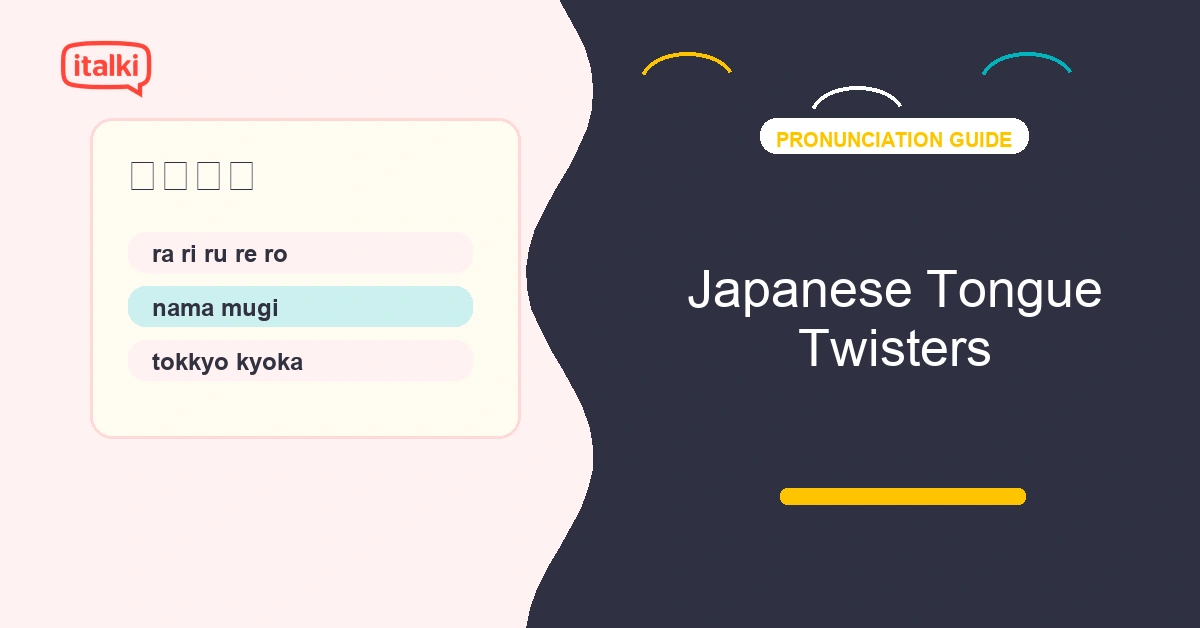
- Long vowels and geminate consonants: Tokkyo kyoka kyoku
- How to practice hayakuchi kotoba correctly
- Start practicing with a tutor who can actually hear the difference
- FAQ
Japanese tongue twisters, called 早口言葉 (hayakuchi kotoba, literally “fast-mouth words”), are one of the most targeted tools for fixing specific pronunciation problems that textbooks rarely address directly. They isolate the exact sounds that trip up learners: the difference between ら行 (ra-row sounds) and English “r” or “l,” the length of long vowels, and the contrast between voiced and voiceless consonants.
italki connects learners with native-speaking tutors who grew up reciting these phrases and can hear exactly where your pronunciation breaks down, something no audio recording can do. Since 2007, italki has helped 10M+ learners build real spoken fluency with support from 30,000+ teachers across 150+ languages.

Find Your Perfect Teacher
Japanese becomes easier when you can practice the examples, get correction, and hear how a real speaker would say it.

What makes Japanese tongue twisters useful for pronunciation practice?
Hayakuchi kotoba work because they force your mouth into rapid repetitions of sounds that do not exist in English, or that exist in a different position. Japanese has five pure vowel sounds (a, i, u, e, o) that never change quality the way English vowels do, and several consonant contrasts that English speakers collapse together.
The three most common problem areas that tongue twisters expose:
- ら行 (ra, ri, ru, re, ro): This is not the English “r” and not an “l.” It is a single flap consonant, produced with a single light tap of the tongue tip against the alveolar ridge, the area just behind the upper front teeth. English speakers either over-curl the tongue (English “r”) or lay it too flat (English “l”), and hayakuchi kotoba at speed will catch both errors immediately.
- Long vowels and geminates: Japanese distinguishes おじさん (ojisan, “uncle”) from おじいさん (ojiisan, “grandfather”) purely by vowel length. Tongue twisters that chain long vowels or doubled consonants (っ) force you to actually hold those sounds.
- Voiced/voiceless pairs: The b/p, d/t, and g/k contrasts appear back-to-back in many classic tongue twisters, so a voicing slip is immediately obvious.
Working with a Japanese tutor on these sounds is the fastest correction method, because a native speaker will hear a misfired ら行 instantly, even when you cannot hear your own error.
Find Your Perfect Teacher
Japanese becomes easier when you can practice the examples, get correction, and hear how a real speaker would say it.
The classic: Niwa ni wa niwa niwatori ga iru
庭には二羽にわとりがいる Niwa ni wa niwa niwatori ga iru “In the garden, there are two chickens.”
This is one of the first hayakuchi kotoba Japanese children learn, and it targets a specific parsing problem rather than a single sound. The phrase contains four instances of the syllable ni and two instances of wa, all grammatically distinct:
- 庭 (niwa) = garden
- には (ni wa) = particle combination “in (the)”
- 二羽 (niwa) = two birds (counter for birds)
- にわとり (niwatori) = chicken
The trap is that your brain, processing for meaning, wants to group syllables at the wrong boundaries. At speed, the phrase runs together as one continuous stream: ni-wa-ni-wa-ni-wa-ni-wa-to-ri-ga-i-ru. The pitch accent pattern also shifts: 庭 (niwa, “garden”) carries a high-low pattern in standard Tokyo Japanese, while 二羽 (niwa, “two birds”) is low-high. Flattening everything to even pitch loses the distinction between the two words entirely.
Practice tip
Say it once very slowly while tracking which niwa you are on, then double speed, then full speed. If you lose your place, slow down again.
The hardest ra-row drill: Ra ri ru re ro cycling
The most demanding dedicated ら行 drill used in Japanese voice training is not a sentence at all. It is a pure sound-cycling exercise:
ら行練習: らりるれろ、りるれろら、るれろらり、れろらりる、ろらりるれ Ra ri ru re ro / ri ru re ro ra / ru re ro ra ri / re ro ra ri ru / ro ra ri ru re
This cycles through all five ら行 sounds in shifting order so there is no predictable pattern to coast on. To produce each correctly, touch the tip of your tongue lightly to the alveolar ridge, just behind the upper teeth, and release it with a single quick flap. If your tongue curls back toward the hard palate, you are producing an English retroflex “r.” If it stays flat and slides forward, you are approximating an English “l.” The target is a single brief contact point, neither curled nor flattened.
A separate classic hayakuchi kotoba that works nasal and bilabial alternation rather than the ら行:
生麦生米生卵 Nama mugi nama kome nama tamago “Raw wheat, raw rice, raw egg.”
Note the correct reading of 生米: it is nama kome, not nama gome (the standalone reading of 米 is kome, not gome; rendaku voicing does not apply here). Every syllable in this phrase ends with the open vowel “a,” and the alternation between the nasal “n” and the bilabial “m” at the start of each word requires precise lip and tongue placement with no time to reset. At speed, the phrase becomes a rapid percussion of nasal-then-bilabial contacts: na-ma, na-ma, na-ma. The moment lip tension drops, the “m” sounds blur into nasals and the phrase collapses.
The s/m contrast: Sumomo mo momo mo
すもももももものうち Sumomo mo momo mo momo no uchi “Plums and peaches are both types of peach.”
This is probably the most famous Japanese tongue twister. The difficulty is not a sibilant/palatal contrast, but rather the density of identical-sounding syllables and the rapid alternation between the /s/ in すもも (sumomo, “plum”) and the sustained /m/ and /o/ sounds that dominate the rest of the phrase. The word も (mo, “also/and”) appears four times, and the full phrase is a grammatically complete sentence that sounds nonsensical at normal conversation speed.
The vowel “o” appears eight times across fourteen syllables. At slow speed, every “o” should be a pure back vowel with rounded lips, never diphthonging toward “ow” the way English speakers tend to do. At fast speed, the mouth wants to open and close on every “mo” without fully completing the vowel, producing a slurred sound that native speakers notice immediately.
The parsing trap works the same way as 庭には二羽にわとりがいる: you must track word boundaries (su-mo-mo / mo / mo-mo / mo / mo-mo / no / u-chi) while the syllable stream gives you almost no acoustic cues to find them. Marking the word breaks with a pencil before your first slow read-through helps significantly.
Voiced vs. voiceless: Basu gasu bakuhatsu
バスガス爆発 Basu gasu bakuhatsu “Bus gas explosion.”
Short, brutal, and effective. This three-word phrase chains voiced consonants (b, g) with a sudden shift to the voiceless aspirated sequence in 爆発 (bakuhatsu, “explosion”), which itself opens with a voiced “b” before moving into the voiceless aspirated “h.” At speed, English speakers tend to either carry voicing through the entire phrase (making ha sound like ba) or devoice the opening consonants under pressure.
An extended version used in broadcast Japanese training:
バスガス爆発、バスガス爆発、バスガス爆発 Basu gasu bakuhatsu, basu gasu bakuhatsu, basu gasu bakuhatsu
Repeat three times in one breath if you can. If “bakuhatsu” starts sounding like “bagabatsu” or “pakupatsu,” your voicing control is breaking down under speed pressure.
Understanding Japanese pronunciation at the consonant level is closely tied to how the Japanese writing system represents sounds. The Japanese alphabet covers the hiragana and katakana charts that map directly onto these sound categories.
Long vowels and geminate consonants: Tokkyo kyoka kyoku
特許許可局 Tokkyo kyoka kyoku “Patent authorization bureau.”
Three words, nine syllables, and two of the hardest features in Japanese phonology packed into one phrase:
- っ (small tsu / geminate): The double “k” in とっきょ (tokkyo) is a geminate consonant. You do not pronounce two separate “k” sounds; instead, you hold the closure for roughly twice the normal duration before releasing. English has no true equivalent. The most common error is skipping the pause entirely, producing tokyo instead of tokkyo, or inserting a vowel between the two stops: to-ku-kyo.
- きょ, きょか, きょく: The combination of き (ki) plus ょ (small yo) creates the palatalized syllable kyo. It is one syllable, not two. English speakers frequently say ki-yo as two beats instead of the single glided kyo.
At full speed, the phrase sounds like: tok-kyo-kyo-ka-kyo-ku. If you can say that correctly three times in a row without the geminate collapsing or the kyo splitting into two syllables, you have real control over two of the most reliable error points in intermediate Japanese pronunciation.
For learners working through how Japanese sounds map onto their written forms, Japanese hiragana covers the foundational sound-to-symbol mapping worth reviewing alongside these drills.
How to practice hayakuchi kotoba correctly
The single biggest mistake learners make is practicing at speed before they have the target sound correct at slow speed. A wrong sound repeated fast becomes wrong muscle memory that is harder to undo than if you had never practiced at all.
A reliable practice sequence:
- Read the phrase in hiragana or katakana, not romaji. Romaji encourages you to map Japanese sounds onto English letter habits. Reading 特許許可局 in kana forces you to think in Japanese syllable units.
- Isolate the problem sound. If it is ら行, drill the ra ri ru re ro cycling pattern above until a single consistent flap is reliable. Only then add it into the full phrase.
- Record yourself. Play it back at 0.75x speed. Slurred sounds that feel acceptable at normal speed become obvious when slowed down.
- Work up in 20% speed increments. A metronome app set to beats per syllable lets you increase pace in controlled steps rather than jumping straight to full speed.
- Get live feedback. A Japanese language tutor can hear the difference between your ら行 and the native version within one repetition. That real-time correction loop cuts the time needed to fix an error significantly compared to solo practice.
Hayakuchi kotoba practice also pairs naturally with understanding the Japanese honorifics and contextual layers of spoken Japanese.
For learners who want to complement tongue-twister drills with broader spoken Japanese skills, the best way to learn conversational Japanese guide covers how to build speaking fluency beyond phonetic exercises.
Working with an online Japanese teacher is particularly useful at the intermediate stage, when you believe your pronunciation is acceptable but have not yet had a native speaker evaluate it in connected speech. Many learners discover that sounds they considered correct have been subtly off for months.
| Practice focus | What to check | How to use feedback |
|---|---|---|
| Pronunciation | Does the sound match natural speech, not just the spelling? | Say one example aloud and ask a Japanese tutor to correct the sound you cannot hear clearly yourself. |
| Pacing | Can you repeat it slowly first, then at normal speed? | Keep the corrected version and repeat it until the rhythm feels stable. |
Start practicing with a tutor who can actually hear the difference
Tongue twisters give you the drill. A native speaker gives you the verdict. If your ら行 has been subtly off for months, or your geminates keep getting swallowed, a live lesson is where that changes. italki’s 30,000+ teachers across 150+ languages include native Japanese speakers with real experience correcting exactly these pronunciation problems, trusted by over 10 million learners worldwide.
Book a trial lesson with a Japanese tutor and get live feedback on your hayakuchi kotoba in your first session.
Find Your Perfect Teacher
Japanese becomes easier when you can practice the examples, get correction, and hear how a real speaker would say it.
FAQ
What is hayakuchi kotoba?
早口言葉 (hayakuchi kotoba) literally means “fast-mouth words.” It is the Japanese term for tongue twisters: short phrases designed to be difficult to say quickly because they chain together similar or contrasting sounds. Japanese children use them as games; actors, broadcasters, and language learners use them as pronunciation drills.
Which Japanese tongue twister is hardest for English speakers?
特許許可局 (Tokkyo kyoka kyoku) consistently causes the most trouble because it combines geminate consonants (っ) with palatalized syllables (kyo), two features that have no real equivalent in English. The ら行 cycling drill is a close second because the Japanese flap consonant does not exist in English phonology.
How long should I spend on tongue twisters each day?
Five to ten focused minutes is enough, provided you are practicing correctly rather than just running through phrases at speed. Sloppy high-volume repetition reinforces errors. Slow, deliberate repetition with accurate sound production, recorded and reviewed, produces faster improvement than rushing.
Do tongue twisters actually improve real Japanese pronunciation?
Yes, for specific sounds, not for overall fluency. Hayakuchi kotoba drill individual phonetic contrasts at the muscular level. Once a sound is reliable in isolation, it transfers into normal speech more readily. They will not teach you intonation, pitch accent patterns, or natural connected speech rhythm; those require conversation practice with real feedback from a native speaker.
Can I practice Japanese tongue twisters without a tutor?
You can, but self-assessment has clear limits. Most learners cannot hear their own ら行 error because the brain compensates for the intended sound. A short session with a private Japanese tutor every few weeks to evaluate your progress is enough to catch errors that solo practice consistently misses.
Want to learn a language at italki?
Here are the best resources for you!