Key takeaways
- Canadian (Quebec) French and France French share the same written standard but diverge sharply in pronunciation, slang, and informal grammar like the “tu veux-tu” question form.
- Vocabulary gaps hit hardest in daily life: cars, meals, shopping, and casual greetings often use different words in Quebec than in France.
- Neither variety is “real” or “pure” French. Your choice should follow where you plan to live, work, study, or travel.
- A Canadian French tutor can train your ear to the specific accent you need and correct the regional habits self-study tools usually ignore.
- How do Canadian French and France French sound different?
- Which vocabulary differences matter most for learners?
- What grammar and expression differences should you know?
- What mistakes should learners avoid when comparing French varieties?
- How should you choose which French variety to learn?
- How can a tutor help you adapt to Canadian or European French?
- FAQ
Canadian French vs France French comes down to one practical fact: the two varieties are mutually understandable, but they differ in accent, vowel sounds, everyday vocabulary, question structure, and a handful of grammar habits that can catch learners off guard.
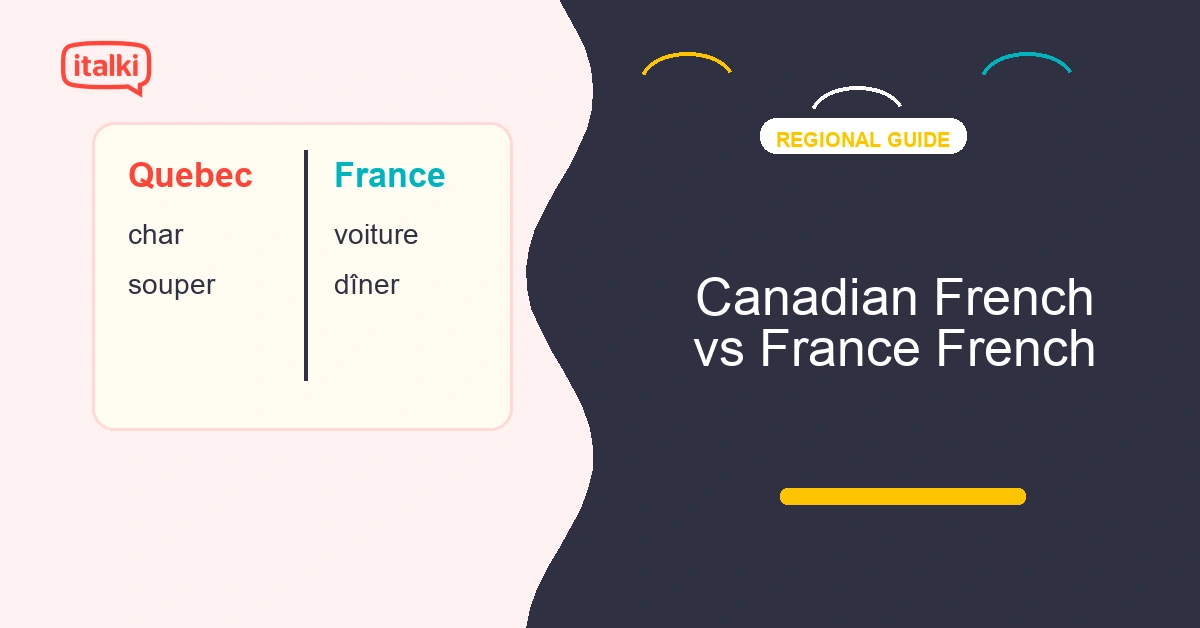
If you want to know which words sound natural in Montreal versus Paris, why a Quebec speaker says “char” instead of “voiture,” or how to pick the variety that fits your goal, this guide breaks it down without pretending one is more correct.
italki has connected learners with French tutors from both Quebec and France since 2007, giving 10M+ learners access to 30,000+ teachers across 150+ languages, so you can hear the real differences from a native speaker instead of guessing.

Find Your Perfect Teacher
French becomes easier when you can practice the examples, get correction, and hear how a real speaker would say it.

How do Canadian French and France French sound different?
The accent is the first and biggest thing you notice. Quebec French keeps older vowel distinctions and pronunciation patterns that European French dropped over the centuries, which is why the two can sound surprisingly far apart even though the spelling is identical.
This split traces back to the 17th- and 18th-century settlement of New France: after the 1760 British conquest cut Canada off from France, the two varieties evolved separately, and Quebec retained older forms that mainland French later abandoned.
A few concrete sound differences:
- Vowel diphthongs. In Quebec, long vowels often stretch into glides. “Père” (father) can sound closer to “paèr,” and “fête” (party) leans toward “faète.” France French keeps these vowels flat and pure. Linguists note that in Quebec French, long and nasalized vowels are generally diphthongized in closed syllables.
- The “t” and “d” before “i” and “u.” Quebec speakers add a soft “s” or “z” sound, so “tu” (you) sounds like “tsu” and “dire” (to say) sounds like “dzire.” This affrication of dental stops before high front vowels does not happen in France French. It is one of the fastest ways to identify a Quebec speaker.
- Nasal vowels. France French has shifted “un” toward an “in” sound in much of the country, while Quebec preserves a more distinct “un”. The word “brun” (brown) is a clear test case.
- Dropped vowels and contractions. Casual Quebec speech compresses words heavily. “Il” becomes “y,” “elle” becomes “a,” and “je suis” can collapse into “chu.” A sentence like “Je suis dans l’autobus” comes out as “Chu dans l’bus” in relaxed speech.
These shifts mean a beginner trained only on Parisian audio can read a Quebec menu perfectly and still struggle to follow a casual conversation in a Montreal café. The written language barely changes; the ear has to be retrained. This is exactly where listening exposure to your target region matters more than any rule.
A French conversation tutor from Quebec or France can model the exact accent you need and slow it down until your ear adjusts, something a fixed audio app cannot do.
Find Your Perfect Teacher
French becomes easier when you can practice the examples, get correction, and hear how a real speaker would say it.
Which vocabulary differences matter most for learners?
Focus first on high-frequency daily words, because those are the gaps you will hit in real conversations within your first week. Many differences come from Quebec’s distinct history: some words are older French forms preserved in Canada, while others are calques or borrowings shaped by living next to English-speaking North America.
| Category | Quebec French | France French | English meaning |
|---|---|---|---|
| Car | char (informal) | voiture | car |
| Breakfast | déjeuner | petit-déjeuner | breakfast |
| Lunch | dîner | déjeuner | lunch |
| Dinner | souper | dîner | dinner |
| Shopping | magasiner | faire du shopping / les courses | to shop |
| Boyfriend / girlfriend | chum / blonde | copain / copine | partner |
| Cellphone | cellulaire (cell) | portable / téléphone | cellphone |
| Cool / nice | le fun | sympa / cool | fun, nice |
The meal words deserve special attention because they actively reverse. If a Quebec colleague invites you for “dîner,” they mean lunch, but the same word in Paris means dinner. Mixing these up can genuinely throw off your schedule when you travel or work across both regions.
A useful detail that surprises learners: France French borrows freely from English for tech and lifestyle (“le weekend,” “le shopping,” “le parking”), while Quebec French, protective of the language in a majority-English continent, shows a much stronger tendency to avoid English borrowings and often invents French equivalents.
The Quebec word for email is “courriel,” while many speakers in France just say “mail” or “email.” This protective instinct is institutional, not just cultural: the Office québécois de la langue française, created in 1961, actively proposes French replacements for anglicisms and was strengthened by the 1977 Charter of the French Language. If you want to go deeper on regional spread, the differences across French speaking countries show how varied the language is beyond France and Quebec.
Pick one row from the table, say it aloud, then build a sentence about your own life with it. Recognizing “char” in a podcast is one thing; choosing the right word when you order, shop, or schedule is what actually builds usable French. The fastest way to learn which words are safe to use, which sound too casual for work, and which neutral form will be understood everywhere is to hear them from a native speaker and get corrected on the spot.
What grammar and expression differences should you know?
The written grammar is nearly identical, so exams and formal writing use the same rules in both regions. The differences live in spoken, informal French, and they show up constantly in casual Quebec speech.
The most distinctive feature is the “-tu” question particle. In informal Quebec French, speakers add “tu” after the verb to mark a yes/no question, regardless of who the subject is. This polar interrogative particle is well documented in linguistic research on Quebec French. It has nothing to do with “you” here. Examples:
- “Tu veux-tu un café?” means “Do you want a coffee?”
- “C’est-tu loin?” means “Is it far?”
- “Ça marche-tu?” means “Does it work?”
You will hear this everywhere in Quebec, and recognizing it is essential for comprehension even if you never produce it yourself.
A few more spoken patterns:
- Informal “tu” address. Quebec society tends to use “tu” more readily and in more situations than France, where “vous” stays the default with strangers and in service settings longer. As one report puts it, “le vouvoiement is the default choice in France. It is mostly the opposite in Quebec, where le tutoiement prevails in schools and the workplace.“
- “Pis” for “et puis.” “And then” gets compressed to “pis” in casual narration: “Je suis arrivé, pis j’ai mangé” (I arrived, and then I ate).
- Anglicisms in syntax. Some Quebec expressions mirror English structure, like “bienvenue” used to mean “you’re welcome” (a calque of English), where France French would say “de rien.”
Quebec French is also rich in expressions that have no France equivalent, including the famous “sacres” (swear words drawn from Catholic church vocabulary like “tabarnak” and “câline”). These are deeply tied to Quebec identity and culture. For a broader look at how everyday phrasing works, the guide to French idioms is a useful companion, and basic everyday wording is covered well in this collection of basic French words.
Keep one rule in mind: casual Quebec features belong in casual Quebec contexts. Writing a “-tu” question into a formal email would read as out of place. Register, unlike vocabulary, is invisible until you get it wrong in front of someone who notices, which is why feedback from a Quebec or France-based teacher beats any grammar list: they hear the slip in the moment and tell you whether it landed as friendly or sloppy.
Find Your Perfect Teacher
French becomes easier when you can practice the examples, get correction, and hear how a real speaker would say it.
What mistakes should learners avoid when comparing French varieties?
Here is the counterintuitive part: the mistakes that trip up learners are almost never about grammar. They cluster around attitude and listening, two things no textbook chapter ever labels as “errors.” The biggest one is treating one variety as “real” French and the other as a corrupted version. Both Quebec French and France French are full, standardized varieties with their own academies, media, literature, and millions of native speakers.
| Mistake | Why it hurts you | Better approach |
|---|---|---|
| Calling Quebec French “broken” or “wrong” | Cuts you off from the over 7 million Canadians who report French as their mother tongue and sounds dismissive | Treat both as legitimate, and learn the one that fits your goal |
| Training only on Parisian audio | You will freeze when you hear a real Quebec accent | Add Canadian listening early if Canada is your target |
| Using Quebec slang in formal writing | Casual sacres and “-tu” questions read as out of place at work | Match register to context every time |
| Assuming the words are interchangeable | “Dîner” reverses meaning between regions and disrupts plans | Learn the high-frequency swaps that actually differ |
Another quiet trap hides in the opposite direction: assuming that learning one variety locks you out of the other. It does not. Think of it less like two languages and more like the same operating system running two regional skins. The shared written standard means once you have a solid base, switching focus is mostly a matter of vocabulary and ear training, not relearning the language from scratch.
There is a subtler trap hiding inside that shared standard. Because the writing is identical, learners read a Quebec article fluently and conclude they “know” Quebec French, then freeze the moment a real conversation starts. The gap is not knowledge; it is exposure. Your eyes are trained and your ears are not. The fix is unglamorous but reliable: spend deliberate listening time on your target region instead of assuming reading comprehension will carry over to the spoken language.
The best fix is one you can reuse. After a correction lands on a regional word or a register slip, write a second sentence using the same pattern so it sticks instead of fading once the lesson ends. That habit, repeated across a few weeks, is what closes the exposure gap, and French teachers who specialize in your target region are simply the fastest way to surface the mistakes self-study tools never flag in the first place.
Find Your Perfect Teacher
French becomes easier when you can practice the examples, get correction, and hear how a real speaker would say it.
How should you choose which French variety to learn?
Choose based on where you will actually use French: living, working, studying, immigrating, or traveling. The variety should follow your real-world goal, not a vague sense of prestige.
Here is a simple way to decide:
- Going to Quebec or elsewhere in Canada? Learn Canadian French. Immigration interviews, the workplace, and daily life in Montreal or Quebec City run on the local accent and vocabulary. Several French tests, such as the TCF Canada, are designed specifically for economic immigration to Canada or Canadian citizenship and expect comfort with the Canadian context.
- Heading to France, Belgium, Switzerland, or much of Africa? Learn France French, which functions as the broader international standard and is what most global media and textbooks use.
- Not sure yet, or want maximum flexibility? Start with a neutral France French base, since it is the most widely understood, then add Canadian listening and vocabulary once your goal sharpens.
- Preparing for a specific exam? Match your study to the test. The DELF and DALF are official diplomas awarded by the French Ministry of Education and use European French, while the TEF Canada targets the Canadian context.
A practical exercise: pick one situation you care about, like ordering coffee or scheduling a meeting. Learn the neutral France version and the Quebec version side by side, listen to a short clip of each, then record yourself. The contrast makes the differences concrete instead of abstract.
You do not have to make this call alone. An online French tutor can tell you within one trial lesson which variety matches your goal and build your lessons around that target, so you stop second-guessing and start practicing the right French.
Find Your Perfect Teacher
French becomes easier when you can practice the examples, get correction, and hear how a real speaker would say it.
How can a tutor help you adapt to Canadian or European French?
A tutor’s biggest value here is your ear and your output, the two things apps and textbooks cannot correct. Self-study shows you that “tu” sounds like “tsu” in Quebec, but only a native speaker can tell you whether your own pronunciation is landing or drifting back into a Parisian default.
This is the exact problem italki solves. You can filter teachers by where they are from, so a learner targeting Montreal can book a Quebec native while a learner heading to Lyon picks a teacher from France. That regional matching is hard to get from a generic course, and it is the difference between recognizing an accent and actually keeping up with it.
Bring a focused request to your session. Instead of “help me improve,” try: “Check whether these five sentences sound natural in Quebec French, correct my most frequent mistake, and ask me follow-up questions until I can answer without reading.” That turns a lesson into a targeted review of your real French. If you want to slot this into a fuller plan, the French study plan guide shows how to structure regular practice around your goal.
Learning faster comes from personal guidance, not more passive input. With 30,000+ tutors trusted by over 10 million learners since 2007, italki lets you book a trial lesson with a teacher from exactly the region you are targeting. Book a trial lesson and practice the accent and vocabulary that match your goal.
Ready to make French feel usable?
The next step is turning examples from this guide into language you can use with another person.
Learn French faster with personal guidance from experienced French teachers online trusted by over 10 million learners worldwide. Book a lesson today and start building real fluency with confidence.
Find Your Perfect Teacher
French becomes easier when you can practice the examples, get correction, and hear how a real speaker would say it.
FAQ
Can French people understand Canadian French?
Usually yes, especially in standard or formal speech, since the written language and grammar are nearly identical. Heavy Quebec accents, fast informal speech, and regional slang can still cause confusion at first.
Should I learn Canadian French or France French?
Choose Canadian French if Canada is your goal for work, study, or immigration. Choose France French if you are focused on France, Europe, or want the most widely understood international standard.
Is Quebec French harder than France French?
Not inherently. It tends to feel harder only because most beginner materials use European French, so the Quebec accent and vocabulary sound unfamiliar until you train your ear to them.
Can I learn both varieties of French?
Yes. Build one solid base first, then add listening practice and vocabulary for the other variety, since they share the same written standard and grammar foundation.
Is Canadian French useful outside Canada?
It is understood across the French-speaking world thanks to the shared standard, but its strongest practical value is for Canada-focused work, study, travel, and community life.
Want to learn a language at italki?
Here are the best resources for you!