Key takeaways
- French has at least four core apology expressions, and mixing them up sounds unnatural to native speakers.
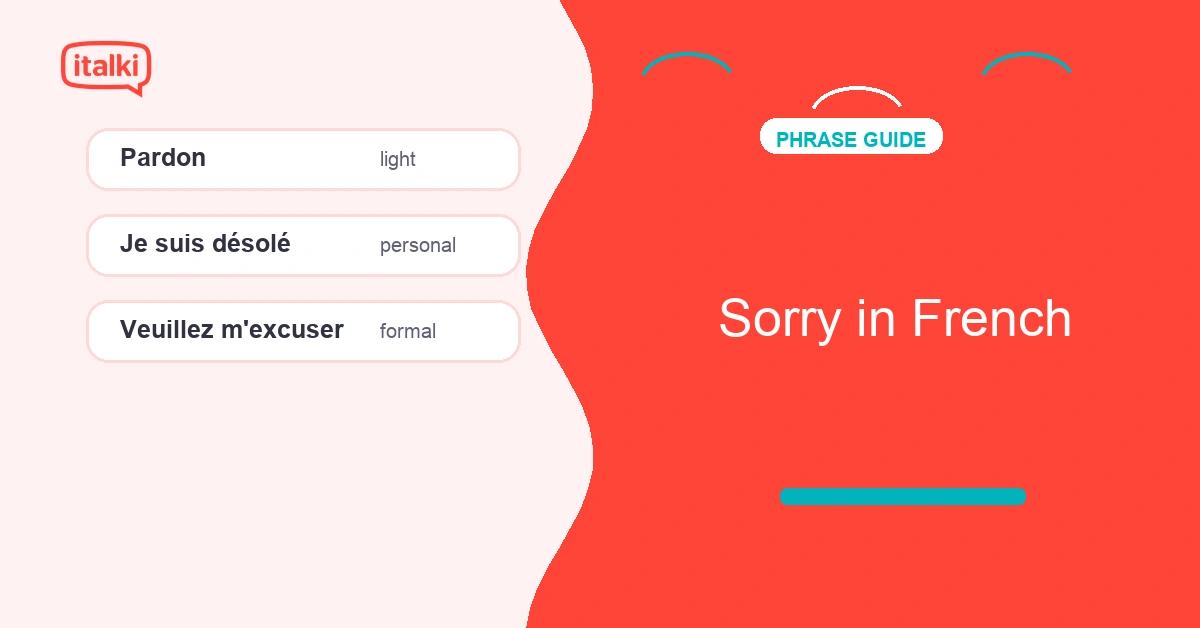
- “Pardon,” “excusez-moi,” “désolé(e),” and “je suis désolé(e)” each signal a different level of regret and formality.
- Context matters: a crowded Paris street, a professional email, and a falling-out with a friend each call for a different phrase.
- Practicing apology phrases in realistic scenarios with a French tutor helps you hear how native speakers actually respond and adjust their tone.
- What is the most common way to say sorry in French?
- What is the difference between "pardon" and "excusez-moi"?
- How do you say "I'm sorry" in French for genuine regret?
- How do you apologize formally in French, in writing or at work?
- How do you apologize in French for hurting someone?
- What are the useful phrases around apologies: accepting, deflecting, and responding?
- Regional and informal variations you will actually hear
- Ready to use French apologies with real confidence?
- FAQ
Sorry in French is not a single word. Depending on whether you bump into a stranger on the Metro, cancel plans with a friend, or make a mistake in a business meeting, you need a different phrase entirely.
italki has helped over 10 million learners across 150+ languages get these real-life distinctions right since 2007, and that is exactly what this guide covers: the right French apology for the right moment, with pronunciation and context so you can use each phrase confidently.

Find Your Perfect Teacher
French becomes easier when you can practice the examples, get correction, and hear how a real speaker would say it.

What is the most common way to say sorry in French?
The most common, all-purpose apology in everyday French is “désolé(e)” (pronounced: day-zoh-LAY). It works the way “sorry” does in casual American English: short, sincere, and appropriate for minor inconveniences.
Add the feminine “e” at the end if you are a woman: “désolée” (same pronunciation, different spelling). In writing, this matters. In speech, no one will notice.
Common everyday uses:
- “Désolé, je suis en retard.” (Sorry, I’m late.)
- “Désolée, je ne peux pas venir.” (Sorry, I can’t come.) [spoken by a woman]
- “Désolé de te déranger.” (Sorry to bother you.)
The phrase is warm but not dramatic. It suits being late to a coffee, forgetting to reply to a message, or canceling low-stakes plans.
What is the difference between “pardon” and “excusez-moi”?
These two expressions are often treated as interchangeable in textbooks, but French speakers use them differently.
“Pardon” (pronounced: par-DON) is used when you have already done something: you have bumped into someone, stepped on a foot, or interrupted briefly. It is a quick, after-the-fact acknowledgment. You say it and keep moving.
“Excusez-moi” (pronounced: ex-kew-ZAY mwah) is used before or during: you are about to interrupt, you need to pass through a crowd, or you want to get a waiter’s attention. The informal version with a friend is “excuse-moi” (ex-KEWZ mwah).
| Phrase | Formality | Timing | Typical scenario |
|---|---|---|---|
| Pardon | Neutral | After | Bumped into someone on the street |
| Excusez-moi | Formal | Before/during | Asking a stranger for directions |
| Excuse-moi | Informal | Before/during | Getting a friend’s attention |
One quick note on “pardon”: it also functions as “I beg your pardon?” when you did not hear something. Tone and context separate the two uses. A rising intonation turns it into a question; flat delivery makes it an apology.
Working on French conversation practice with a French teacher is one of the fastest ways to internalize this kind of tonal distinction, because reading about it and actually hearing a native speaker say it are very different things.
How do you say “I’m sorry” in French for genuine regret?
When you mean it, you use “je suis désolé(e)” (pronounced: zhuh swee day-zoh-LAY). The “je suis” signals that this is a full statement of regret, not just a social reflex.
To add depth, French speakers often follow it with a reason:
- “Je suis désolé(e) pour ce qui s’est passé.” (I’m sorry for what happened.)
- “Je suis vraiment désolé(e).” (I’m truly sorry.) The adverb “vraiment” (vray-MON) intensifies sincerity.
- “Je suis tellement désolé(e).” (I’m so sorry.) “Tellement” (tel-MON) is slightly more emotional.
Another phrase that signals deep, heartfelt regret is “je regrette” (zhuh ruh-GRET), meaning “I regret it.” This one is more literary and appears more often in writing or formal speech. It carries a weight that “désolé” does not.
You can also say “je regrette sincèrement” (I sincerely regret) in a formal letter or professional context where you want to be explicit about remorse.
Find Your Perfect Teacher
French becomes easier when you can practice the examples, get correction, and hear how a real speaker would say it.
How do you apologize formally in French, in writing or at work?
In professional French, the register shifts entirely. The casual “désolé” sounds flippant in an email to a client or a message to a superior.
Formal written apologies in French use:
- “Veuillez accepter mes excuses.” (Please accept my apologies.) Pronounced: vuh-YAY ak-sep-TAY may ex-KEWZ. This is the go-to formula in business correspondence.
- “Je vous présente mes sincères excuses.” (I present you with my sincere apologies.) Used when something has gone wrong at work and you want to take clear ownership.
- “Nous regrettons sincèrement cet incident.” (We sincerely regret this incident.) Common in corporate or official contexts when writing on behalf of an organization.
- “Je m’excuse de ce contretemps.” (I apologize for this inconvenience.) Natural in client-facing communication.
Note that “je m’excuse” (zhuh mex-KEWZ) is widely used, but some French speakers consider it slightly self-serving because the literal meaning is closer to “I excuse myself.” In casual and semiformal contexts, it is perfectly fine. In a formal written apology, “veuillez accepter mes excuses” or “je vous présente mes excuses” is safer.
If you are preparing to write in French professionally, the guide on how to write an email in French covers the full register of formal correspondence, including greetings and sign-offs.
Connect with an online French tutor to role-play a professional apology scenario before you send a real email. Getting feedback on tone before it matters is exactly the kind of thing a live tutor can help with.
Find Your Perfect Teacher
French becomes easier when you can practice the examples, get correction, and hear how a real speaker would say it.
How do you apologize in French for hurting someone?
When you have genuinely upset a close friend, a partner, or a family member, none of the above phrases feel adequate on their own. French speakers layer phrases together to show real remorse.
Useful combinations:
- “Je suis tellement désolé(e). Je n’aurais pas dû dire ça.” (I’m so sorry. I shouldn’t have said that.)
- “Je regrette vraiment ce que j’ai fait.” (I truly regret what I did.)
- “Pardonne-moi, c’était de ma faute.” (Forgive me, it was my fault.) “Pardonne-moi” (par-DON mwah) is more emotionally charged than a simple “pardon.” It is asking for forgiveness, not just acknowledging a bump.
- “Je te demande pardon.” (I ask for your forgiveness.) Formal enough to feel serious, personal enough to feel genuine.
The phrase “mea culpa” (same in French, borrowed from Latin) also appears in spoken French when someone is owning a mistake with a slight self-deprecating tone. It is used among friends rather than in serious emotional situations.
Understanding when to use formal versus intimate language in French is tied to the broader system of French greetings and register, where the “tu/vous” distinction runs through everything including apologies. “Pardonne-moi” uses “tu” (informal you), while “veuillez accepter mes excuses” sits firmly in the “vous” world.
What are the useful phrases around apologies: accepting, deflecting, and responding?
Knowing how to apologize is only half the conversation. You also need to understand what happens next.
Accepting an apology:
- “Ce n’est pas grave.” (It’s not a big deal. / No harm done.) Pronounced: suh nay pah grahv. This is by far the most common response to a minor apology.
- “Ne t’en fais pas.” (Don’t worry about it.) Informal, to someone you know well.
- “C’est oublié.” (It’s forgotten.) A warm way to show the matter is closed.
- “Je t’accepte tes excuses.” (I accept your apology.) More deliberate; used when the apology actually needed to happen.
Deflecting when you are not at fault:
- “Ce n’est pas votre faute.” (It’s not your fault.) Formal.
- “Tu n’as rien à te reprocher.” (You have nothing to blame yourself for.) Informal, reassuring.
Asking someone to repeat themselves (using pardon as a question):
- “Pardon ?” said with a rising tone. Direct and neutral.
- “Comment ?” (What? / Pardon?) Slightly less formal than “pardon” but very common.
- “Vous pouvez répéter, s’il vous plaît ?” (Could you repeat that, please?) Polite, works in any public setting.
Working through these response patterns with French tutors in live conversation is the clearest way to build the reflex for which phrase fits which social moment.
Regional and informal variations you will actually hear
French is spoken across many countries, and apology expressions shift with geography and age group.
In France (informal register):
- “Mince” (mans) is sometimes used as a mild apology combined with dismay, similar to “whoops” or “oh no.”
- “Oh là là, pardon.” is a natural, expressive reaction to a social misstep. “Oh là là” is not a cliché in France; it is a real expression of surprise or mild distress.
In Quebec:
- “Excusez” (without “moi”) is frequently used as a standalone apology or to get attention, particularly in informal speech.
- “Je m’excuse” is extremely common and does not carry the “self-excusing” criticism that some Parisian speakers attach to it.
In Belgium and Switzerland:
- French speakers in these regions tend to follow similar patterns to standard French, though the pace and intonation differ. “Pardon” and “désolé” are used in the same situations.
Slang and very casual speech:
- “Sorry” (borrowed from English) is used among younger French speakers, particularly in text messages and social media, though it would sound odd in any formal or adult context.
Understanding these regional layers takes time, but it is one of the reasons that working with a French language tutor who matches your target region makes a real difference. The italki platform, which has operated since 2007 and connects learners with 30,000+ teachers across 150+ languages, lets you filter by tutor background and region so you can focus on the French actually spoken where you need it.
For a fuller picture of how vocabulary shifts across Francophone regions, the guide on French speaking countries gives useful geographic context.
Ready to use French apologies with real confidence?
Knowing the phrases is a start, but the moment you need to use them in real life, the right words have to come out automatically. That kind of fluency comes from practice in real conversations, not from memorizing lists.
With italki’s 30,000+ teachers across 150+ languages and 10 million+ learners already on the platform, you can find a French tutor who matches your level, your region, and your exact learning goal. Book a trial lesson and get real-time feedback on your pronunciation, register, and the subtle differences that make your French sound natural rather than textbook.
Find Your Perfect Teacher
French becomes easier when you can practice the examples, get correction, and hear how a real speaker would say it.
FAQ
What is the simplest way to say sorry in French?
“Pardon” for a quick, minor apology after bumping into someone, and “désolé(e)” for anything more personal. These two cover the majority of everyday situations.
Is “je m’excuse” correct French?
Yes, it is grammatically correct and widely used across France and Quebec. Some speakers prefer “je suis désolé(e)” for sincere apologies because “je m’excuse” can sound like you are letting yourself off the hook, but in practice both are acceptable.
How do you say sorry formally in a French email?
Use “Veuillez accepter mes excuses” or “Je vous présente mes sincères excuses.” Both are standard in professional French correspondence and signal that you are taking the situation seriously.
What does “ce n’est pas grave” mean when someone apologizes to you?
It means “it’s not serious” or “no big deal.” It is the standard, friendly way to accept a minor French apology and let the other person know no harm was done.
How is “pardon” different from “excusez-moi”?
“Pardon” comes after an action you have already taken, such as bumping into someone. “Excusez-moi” comes before you interrupt or need to pass through, functioning more like “excuse me” when you are about to speak or move.
Want to learn a language at italki?
Here are the best resources for you!