Key takeaways
- Tú, usted, and vos are not interchangeable. Each carries its own verb endings and signals a different relationship and level of respect.
- Region decides everything. Vos is standard in the Río de la Plata, usted is the default in Colombia even between friends, and tú dominates in Spain and Mexico.
- The safest move when you are unsure is usted. It rarely offends, while wrongly defaulting to tú can read as too familiar.
- A Spanish conversation tutor can run register role-plays with you so you learn which pronoun fits a specific country, age group, and setting before you use it for real.
- What changes when you switch between tú, usted, and vos
- When should you use tú, usted, and vos?
- How does pronoun choice change by country?
- Conversational Spanish phrases in both registers
- What mistakes should learners avoid with formality?
- How do you practice formal and informal Spanish?
- How can feedback help with Spanish register?
- FAQ
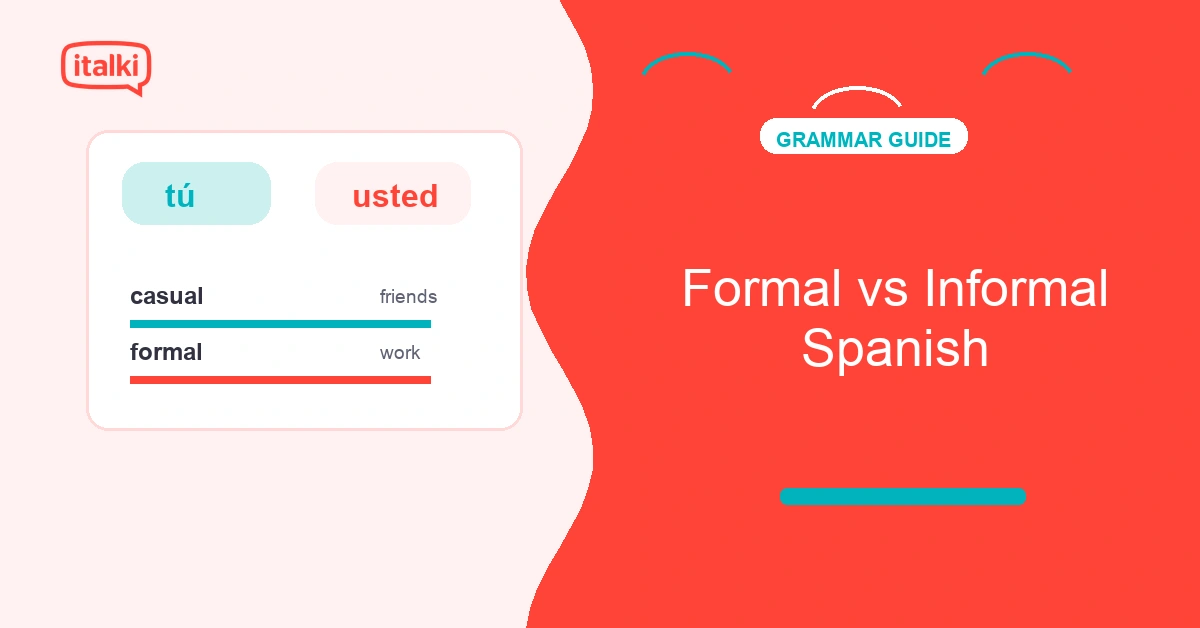
Informal vs formal Spanish comes down to one decision you make before almost every sentence: how close or how respectful do you want to sound to the person in front of you. Tú is the familiar form for friends, kids, and peers. Usted signals respect or distance with strangers, elders, and clients. Vos is the everyday informal pronoun in Argentina, Uruguay, and much of Central America, where it replaces tú entirely. Get this choice right and you sound natural. Get it wrong and you risk sounding cold, overly casual, or like you learned Spanish from a single textbook.
italki connects you with Spanish tutors who can tell you exactly which form a Mexican coworker, a Colombian shopkeeper, or an Argentine friend would actually expect, drawing on a platform that has helped over 10 million learners since 2007.

Find Your Perfect Teacher
Spanish becomes easier when you can practice the examples, get correction, and hear how a real speaker would say it.

What changes when you switch between tú, usted, and vos
Switching pronoun does not just swap one word. It changes the verb ending, and sometimes the stress, so the whole sentence sounds different.
Take the simple question “how are you.” With tú you say ¿cómo estás? With usted you say ¿cómo está? With vos you say ¿cómo estás? too, but in the present tense vos often shifts the stress and drops the stem change.
Tú puedes (you can) becomes vos podés. Tú tienes (you have) becomes vos tenés. Tú quieres becomes vos querés. The accent lands on the final syllable, and the irregular stem change disappears. The Real Academia Española documents this voseo conjugation and the Hispanic American regions where it is standard.
The command forms move as well. To tell a friend “listen” you say escucha (tú) or escuchá (vos). To say it respectfully you say escuche (usted). Pronouns attached to the verb follow the same logic: te llamo for tú and vos, le llamo for usted.
This is why memorizing a pronoun chart alone does not get you far. You also need the verb forms that travel with each pronoun, and you need to hear them enough to choose without pausing. Practicing this with a Spanish tutor online who corrects the verb ending in real time fixes the gap that grammar tables leave open.
Find Your Perfect Teacher
Spanish becomes easier when you can practice the examples, get correction, and hear how a real speaker would say it.
When should you use tú, usted, and vos?
Use tú with people you treat as equals or familiars, usted when respect or distance is expected, and vos in regions where it is the normal informal form. The decision rests on four things: the relationship, the age gap, the setting, and the country you are in.
With friends, classmates, children, and younger relatives, tú or vos is normal. With a new client, a police officer, your partner’s grandmother, or a doctor you have just met, usted shows respect. In a job interview in Spain or Mexico, start with usted and let the other person invite you to switch. In Bogotá, you might hear usted between two close friends, which would sound strange almost anywhere else.
| Who you are speaking to | What you say | Why this form fits |
|---|---|---|
| A friend in Mexico or Spain | ¿Qué tal? ¿Cómo estás? | Tú is the standard informal form across most of these regions |
| A new client or your boss | ¿Cómo está usted? Encantado de conocerle. | Usted creates the professional distance these settings expect |
| A friend in Buenos Aires | ¿Cómo andás, che? | Vos is the everyday informal pronoun in Argentina, not slang |
| An elderly stranger anywhere | Disculpe, ¿me puede ayudar? | Usted is the respectful default when age and distance both apply |
| A waiter you do not know in Spain | Perdona, ¿me traes la carta? | In Spain tú is common even with service staff your own age |
A quick test: if you would use a first name with this person in English, tú or vos usually fits. If you would say “sir,” “ma’am,” or a title, reach for usted. When the two signals conflict, default to usted and adjust once you hear what the other person uses.
Booking a few sessions with Spanish tutors online lets you rehearse these exact moments, a first meeting, a service interaction, a conversation with an older relative, so the right form arrives automatically instead of after an awkward pause.
How does pronoun choice change by country?
Region is the single biggest factor in pronoun choice, and the rules genuinely contradict each other across the Spanish speaking countries. The same sentence that sounds polite in Madrid can sound stiff in Buenos Aires and overly familiar in Bogotá.
In Spain, tú dominates daily life, including with shop staff and acquaintances your own age. Usted exists but is reserved for clear formality, such as addressing an elderly stranger or a senior official. The plural informal vosotros is also alive here, while Latin America uses ustedes for every plural “you,” a Spain-versus-America split the Real Academia Española records.
In Mexico and most of Central America’s cities, tú is the everyday informal form and usted carries respect, much like Spain minus the vosotros.
In Argentina, Uruguay, Paraguay, and much of Central America, vos replaces tú completely. An Argentine will rarely say tú tienes; they say vos tenés. Learning tú-only Spanish and landing in Buenos Aires means you understand people but sound slightly foreign every time you address them directly. If the Río de la Plata is your target, the guide on Spanish dialects goes deeper into when to use vos.
In Colombia, especially Bogotá and the Andean interior, usted is used far more broadly than elsewhere, even between spouses, close friends, and parents and children. Defaulting to tú with a new Colombian friend can read as forward.
These contrasts are why a single chart cannot answer “which pronoun do I use.” You need the version for the country you actually deal with. A native Spanish speaker tutor from your target country can confirm what locals truly use, not what a textbook averages out.
Conversational Spanish phrases in both registers
The fastest way to internalize register is to learn the same conversational Spanish phrases in two versions, then pick the one that fits the moment. These are sentence starters you will reuse constantly, shown in informal (tú) and formal (usted) so you can switch on demand.
Greeting and checking in:
- Informal: ¿Cómo estás? ¿Qué tal todo? (How are you? How’s everything?)
- Formal: ¿Cómo está? ¿Cómo le va? (How are you? How are things going for you?)
Asking for help:
- Informal: ¿Me ayudas con una cosa? (Can you help me with something?)
- Formal: ¿Me podría ayudar con una cosa? (Could you help me with something?)
Asking someone to repeat:
- Informal: ¿Puedes repetir, por favor? (Can you repeat that, please?)
- Formal: ¿Podría repetirlo, por favor? (Could you repeat that, please?)
Introducing yourself:
- Informal: Hola, soy Ana. ¿Y tú? (Hi, I’m Ana. And you?)
- Formal: Buenos días, me llamo Ana. ¿Y usted? (Good morning, my name is Ana. And you?)
Making a request at a shop or café:
- Informal: Ponme un café, por favor. (Get me a coffee, please.)
- Formal: ¿Me pone un café, por favor? (Could you get me a coffee, please?)
Notice how the formal versions lean on podría and me pone instead of direct commands. That softening is what carries the respect, not just the pronoun. The vos version of these starters keeps the informal tone but shifts the verb: ¿me ayudás?, ¿podés repetir?, poneme un café.
If you want more building blocks like these, the guide on common Spanish phrases gives you more starters to slot into either register. When you are ready to chain them into longer exchanges, basic conversation Spanish shows how the pieces fit together. To lock them in, run them aloud with online Spanish tutors who can flag the moment your formal request accidentally slips into a command.
Find Your Perfect Teacher
Spanish becomes easier when you can practice the examples, get correction, and hear how a real speaker would say it.
What mistakes should learners avoid with formality?
The most common register mistake is assuming one pronoun works everywhere. Region, age, relationship, and setting all pull the choice in different directions, and ignoring any one of them is what makes learners sound off.
| Mistake | What it sounds like | The fix |
|---|---|---|
| Using tú with every older stranger | Too familiar, almost like calling a stranger by their first name | Switch to usted when age or distance is in play, then follow their lead |
| Treating vos as slang | You skip it, then sound foreign in Argentina or Uruguay | Learn vos verb endings if your target country uses it daily |
| Mixing registers mid-conversation | Tú in one sentence, usted in the next, with no reason | Keep one register until the relationship itself changes |
| Forgetting the verb changes too | Saying usted tienes instead of usted tiene | Practice the pronoun and its matching verb form as one unit |
| Over-formalizing with friends | Usted with people who already use tú with you | Mirror the form the other person uses with you |
The verb-mismatch error is the one learners notice last. You can pick usted correctly and still give yourself away by attaching a tú verb. A focused correction session with Spanish tutoring catches these pairings fast, because a tutor hears usted tienes and fixes it on the spot, something a grammar app rarely flags.
How do you practice formal and informal Spanish?
The best way to practice is to take one message and say it in two registers, so switching becomes automatic instead of stressful. This trains the decision, not just the vocabulary.
Try this sequence with a real situation from your own life:
- Write a request to a friend using tú: ¿Me prestas tu cargador? (Will you lend me your charger?)
- Rewrite it for a client or an older stranger using usted: ¿Me presta su cargador, por favor?
- If your target country uses vos, add that version: ¿Me prestás tu cargador?
- Say all three aloud, paying attention to where the stress lands in the vos form.
- Ask for correction on both the pronoun and the verb ending.
Repeat this with five everyday messages: asking for directions, ordering food, declining an invitation, apologizing, and asking someone to wait. Within a week you will have a personal bank of sentences you can produce in either register without freezing.
A useful prompt to bring to a lesson: “Give me a situation, tell me who I’m speaking to, and let me choose tú, usted, or vos. Correct my pronoun and my verb, then change the situation.” Running this drill with Spanish teachers turns a static rule into a reflex, because you are forced to decide under light pressure and get corrected immediately.
Find Your Perfect Teacher
Spanish becomes easier when you can practice the examples, get correction, and hear how a real speaker would say it.
How can feedback help with Spanish register?
Feedback is what tells you whether your register choice actually works for a specific country, age group, and setting, which a chart can never confirm. Self-study shows you the rule. A real conversation shows you whether you applied it naturally.
This is the exact gap italki was built to close. Register is contextual and regional, so the most useful correction comes from someone who speaks the variety you are learning. On italki, you can search for a tutor from Argentina if you need vos, from Colombia if you want to master their broad use of usted, or from Spain if you need vosotros and tú in everyday speech. That country-level matching, across 30,000+ teachers in 150+ languages, is hard to replicate with apps or generic courses.
To get more from this topic before a lesson, the deeper breakdown of Spanish pronouns gives you the structure, while a tutor supplies the judgment calls. The Spanish grammar rules behind each form fill in the verb endings that travel with tú, usted, and vos. Bring three of your own sentences, name the country and setting you care about, and ask one focused question. Practicing live with Spanish tutors who correct your register on the spot is the fastest path from knowing the rule to using it under pressure.
The goal is not to memorize more about tú, usted, and vos. It is to choose the right one the instant someone speaks to you. Pick one situation that matters to you, a job interview, a trip to Buenos Aires, a chat with your partner’s family, and rehearse it in the right register with feedback. Learn with guidance from 30,000+ expert tutors trusted by over 10 million learners worldwide. Book a trial lesson and practice the exact register your situation calls for.
Ready to make Spanish feel usable?
The next step is turning examples from this guide into language you can use with another person.
Learn Spanish faster with personal guidance from expert online Spanish teachers trusted by over 10 million learners worldwide. Book a trial lesson today.
Find Your Perfect Teacher
Spanish becomes easier when you can practice the examples, get correction, and hear how a real speaker would say it.
FAQ
Is tú formal or informal?
Tú is informal and familiar. Use it with friends, peers, children, and people who already address you with tú, in most Spanish-speaking regions except those that use vos instead.
Is usted always formal?
Usted is usually formal or respectful, but Colombia and parts of the Andes use it widely, even between close friends and family. Outside those areas, it signals distance or respect.
Where is vos used?
Vos is the standard informal pronoun in Argentina, Uruguay, Paraguay, and much of Central America, including parts of Guatemala, Costa Rica, and Nicaragua. It replaces tú entirely, with its own verb endings.
Can I use usted if I am unsure?
Yes. Usted is the safer default when you cannot read the situation. It rarely offends, while wrongly using tú can come across as too familiar.
Do Spanish speakers care if learners choose wrong?
Most people are forgiving with learners and will still understand you. Still, choosing the right register makes you sound more respectful and natural, and it signals that you understand the culture, not just the words.
Want to learn a language at italki?
Here are the best resources for you!