Key takeaways
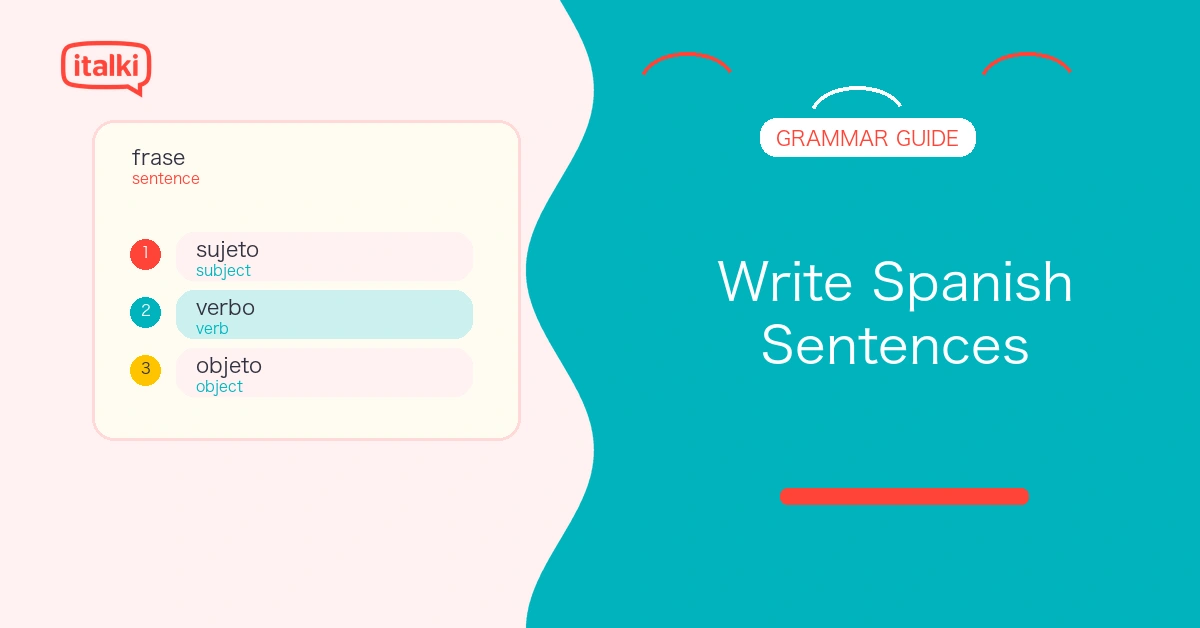
- Spanish basic word order is subject-verb-object (SVO), the same as English. The difference is that Spanish allows significantly more flexibility in word order because particles and verb endings carry grammatical role; the subject and object do not have to occupy fixed positions to be understood.
- Spanish adjectives typically follow the noun they modify: una casa grande (a big house), not una grande casa. This is the opposite of English and the source of one of the most persistent word order errors for English speakers.
- Subjects are frequently omitted in Spanish because the verb ending encodes who is performing the action. Tengo hambre (I am hungry): the yo (I) is understood from the verb form and does not need to be stated.
- Spanish negation works by placing no directly before the verb, not at the end of the sentence. No tengo dinero (I do not have money). Double negation is grammatically correct in Spanish: No tengo nada (I do not have anything, which literally translates as I do not have nothing).
English sentence structure is rigid: change the word order and you change or lose the meaning. Spanish is more flexible. The same information can often be arranged in multiple ways without ambiguity, because Spanish uses verb endings to track who is doing what regardless of position.
Understanding this difference unlocks a lot about Spanish writing and speech that feels wrong by English standards but is entirely natural in Spanish. italki connects you with Spanish teachers who can correct your word order in real sentences as you produce them, not just in isolated grammar exercises, but in the full-context speech where word order choices actually create meaning.
This guide covers the core rules of Spanish sentence structure: basic SVO order and when it shifts, subject omission, adjective placement, question formation, negation, and the sentence-level patterns that differ most from English.
A Spanish tutor online can work through sentence construction with you in real time, explaining why a rearrangement sounds natural or unnatural and building the instinct that grammar tables alone cannot produce.

Find your perfect teacher
Build real speaking confidence with personalized lessons from a teacher who matches your goals, schedule, and learning style.
Book a trial lesson
Basic word order: subject-verb-object
Spanish canonical sentence structure is subject-verb-object (SVO), which matches English:
| English | Spanish |
|---|---|
| I (S) eat (V) apples (O). | Yo (S) como (V) manzanas (O). |
| She (S) reads (V) the book (O). | Ella (S) lee (V) el libro (O). |
| They (S) speak (V) Spanish (O). | Ellos (S) hablan (V) español (O). |
Within this framework, several elements have fixed positions:
Articles and possessives come before the noun:
- el coche (the car), mi libro (my book), una pregunta (a question)
Spanish adverbs of frequency go before the verb or after:
- Siempre llego tarde. (I always arrive late.) Placement before the verb is common.
- Llego tarde siempre. (I arrive late always.) Placement after the verb is also natural.
Prepositions come before their object (same as English):
- Voy a la tienda. (I am going to the store.)
- Habla con su amigo. (He speaks with his friend.)
Subject omission: when to drop the pronoun
Spanish is a pro-drop language: the subject pronoun can be omitted when it is recoverable from the verb ending. This is one of the most immediately noticeable differences from English.
| With pronoun | Without pronoun | Meaning |
|---|---|---|
| Yo tengo hambre. | Tengo hambre. | I am hungry |
| Tú hablas bien. | Hablas bien. | You speak well |
| Nosotros vivimos aquí. | Vivimos aquí. | We live here |
| Ellos salen ahora. | Salen ahora. | They are leaving now |
When to keep the subject pronoun:
- For emphasis or contrast: Yo no lo hice, fue él. (I did not do it, he did.)
- When the verb form is ambiguous: The third-person singular of many verbs is the same for él/ella/usted. If context does not make clear who is acting, the pronoun clarifies: Él habla, ella escucha. (He speaks, she listens.)
- Immediately after introducing a topic switch: When shifting from one subject to another, a pronoun prevents confusion.
In spoken Spanish, dropping the pronoun is the default. Keeping it adds a layer of contrast or emphasis.
A private Spanish tutor can work through conversation exercises where you practice both forms, with and without the subject, so you develop an instinct for when the pronoun adds meaning and when it is simply unnecessary weight.
Find your perfect teacher
Build real speaking confidence with personalized lessons from a teacher who matches your goals, schedule, and learning style.
Book a trial lesson
Adjective placement
In English, adjectives precede the noun: a big house, an interesting book. In Spanish, descriptive adjectives typically follow the noun. This is one of the most consistent word order differences between the two languages.
Standard: noun + adjective
| Spanish | English |
|---|---|
| una casa grande | a big house |
| un libro interesante | an interesting book |
| una película española | a Spanish film |
| el examen difícil | the difficult exam |
Exceptions: adjectives that come before the noun
A small group of common adjectives typically precede the noun:
| Adjective | Meaning | Example |
|---|---|---|
| bueno/a | good | un buen libro (a good book) |
| malo/a | bad | un mal día (a bad day) |
| grande | great (before noun) / large (after noun) | un gran hombre / una casa grande |
| pequeño/a | small | un pequeño problema (a small problem) |
| nuevo/a | new (another/different) | mi nuevo coche (my new car) |
| viejo/a | old (longtime) | mi viejo amigo (my old friend) |
| mismo/a | same | el mismo error (the same mistake) |
Meaning shift with position: Some adjectives change meaning depending on whether they precede or follow the noun:
- un hombre grande = a large/tall man | un gran hombre = a great man
- una mujer pobre = a poor (financially) woman | una pobre mujer = a poor (unfortunate) woman
- mi nuevo coche = my new (replacement) car | un coche nuevo = a new (brand new) car
For how adjective gender and number agreement work in these structures, un libro bueno, una casa buena, unos libros buenos, unas casas buenas, the guide to Spanish adjectives covers the agreement rules in full.
Questions and interrogative word order
Spanish questions can be formed two ways: inversion (moving the verb before the subject) or intonation alone (with no word order change, the question is signaled only by the rising tone and question marks).
Yes/no questions:
| Statement | Question (inversion) | Question (intonation) |
|---|---|---|
| Tú hablas español. | ¿Hablas tú español? | ¿Tú hablas español? |
| Ella vive aquí. | ¿Vive ella aquí? | ¿Ella vive aquí? |
In spoken Spanish, the intonation-only form is very common. Inversion is more common in formal writing and makes questions unambiguous in text.
Wh-questions (with interrogative words):
Interrogative words always move to the front of the sentence, followed by the verb:
| Spanish | English |
|---|---|
| ¿Qué quieres? | What do you want? |
| ¿Dónde vives? | Where do you live? |
| ¿Cuándo llegaste? | When did you arrive? |
| ¿Por qué estudias español? | Why do you study Spanish? |
| ¿Cómo te llamas? | What is your name? |
| ¿Cuánto cuesta? | How much does it cost? |
| ¿Quién habló? | Who spoke? |
| ¿Cuál prefieres? | Which do you prefer? |
Note that Spanish uses an inverted question mark (¿) at the beginning of every question, not just at the end. In writing, both marks are required.
Indirect questions: In an embedded question, the word order returns to normal, the verb does not need to invert: No sé dónde vive. (I do not know where he lives.) The question word remains at the front of the clause, but the subject-verb order is standard.
Find your perfect teacher
Build real speaking confidence with personalized lessons from a teacher who matches your goals, schedule, and learning style.
Book a trial lesson
Negation
Spanish negation places no directly before the conjugated verb. This is the only rule for simple negation.
| Affirmative | Negative |
|---|---|
| Tengo dinero. (I have money.) | No tengo dinero. (I do not have money.) |
| Habla inglés. (She speaks English.) | No habla inglés. (She does not speak English.) |
| Fueron al cine. (They went to the cinema.) | No fueron al cine. (They did not go to the cinema.) |
Double negation: Spanish requires double negation, if a negative word follows the verb, no before the verb is also required.
| Spanish | Literal English | Actual meaning |
|---|---|---|
| No tengo nada. | I do not have nothing. | I do not have anything. |
| No vino nadie. | No one did not come. | No one came. |
| No lo vi nunca. | I did not see it never. | I never saw it. |
If the negative word (nada, nadie, nunca, tampoco) comes before the verb, no is not required: Nadie vino. (No one came.) Both versions are correct; the position of the negative word determines whether no is needed.
Common negative words:
| Spanish | Meaning |
|---|---|
| nada | nothing / not anything |
| nadie | no one / not anyone |
| nunca / jamás | never |
| tampoco | neither / not either |
| ningún / ninguno/a | none / no (adjective/pronoun) |
Word order flexibility in Spanish
Because Spanish verb endings and object pronouns encode grammatical role, word order can shift to express emphasis, contrast, or focus without changing the fundamental meaning.
Topic-fronting (moving the object to the front): El libro lo leí ayer. (The book, I read it yesterday.), el libro moves to the front to signal it as the topic. The object pronoun lo is added to maintain grammatical reference to el libro.
Verb-subject order (VS instead of SV): Llegó María. (Maria arrived.), the verb comes first. This is common when the subject is the new, focused information in the sentence. It would sound strange in English but is perfectly natural in Spanish.
Sentence-final adverbs for emphasis: Adverbs can move to the end of a sentence for emphatic effect: Lo hice yo sola. (I did it alone, all by myself.) The pronoun yo after the verb adds emphasis.
For how verb conjugation changes interact with sentence structure, especially when using compound tenses or reflexive verbs, the guide to Spanish verb conjugation covers the patterns that underlie these constructions.
Find your perfect teacher
Build real speaking confidence with personalized lessons from a teacher who matches your goals, schedule, and learning style.
Book a trial lesson
Common sentence structure errors for English speakers
Placing adjectives before the noun as a default: Writing una grande casa instead of una casa grande. The English habit of pre-noun adjectives is the most common word order error in Spanish writing.
Always including the subject pronoun: Writing Yo quiero café when Quiero café is more natural. The pronoun is not wrong, but using it in every sentence sounds slightly unnatural and over-formal in casual Spanish.
English-style negation placement: Writing Tengo dinero no (modeled on I have no money) instead of No tengo dinero. The no always goes before the verb in Spanish, not at the end.
Forgetting double negation: Writing No tengo algo (I do not have something) instead of No tengo nada (I do not have anything). After no, the negative indefinites (nada, nadie, nunca) replace the positive ones (algo, alguien, siempre).
Question word order in indirect questions: Writing No sé dónde vive él with inversion (vive él), but indirect questions do not use inversion in Spanish. Correct form: No sé dónde vive. (with subject dropped) or No sé dónde vive él. (subject after verb is fine, but no inversion needed).
An online Spanish tutor can catch these patterns in real speech, where they appear most frequently, and give you the correction in context rather than in isolation.
Build Spanish fluency with a teacher
Word order becomes natural through production, not rules. Reading the adjective-after-noun pattern is not the same as consistently applying it when speaking, which is when the English habit is hardest to override.
italki has helped over 10 million learners find Spanish teachers who work through sentence structure in real conversation, flagging every word-order slip as it happens. Book a trial lesson and ask your teacher to run a structured writing-and-speaking session where you produce full sentences from prompts, so the correct Spanish order starts to feel as automatic as the English one does now.
Find your perfect teacher
Build real speaking confidence with personalized lessons from a teacher who matches your goals, schedule, and learning style.
Book a trial lesson
FAQ
Is Spanish word order the same as English?
The basic order is the same, subject-verb-object, but Spanish is more flexible because verb endings carry grammatical information. Spanish allows verb-subject inversion, object-fronting, and subject omission in ways that would be ungrammatical or ambiguous in English. The main structural difference learners notice first is adjective placement: Spanish puts descriptive adjectives after the noun.
Why do Spanish adjectives come after the noun?
This is the standard position for descriptive adjectives in Spanish: una casa grande (a big house), un libro interesante (an interesting book). A small group of adjectives (bueno, malo, grande, pequeño) are exceptions that commonly precede the noun. Some adjectives shift meaning depending on their position.
Do I always need to say the subject pronoun in Spanish?
No. Spanish regularly drops the subject pronoun because the verb ending makes clear who is performing the action. Tengo hambre (I am hungry), the -go ending identifies first-person singular without needing yo. The pronoun is kept for emphasis or contrast: Yo no lo hice. (I did not do it, someone else did.)
How does Spanish negation work?
Place no directly before the conjugated verb: No quiero. (I do not want.) If a negative word (nada, nadie, nunca) comes after the verb, no before the verb is still required: No vi nada. (I did not see anything.) If the negative word comes before the verb, no is not needed: Nada vi.
Why does Spanish use double negatives?
Spanish grammar requires that negative words (nada, nadie, nunca) agree with the negation of the verb when they come after it. This is a grammatical rule, not a logical contradiction, it is the standard pattern in Spanish, unlike English where double negation is typically considered an error. No hay nada (There is nothing) is the only correct form in Spanish.
Want to learn a language at italki?
Here are the best resources for you!