Key takeaways
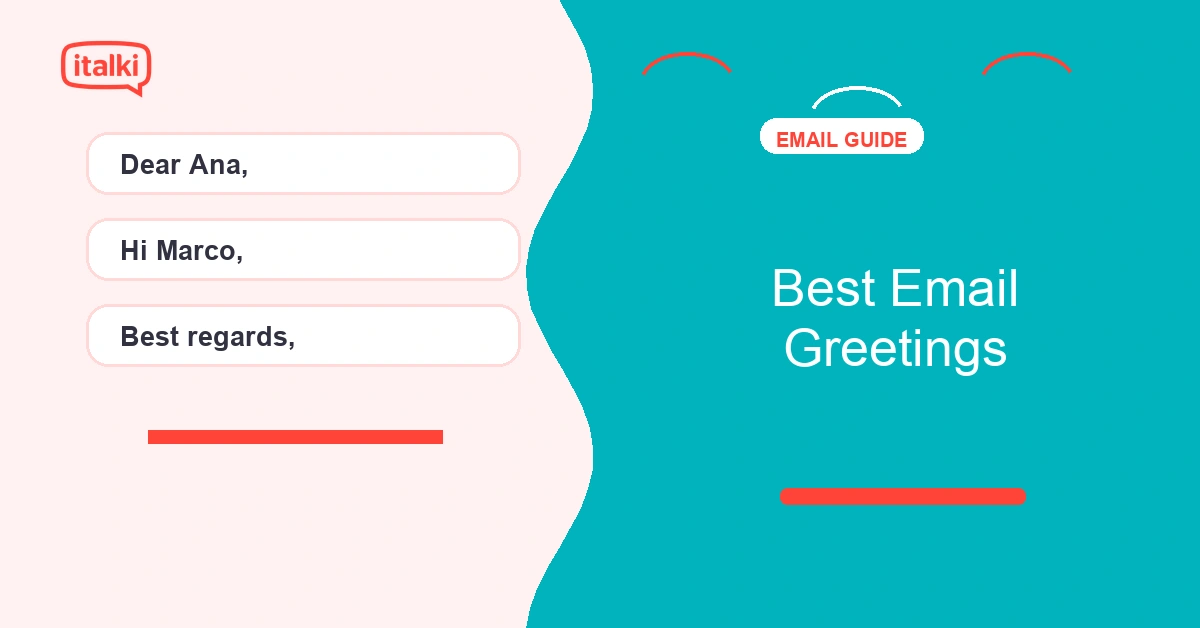
- The safest professional opener is “Dear [Title] [Last name],” for external or formal contacts, while “Hi [First name],” fits most internal and semi-formal emails.
- English email greetings change with relationship, seniority, and whether the message is internal or external, not just with how “polite” the words sound.
- The most common learner errors are mismatched titles (“Dear Mr. Anna”), greetings that are too casual for a first contact (“Hey”), and missing commas after the salutation.
- A English tutor can review the real emails you send, fix tone and punctuation, and tell you whether “Hi” or “Dear” suits a specific recipient.
- What are the best email greetings for professional English?
- Which greeting should you use by situation?
- How formal should your email greeting be?
- What email greeting mistakes should English learners avoid?
- What grammar rules apply to email greetings?
- How do you practice professional email openings?
- How should you build an email greeting bank?
- FAQ
Choosing the best email greetings comes down to three things: how formal the message needs to be, whether you know the reader’s name, and whether you are writing inside your company or to someone outside it. Get those right and a greeting like “Dear Ms. Rivera,” or “Hi team,” does most of the work before your first sentence.
italki connects English learners with native-speaking tutors who correct the exact greetings you send at work, and the platform has helped over 10 million learners since 2007 with on-demand feedback that grammar checkers cannot give you. This guide gives you the greetings that actually work in business English, sorted by relationship and tone, plus the mistakes that quietly damage your professional image.

Find Your Perfect Teacher
English becomes easier when you can practice the examples, get correction, and hear how a real speaker would say it.

What are the best email greetings for professional English?
The best email greeting is clear, matches your relationship with the reader, and fits whether the message is formal or casual. For most professional emails, that means one of three reliable openers.
Here are the ones that work in almost every business context:
- “Dear Ms. Rivera,” for formal or first-contact emails to clients, managers, or people outside your company. Use “Ms.” for women unless you know they prefer “Mrs.” or “Dr.,” and “Mr.” for men.
- “Hi Daniel,” for colleagues, ongoing threads, and companies with a relaxed culture. This is the modern default for internal English email.
- “Hello [First name],” as a slightly more neutral middle ground when “Hi” feels too casual and “Dear” feels too stiff.
Notice what these have in common. They name the person where possible, they end with a comma, and they signal respect without sounding cold. “To Whom It May Concern,” still exists, but it reads as dated and distant, so reserve it for formal letters where you have no contact name at all and no department to address.
One more rule that trips up learners: in English, you greet the person, then start a fresh sentence. “Dear Sam, I hope you are well.” The “I” is capitalized because it begins a new sentence, even though it sits on the same line as the greeting.
If you are not sure whether your greeting lands as polite or abrupt, that is exactly the kind of judgment a native speaker can confirm in seconds. Book a lesson with an online English tutor and bring three real emails you need to send this week.
Which greeting should you use by situation?
Match your greeting to formality, whether you know the name, and whether the email is internal or external. The table below maps the most common work situations to a safe opener.
| Situation | Greeting to use | Why it works |
|---|---|---|
| Known client, external | Dear Ms. Rivera, | Formal and respectful for business outside your company. |
| Colleague you know | Hi Daniel, | Friendly but still professional for internal email. |
| Senior manager, first contact | Dear Mr. Okafor, | Signals respect for seniority before a relationship exists. |
| Recipient whose name you do not know | Hello, | Neutral and safe when no name is available. |
| Group or team message | Hi team, | Natural for an email sent to several people at once. |
| Job application, no contact name | Dear Hiring Team, | More personal than “To Whom It May Concern,” and still formal. |
| Reply in an ongoing thread | Hi again, or just the first name | Repeating “Dear” on every reply sounds overly formal. |
A detail worth remembering: in a long thread, you usually drop the formal greeting after the first one or two messages and switch to “Hi [name],” or no greeting at all. Restarting every reply with “Dear Ms. Rivera,” makes you sound like you forgot you were already talking.
Pick one row that matches an email you genuinely need to send, then adapt the example with the real name and context. That single change turns a copied line into language you own. A private English tutor can run through these situations with you and tell you when “Hi” crosses into too casual for your industry.
How formal should your email greeting be?
Formality in English email runs on a spectrum, and the safest move when you are unsure is to start one level more formal than you think you need. You can always relax later once the other person sets the tone.
Here is how the main openers rank, from most to least formal:
- Dear [Title] [Last name], the most formal. Use for clients, senior people, and any first contact outside your team.
- Dear [First name], formal but warmer. Common in cover letters and polite first emails when you only have a first name.
- Hello [First name], neutral and professional. Works almost anywhere and rarely feels wrong.
- Hi [First name], friendly and standard for colleagues and ongoing business contacts.
- Hey [name], casual. Fine between close coworkers, risky for clients or first contact.
The reader’s seniority and your company culture decide where you land. A startup may run entirely on “Hi” and “Hey,” while a law firm or a bank still expects “Dear” for external letters. If you are writing across cultures, match the formality the other person used in their last email. When they wrote “Dear,” reply with “Dear.” When they opened with “Hi Tom,” you can return “Hi Sarah.”
Getting this calibration right is one of the hardest parts of business English, because the rules are unwritten and shift by industry. Practicing real scenarios with an English teacher online is the fastest way to develop the instinct for it.
What email greeting mistakes should English learners avoid?
The most common errors are greetings that are too casual for the relationship, mismatched titles, and punctuation slips that make a professional email look careless. Each one is small on its own, but together they shape how seriously a reader takes you.
| Mistake | Weak version | Better version | Why the fix matters |
|---|---|---|---|
| Too casual for first contact | Hey boss, | Hi Maria, / Dear Ms. Lopez, | Keeps a professional tone before you know how informal they are. |
| Title attached to a first name | Dear Mr. Anna, | Dear Anna, / Dear Ms. Smith, | “Mr.” and “Ms.” go with last names, not first names. |
| Missing comma after the greeting | Dear Sam I hope… | Dear Sam, I hope… | The comma separates the greeting from the message and aids readability. |
| Guessing gender from a name | Dear Mr. Andrea, | Dear Andrea, | Drop the title when you cannot confirm gender or preference. |
| Overly stiff for a known colleague | Dear Mr. Daniel Park, | Hi Daniel, | Full formal titles to a teammate read as cold or sarcastic. |
The title trap deserves extra attention. In English, “Mr.,” “Ms.,” “Mrs.,” and “Dr.” pair with the last name only. “Dear Mr. James,” is wrong if James is the first name. When you cannot tell whether a name is a first or last name, or whether the person is male or female, the clean solution is to use the full name with no title: “Dear Andrea Rossi,”. That avoids both the gender guess and the title error in one move.
When you fix one of these, write a second example with the same pattern so the correction sticks. The fastest way to stop repeating a greeting mistake is to get it flagged in your own writing. An English tutoring session built around emails you have actually sent catches the errors that keep slipping through.
Find Your Perfect Teacher
English becomes easier when you can practice the examples, get correction, and hear how a real speaker would say it.
What grammar rules apply to email greetings?
Email greetings follow a few fixed punctuation and capitalization rules that stay consistent across business English. Learn these once and they apply to every email you write.
- Capitalize the first word and any name. “Dear,” “Hi,” and “Hello” are always capitalized, and so is the name that follows.
- Use a comma after the greeting in business email. “Hi Daniel,” is standard. A colon (“Dear Ms. Rivera:”) is more formal and common in American business letters, but the comma is safe everywhere.
- Start the message body with a capital letter. Even on the same line, “Dear Sam, I hope you are well.” begins a new sentence, so “I” is capitalized.
- Do not capitalize the second word of a greeting unless it is a name. “Hi team,” not “Hi Team,” because “team” is a common noun here.
These small choices matter because greetings are the first thing a reader processes, and one of the easiest business email grammar rules to get wrong is the comma. A missing or misplaced one signals rushed writing before the reader has even read your request.
Email grammar also shapes the sentence right after the greeting, which is where tone is set. “I am writing to” sounds formal, while “Just wanted to check in” sounds relaxed. If you want this to feed into wider speaking and writing skill, treating greetings as a gateway into business English conversation practice helps the formal and casual registers feel natural rather than memorized.
Work through these rules with a business English tutor who can correct your live emails and explain the punctuation as you go.
Find Your Perfect Teacher
English becomes easier when you can practice the examples, get correction, and hear how a real speaker would say it.
How do you practice professional email openings?
The most effective practice is rewriting the same opening for four different readers, because that forces you to feel how relationship changes the words. Here is a routine you can run in fifteen minutes.
- Write one email opening for an external client you address formally.
- Rewrite the same opening for a teammate you know well.
- Rewrite it again for someone whose name you do not know.
- Rewrite it once more for a group or team message.
- Add the first body sentence after each greeting so you practice the transition, not just the salutation.
This works because the content stays the same while the register shifts, so you isolate exactly the skill the topic is about. You will quickly notice that “I am writing to request the updated figures.” fits the client, while “Can you send me the updated figures when you get a chance?” fits the teammate.
Try this prompt when you book a session: “Please help me practice email greetings. Give me a workplace scenario, let me write the opening, then correct my tone, title use, and punctuation, and ask me to redo it for a different reader.” Practicing these registers out loud with an English conversation tutor also helps, because the words you choose in spoken introductions feed directly into the tone you use in writing.
For a fuller plan around this skill, pairing greeting drills with how to introduce yourself in English covers both the spoken and written first impression.
How should you build an email greeting bank?
A greeting bank is a short personal list of corrected openers sorted by situation, so you can reuse the right one in seconds instead of guessing each time. Keep it small and specific to the emails you actually write.
Organize yours by the four situations you face most:
- Formal external: “Dear Ms. Rivera,” “Dear Hiring Team,” “Dear Dr. Chen,”
- Internal colleague: “Hi Daniel,” “Hello again,” “Hi team,”
- Unknown name: “Hello,” “Dear Sir or Madam,” “Dear Customer Service Team,”
- Follow-up or reply: first name only, or no greeting on a fast back-and-forth
For each entry, save the greeting, one alternative, and one note about when not to use it. For example: “Hi team,” works for your department, but switch to “Dear all,” when senior leadership is on the thread. That one warning is what keeps a copied phrase from misfiring in a higher-stakes email.
Refresh the bank whenever a tutor corrects one of your real emails. Self-study shows you the rule, but feedback shows you whether the rule held up under the pressure of an email you needed to get right. With 30,000+ teachers across 150+ languages and flexible scheduling that fits around a working day, italki lets you turn the corrections from one lesson into a bank you reuse for years. Book a trial lesson with an English tutor online and start with the greetings you send most often.
Ready to use English confidently at work?
Professional language improves fastest when you practice real scenarios before you need them in front of clients or colleagues.
Learn English with guided practice, then work with a business English tutor to turn examples into confident answers.
Find Your Perfect Teacher
English becomes easier when you can practice the examples, get correction, and hear how a real speaker would say it.
FAQ
Is “Dear” still professional?
Yes. “Dear” remains the standard opener for formal and external business emails, cover letters, and first contact with clients or senior people.
Can I start a business email with “Hi”?
Yes, when you are writing to colleagues, ongoing contacts, or a company with a relaxed culture. For a first email to a client or executive, “Dear” is safer.
What greeting should I use if I do not know the name?
Use “Hello,” for a neutral tone, or “Dear Hiring Team,” and “Dear Customer Service Team,” when you can address the right department.
Is “Hey” professional?
Usually not for first contact or external email. “Hey” is fine between close coworkers but reads as too casual for clients or formal messages.
Should email greetings have commas?
Yes. A comma after the greeting (“Hi Daniel,”) is standard in business email. A colon is more formal and common in American business letters.
Want to learn a language at italki?
Here are the best resources for you!