IELTS vocabulary helps only when you can use the words accurately in writing and speaking, not when you memorise a long list and hope it appears on test day.
A stronger vocabulary plan groups words by topic, checks collocations, and turns each word into sentences that fit IELTS tasks.
italki can make IELTS vocabulary more useful because English teachers can check whether your word choice is accurate, formal enough, and natural for the task. Instead of memorising lists, a tutor helps you turn topic words into Writing Task 2 sentences and Speaking answers. Because italki has supported 10M+ learners and lists 30,000+ teachers across 150+ languages, IELTS learners can find correction for test answers rather than only collecting word lists.
Key takeaways
- IELTS vocabulary is about accurate use, not impressive memorisation.
- Topic words need collocations and example sentences to help your score.
- Practise vocabulary in Writing Task 2 and Speaking answers.
- English teachers can correct unnatural word choice before test day.
For test prep, IELTS speaking topics helps connect vocabulary to speaking answers, while TOEFL vs IELTS is useful if you are choosing between English exams.
What does IELTS vocabulary really mean?
IELTS vocabulary is not about memorising rare words. The official IELTS writing guidance explains Lexical Resource as vocabulary range, accuracy, and appropriacy for the task or topic. The same page discusses precision, collocation, spelling, and word formation: IELTS writing preparation resources.
The best vocabulary list helps you choose accurate words under exam pressure, not just recognise impressive terms.
| IELTS need | Vocabulary skill | Example focus |
|---|---|---|
| Writing Task 2 | Topic vocabulary and collocations. | environmental impact, public funding |
| Speaking Part 2 | Storytelling words. | memorable, challenging, rewarding |
| Graphs | Trend verbs and comparisons. | rise, decline, remain stable |
| Opinion | Stance and qualification. | arguably, tends to, in many cases |
Which IELTS vocabulary topics should you organise first?
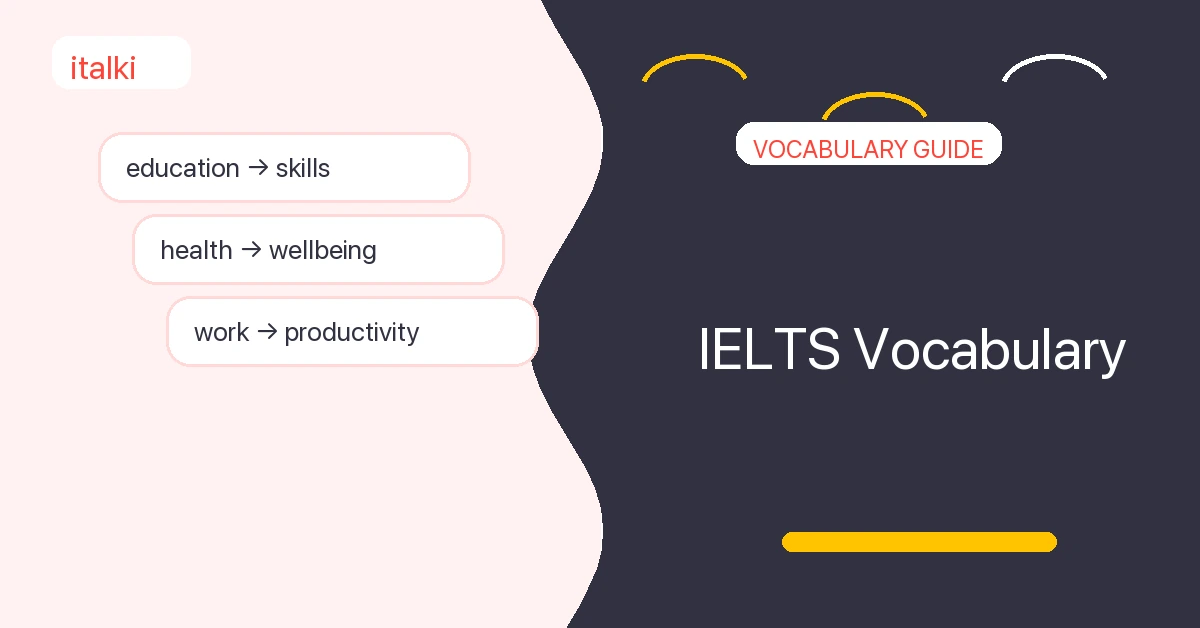
Organise vocabulary by common IELTS topic families: education, work, technology, environment, health, cities, transport, media, culture, and government.
For each topic, learn nouns, verbs, adjectives, collocations, and one example sentence. This builds flexible vocabulary instead of a loose word pile.
| Topic | Useful word types | Example collocations |
|---|---|---|
| Education | policy, access, skills. | higher education, lifelong learning |
| Environment | impact, emissions, conservation. | reduce emissions, protect habitats |
| Work | career, productivity, training. | remote work, professional development |
| Health | prevention, treatment, wellbeing. | public health, mental wellbeing |
| Technology | automation, privacy, innovation. | digital privacy, artificial intelligence |
How do you learn IELTS vocabulary so it appears in answers?
Use vocabulary in full answers, not isolated flashcards. Write one sentence, speak one answer, and correct one mistake for each topic group.
Accuracy matters. A simpler correct word usually scores better than a rare word used awkwardly.
- Write one Task 2 sentence.
- Record one Speaking Part 2 answer.
- Underline weak word choices.
- Replace vague words with precise topic words.
- Review spelling and word forms.
What is a simple weekly IELTS vocabulary plan?
A weekly plan should cover topic grouping, sentence practice, speaking use, and correction. Do not try to memorise hundreds of words in one sitting.
By the end of the week, you should have a small set of words you can use accurately in at least two tasks.
| Day | Task | Output |
|---|---|---|
| 1 | Choose one topic. | 20 useful words and phrases. |
| 2 | Learn collocations. | 10 example sentences. |
| 3 | Write Task 2 sentences. | One paragraph. |
| 4 | Speak about the topic. | Two-minute answer. |
| 5 | Correct errors. | Final word bank. |
What are 100+ IELTS vocabulary words by topic?
A useful IELTS vocabulary list should give you topic words you can actually place inside Writing Task 2 and Speaking answers. The list below includes 100+ words and phrases grouped by common IELTS themes, with example sentences to show usage.
Do not memorise the list as isolated words. Learn the topic, the word or phrase, and the sentence pattern so you can reuse it under exam pressure.
| Topic | IELTS vocabulary | Example sentence |
|---|---|---|
| Education | curriculum | Schools should update the curriculum to include digital skills. |
| Education | literacy | Early literacy programmes can reduce inequality. |
| Education | assessment | Continuous assessment may reflect progress better than one final exam. |
| Education | tuition | High tuition fees can limit access to university. |
| Education | scholarship | A scholarship can help talented students from low-income families. |
| Education | critical thinking | Universities should help students develop critical thinking. |
| Education | vocational training | Vocational training gives learners practical job skills. |
| Education | academic performance | Sleep and stress both affect academic performance. |
| Education | lifelong learning | Lifelong learning is essential in a changing labour market. |
| Education | digital classroom | A digital classroom can support students in remote areas. |
| Education | student engagement | Interactive lessons often improve student engagement. |
| Work and careers | productivity | Flexible schedules can improve productivity. |
| Work and careers | workforce | Automation is changing the skills required in the workforce. |
| Work and careers | remote work | Remote work can reduce commuting time. |
| Work and careers | job security | Many workers value job security more than a higher salary. |
| Work and careers | career progression | Training can support long-term career progression. |
| Work and careers | employee retention | Good management improves employee retention. |
| Work and careers | work-life balance | A healthy work-life balance can reduce burnout. |
| Work and careers | entrepreneurship | Entrepreneurship creates jobs but involves financial risk. |
| Work and careers | professional development | Professional development helps employees adapt. |
| Work and careers | labour market | The labour market increasingly rewards digital skills. |
| Work and careers | minimum wage | A higher minimum wage can improve living standards. |
| Environment | sustainability | Sustainability should guide urban planning. |
| Environment | renewable energy | Renewable energy can reduce dependence on fossil fuels. |
| Environment | carbon emissions | Public transport can help reduce carbon emissions. |
| Environment | biodiversity | Deforestation threatens biodiversity. |
| Environment | conservation | Conservation projects protect endangered species. |
| Environment | climate change | Climate change is affecting food production. |
| Environment | waste management | Better waste management can reduce pollution. |
| Environment | air quality | Traffic restrictions can improve air quality. |
| Environment | environmental impact | Companies should measure their environmental impact. |
| Environment | natural resources | Natural resources must be managed responsibly. |
| Environment | single-use plastic | Bans on single-use plastic can reduce ocean waste. |
| Health | public health | Vaccination campaigns are important for public health. |
| Health | healthcare system | An efficient healthcare system improves life expectancy. |
| Health | preventive care | Preventive care can reduce long-term medical costs. |
| Health | mental health | Work stress can affect mental health. |
| Health | life expectancy | Clean water has increased life expectancy in many regions. |
| Health | obesity | Obesity is linked to diet and physical activity. |
| Health | nutrition | Schools can teach children basic nutrition. |
| Health | sedentary lifestyle | A sedentary lifestyle increases health risks. |
| Health | medical treatment | Access to medical treatment should not depend only on income. |
| Health | health awareness | Health awareness campaigns can change behaviour. |
| Health | infectious disease | Travel can increase the spread of infectious disease. |
| Technology | innovation | Innovation can make public services more efficient. |
| Technology | artificial intelligence | Artificial intelligence is changing many professions. |
| Technology | automation | Automation can replace repetitive tasks. |
| Technology | data privacy | Data privacy is a major concern for internet users. |
| Technology | cybersecurity | Businesses need strong cybersecurity systems. |
| Technology | digital divide | The digital divide limits access to online education. |
| Technology | online learning | Online learning is flexible but requires discipline. |
| Technology | technological advancement | Technological advancement can improve healthcare. |
| Technology | screen time | Excessive screen time may affect sleep. |
| Technology | digital literacy | Digital literacy is now a basic workplace skill. |
| Technology | e-commerce | E-commerce has changed consumer behaviour. |
| Society | inequality | Education can reduce inequality. |
| Society | social mobility | Affordable universities can improve social mobility. |
| Society | community | Community projects can reduce isolation. |
| Society | crime prevention | Youth programmes can support crime prevention. |
| Society | urbanisation | Urbanisation creates pressure on housing and transport. |
| Society | population growth | Population growth increases demand for public services. |
| Society | ageing population | An ageing population requires more healthcare funding. |
| Society | cultural diversity | Cultural diversity can make cities more dynamic. |
| Society | public services | Public services should be accessible to all citizens. |
| Society | standard of living | Stable employment can improve the standard of living. |
| Society | social responsibility | Companies have a social responsibility to local communities. |
| Government and policy | regulation | Regulation can protect consumers from unsafe products. |
| Government and policy | public funding | Public funding is necessary for hospitals and schools. |
| Government and policy | taxation | Taxation pays for essential services. |
| Government and policy | infrastructure | Good infrastructure supports economic growth. |
| Government and policy | law enforcement | Effective law enforcement can improve public safety. |
| Government and policy | policy makers | Policy makers should consider long-term effects. |
| Government and policy | welfare system | A welfare system protects vulnerable citizens. |
| Government and policy | civic participation | Civic participation strengthens democracy. |
| Government and policy | public transport | Investment in public transport can reduce congestion. |
| Government and policy | national security | Governments must balance privacy and national security. |
| Government and policy | bureaucracy | Too much bureaucracy can slow business growth. |
| Economy | economic growth | Education and innovation can support economic growth. |
| Economy | inflation | Inflation reduces purchasing power. |
| Economy | consumer spending | Consumer spending often falls during recessions. |
| Economy | global trade | Global trade gives companies access to larger markets. |
| Economy | investment | Investment in technology can increase efficiency. |
| Economy | poverty | Job creation is one way to reduce poverty. |
| Economy | income gap | The income gap has widened in some countries. |
| Economy | financial stability | Savings can improve household financial stability. |
| Economy | cost of living | The cost of living is rising in many cities. |
| Economy | small business | Small business owners often need better access to credit. |
| Economy | supply chain | Supply chain problems can increase prices. |
| Culture and media | mass media | Mass media can shape public opinion. |
| Culture and media | social media | Social media spreads information quickly. |
| Culture and media | cultural heritage | Museums help preserve cultural heritage. |
| Culture and media | globalisation | Globalisation can spread culture but also reduce local traditions. |
| Culture and media | advertising | Advertising influences consumer choices. |
| Culture and media | entertainment industry | The entertainment industry creates many creative jobs. |
| Culture and media | freedom of expression | Freedom of expression is important in democratic societies. |
| Culture and media | misinformation | Misinformation can damage public trust. |
| Culture and media | cultural identity | Language is part of cultural identity. |
| Culture and media | traditional values | Traditional values can change over time. |
| Culture and media | media literacy | Media literacy helps people evaluate online claims. |
| Travel and cities | tourism | Tourism creates jobs but can damage local environments. |
| Travel and cities | public space | Public space makes cities more liveable. |
| Travel and cities | traffic congestion | Traffic congestion wastes time and fuel. |
| Travel and cities | housing shortage | A housing shortage can push rents higher. |
| Travel and cities | urban planning | Good urban planning improves transport and safety. |
| Travel and cities | commuting | Long commuting times can reduce quality of life. |
| Travel and cities | local economy | Tourism can support the local economy. |
| Travel and cities | overcrowding | Overcrowding is a problem in popular tourist areas. |
| Travel and cities | sustainable tourism | Sustainable tourism protects local communities. |
| Travel and cities | cultural exchange | Travel can encourage cultural exchange. |
| Travel and cities | quality of life | Green spaces can improve quality of life. |
How should you turn IELTS vocabulary into test answers?
Choose one IELTS topic and build ten useful sentences with accurate collocations. Then use those words in one Writing Task 2 paragraph and one Speaking answer.
Vocabulary only helps IELTS when it improves clarity, precision, and natural phrasing inside the answer the examiner actually hears or reads.

Find Your Perfect Teacher
Your language goal does not have to stay abstract. Get personalized lessons from native tutors who can correct real sentences, role-play useful situations, and help you keep a realistic study rhythm.
Book a English trial lesson
FAQs
How much vocabulary is enough for IELTS?
There is no fixed number. You need enough accurate topic vocabulary to answer common speaking and writing tasks clearly.
Should I memorise IELTS word lists?
Use lists as input, but learn words through collocations and example sentences.
What vocabulary topics matter most?
Education, work, environment, health, technology, society, culture, transport, and media are common areas.
How do I avoid unnatural word choice?
Test new words in full answers and ask for correction on collocation and tone.
Want to learn a language at italki?
Here are the best resources for you!