Key takeaways
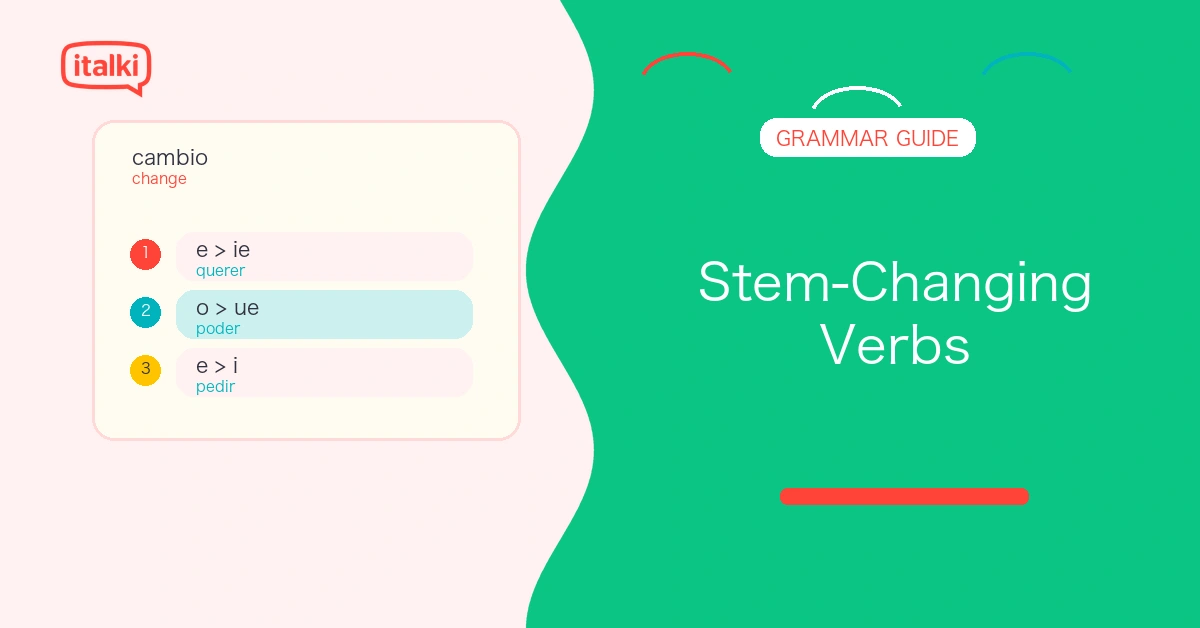
- Stem-changing verbs in Spanish change their stem vowel in specific forms of the present tense. There are three change patterns: e – ie (querer, pensar), o – ue (poder, dormir), and e – i (pedir, servir). A fourth sub-pattern, u – ue, applies to one very common verb: jugar (to play).
- The change follows a boot (el zapato) pattern: the stem change happens in the yo, tú, él/ella/usted, and ellos/ellas/ustedes forms, but NOT in nosotros or vosotros. Visualized on a conjugation grid, these changed forms surround the two unchanged forms, creating a boot shape.
- The infinitive stem does not change: the change only happens in the present indicative (and in some tenses for -ir stem-changing verbs). This means that when you see an infinitive like querer or poder, you cannot tell from the infinitive alone whether or when the stem will change.
- Many of the most-used Spanish verbs are stem-changers: querer (to want), poder (can), pensar (to think), entender (to understand), dormir (to sleep), volver (to return), pedir (to ask for). Learning the boot pattern well means you can conjugate dozens of high-frequency verbs correctly.
Stem-changing verbs are among the most important irregular patterns in Spanish, precisely because so many extremely common verbs follow them. Once you understand the boot pattern and the three change types, conjugating a new stem-changing verb becomes straightforward.
italki connects learners with Spanish tutors who can help you practice these conjugations in real conversation until the changes become instinctive. This guide covers all three patterns with full conjugation tables, the boot visualization, irregular yo forms in some stem-changers, and the most important verbs in each category.
Work with a Spanish tutor to practice stem-changing verbs in real sentences and build conjugation fluency that comes naturally under conversation speed.

Find your perfect teacher
Build real speaking confidence with personalized lessons from a teacher who matches your goals, schedule, and learning style.
Book a trial lesson
What is a stem-changing verb?
In Spanish, most verb conjugation changes happen in the ending (the suffix that attaches to the verb stem). For example, hablar – yo hablo, tú hablas, él habla: the ending changes, but the stem habl- stays the same.
Stem-changing verbs are different: the vowel inside the stem itself changes in certain conjugated forms. The infinitive ending is not affected.
| Infinitive | Stem | Change | Example form |
|---|---|---|---|
| querer | quer- | e – ie | yo quiero (not quero) |
| poder | pod- | o – ue | yo puedo (not podo) |
| pedir | ped- | e – i | yo pido (not pedo) |
The crucial point: the stem only changes in certain forms of the present tense, following the boot pattern described below. The infinitive stem stays unchanged.
The boot (zapato) pattern
Stem-changing verbs follow a consistent pattern sometimes called the boot (el zapato) because when you draw a box around the conjugation grid, the forms that change look like a boot.
Using querer (e – ie) as an example:
| Subject | Form | Changed? |
|---|---|---|
| yo | quiero | YES |
| tú | quieres | YES |
| él/ella/usted | quiere | YES |
| nosotros | queremos | NO |
| vosotros | queréis | NO |
| ellos/ellas/ustedes | quieren | YES |
The four forms that change (yo, tú, él, ellos) form the outer part of a boot shape on the conjugation grid. The two forms that do NOT change (nosotros, vosotros) sit inside the boot.
This pattern applies to ALL stem-changing verbs in the present tense: the stem change never affects nosotros and vosotros forms.
Find your perfect teacher
Build real speaking confidence with personalized lessons from a teacher who matches your goals, schedule, and learning style.
Book a trial lesson
Pattern 1: e – ie verbs
The e in the stem changes to ie in the boot forms.
querer (to want / to love):
| Subject | Conjugation |
|---|---|
| yo | quiero |
| tú | quieres |
| él/ella/usted | quiere |
| nosotros | queremos |
| vosotros | queréis |
| ellos/ellas/ustedes | quieren |
Full conjugation of pensar (to think):
| Subject | Conjugation |
|---|---|
| yo | pienso |
| tú | piensas |
| él/ella/usted | piensa |
| nosotros | pensamos |
| vosotros | pensáis |
| ellos/ellas/ustedes | piensan |
Other important e – ie verbs:
| Infinitive | Meaning | yo form |
|---|---|---|
| pensar | to think | pienso |
| querer | to want / to love | quiero |
| empezar | to begin / to start | empiezo |
| entender | to understand | entiendo |
| preferir | to prefer | prefiero |
| perder | to lose | pierdo |
| cerrar | to close | cierro |
| sentarse | to sit down | me siento |
| despertar | to wake up | me despierto |
| mentir | to lie | miento |
| hervir | to boil | hiervo |
Note that preferir and sentir/sentarse are -ir verbs with e – ie. These also have a stem change in the preterite and subjunctive, discussed in the section on other tenses.
Pattern 2: o – ue verbs (and u – ue)
The o in the stem changes to ue in the boot forms.
poder (to be able / can):
| Subject | Conjugation |
|---|---|
| yo | puedo |
| tú | puedes |
| él/ella/usted | puede |
| nosotros | podemos |
| vosotros | podéis |
| ellos/ellas/ustedes | pueden |
Full conjugation of dormir (to sleep):
| Subject | Conjugation |
|---|---|
| yo | duermo |
| tú | duermes |
| él/ella/usted | duerme |
| nosotros | dormimos |
| vosotros | dormís |
| ellos/ellas/ustedes | duermen |
Other important o – ue verbs:
| Infinitive | Meaning | yo form |
|---|---|---|
| poder | can / to be able | puedo |
| dormir | to sleep | duermo |
| volver | to return | vuelvo |
| encontrar | to find | encuentro |
| recordar | to remember | recuerdo |
| contar | to count / to tell | cuento |
| costar | to cost | cuesta (it costs) |
| mover | to move | muevo |
| morir | to die | muero |
| probar | to try / to taste | pruebo |
| mostrar | to show | muestro |
| soler | to usually do | suelo |
| soñar | to dream | sueño |
The u – ue exception: jugar (to play)
Jugar is unique: the stem vowel u changes to ue in the boot forms. No other common verb follows this pattern.
| Subject | Conjugation |
|---|---|
| yo | juego |
| tú | juegas |
| él/ella/usted | juega |
| nosotros | jugamos |
| vosotros | jugáis |
| ellos/ellas/ustedes | juegan |
Jugar (to play a sport or game) is a high-frequency verb and its conjugation is worth memorizing specifically.
Find your perfect teacher
Build real speaking confidence with personalized lessons from a teacher who matches your goals, schedule, and learning style.
Book a trial lesson
Pattern 3: e – I verbs
The e in the stem changes to i in the boot forms. This pattern occurs only with -ir verbs.
pedir (to ask for / to order):
| Subject | Conjugation |
|---|---|
| yo | pido |
| tú | pides |
| él/ella/usted | pide |
| nosotros | pedimos |
| vosotros | pedís |
| ellos/ellas/ustedes | piden |
Other important e – i verbs:
| Infinitive | Meaning | yo form |
|---|---|---|
| pedir | to ask for / to order | pido |
| seguir | to follow / to continue | sigo |
| repetir | to repeat | repito |
| servir | to serve | sirvo |
| vestirse | to get dressed | me visto |
| reír | to laugh | río |
| sonreír | to smile | sonrío |
| elegir | to choose | elijo |
| conseguir | to get / to achieve | consigo |
| medir | to measure | mido |
Note that seguir and conseguir and elegir have an additional spelling change in the yo form due to spelling rules (the g/j or gu alternation), on top of the stem change.
Stem-changing verbs with irregular yo forms
Some stem-changing verbs also have an irregular yo form that is completely separate from the stem change pattern. These are among the most commonly used verbs in Spanish.
| Infinitive | yo form | Pattern | Regular boot form would be… |
|---|---|---|---|
| tener | tengo | e – ie + irregular yo | teno (does not exist) |
| venir | vengo | e – ie + irregular yo | veno (does not exist) |
| decir | digo | e – i + irregular yo | deso (does not exist) |
| oír | oigo | irregular yo | oo (does not exist) |
For tener and venir, the yo form is irregular (tengo, vengo) but the other boot forms follow e – ie: tienes, tiene, tienen / vienes, viene, vienen.
For a full list of the essential Spanish verbs including these irregular forms, the guide to essential Spanish verbs covers 80 verbs organized by category.
Find your perfect teacher
Build real speaking confidence with personalized lessons from a teacher who matches your goals, schedule, and learning style.
Book a trial lesson
Stem changes in other tenses (-ir verbs)
For -er and -ar stem-changing verbs, the stem change only happens in the present tense. The preterite, imperfect, and subjunctive have no stem change (except for the normal conjugation rules).
For -ir stem-changing verbs, the stem change extends into other tenses:
Preterite: The stem changes in the third person (él/ella/usted and ellos/ellas/ustedes) only.
- dormir: durmió (he slept), durmieron (they slept)
- pedir: pidió (he asked for), pidieron (they asked for)
- preferir: prefirió (he preferred), prefirieron (they preferred)
Present subjunctive: The boot pattern applies, plus nosotros/vosotros have a special stem change.
- dormir: duerma, duermas, duerma, durmamos, durmáis, duerman
This is more advanced grammar, but knowing it exists helps you recognize these verbs when you encounter them in conjugated forms beyond the present tense.
The most important stem-changing verbs to know
If you prioritize these verbs, you will cover the vast majority of stem-changing verb use in everyday conversation:
e – ie (7 priority verbs): querer (to want/love), pensar (to think), entender (to understand), empezar (to start), preferir (to prefer), tener (to have, with irregular yo), venir (to come, with irregular yo)
o – ue (6 priority verbs): poder (can), dormir (to sleep), volver (to return), encontrar (to find), recordar (to remember), costar (to cost)
u – ue (1 verb): jugar (to play)
e – i (4 priority verbs): pedir (to ask for/order), servir (to serve), seguir (to continue), decir* (to say, with irregular yo)
Find your perfect teacher
Build real speaking confidence with personalized lessons from a teacher who matches your goals, schedule, and learning style.
Book a trial lesson
Practice tips
Learn stem-changing verbs in sentences. I want coffee / Quiero café ingrains quiero directly. Memorizing isolated forms is slower than practicing in meaningful phrases.
Say the boot forms aloud. The stem change in Spanish often has a different vowel sound than the base form. Querer (to want) has e; quiero (I want) has ie (sounds like kyeh). Saying these aloud helps your ear recognize and produce the change naturally.
Spot the pattern in new verbs. When you learn a new -ar, -er, or -ir verb, check if it is stem-changing in your dictionary or app. Most resources mark stem-changing verbs with the change in parentheses: querer (ie), poder (ue), pedir (i).
Practice with a tutor
Stem-changing verb conjugations feel manageable in a grammar explanation but often break down under conversation speed. A tutor can give you the live practice to solidify these forms: asking you questions with stem-changing verbs, correcting errors in real time, and helping you develop the automatic recall needed for fluid speech.
italki’s 30,000+ expert tutors include native Spanish speakers who specialize in grammar instruction and conversational fluency. Trusted by over 10 million learners worldwide, the platform lets you find a tutor who can design verb-focused practice sessions around your current level. Book a trial lesson and practice stem-changing verb conjugations in real conversation.
Find your perfect teacher
Build real speaking confidence with personalized lessons from a teacher who matches your goals, schedule, and learning style.
Book a trial lesson
FAQ
What are stem-changing verbs in Spanish?
Stem-changing verbs (also called boot verbs or verbos con cambio de raíz) are verbs in which the vowel in the stem changes in certain present tense forms. The three change patterns are: e – ie (querer, pensar), o – ue (poder, dormir), and e – i (pedir, servir). A fourth pattern, u – ue, applies to jugar (to play).
What is the boot pattern in Spanish verbs?
The boot pattern describes which forms of a stem-changing verb have the vowel change. The change happens in: yo, tú, él/ella/usted, and ellos/ellas/ustedes. It does NOT happen in nosotros or vosotros. On a conjugation grid, the four changed forms surround the two unchanged ones, resembling the outline of a boot.
Do stem-changing verbs change in other tenses?
For -ar and -er stem-changing verbs, the stem change only applies in the present tense. For -ir stem-changing verbs, the change also appears in the preterite (third-person forms only) and the present subjunctive. This makes -ir stem-changing verbs particularly important to master completely.
What is the conjugation of poder in Spanish?
Poder (o – ue) in the present tense: yo puedo, tú puedes, él/ella puede, nosotros podemos, vosotros podéis, ellos/ellas pueden. Note the unchanged nosotros (podemos) and vosotros (podéis) forms.
Why don’t nosotros and vosotros change?
The absence of stem change in nosotros and vosotros is a feature of Spanish phonological history. The boot pattern reflects which syllables were stressed in earlier forms of the language: the stem vowel was stressed in the singular and third-person plural forms, which is where the change occurred, and unstressed in the nosotros/vosotros forms, where it did not. The pattern has remained stable in modern Spanish.
Want to learn a language at italki?
Here are the best resources for you!