Key takeaways:
- Young kids as early as age 3 can start picking up Japanese, and the earlier they start, the easier it tends to feel.
- Talking and listening in Japanese every day counts for far more than any app or workbook.
- Private Japanese lessons with a specialist give kids one-on-one attention that gets real results.
- Short daily practice beats one long weekly session every time.
- Songs, Japanese games, stories, and Japanese videos keep kids interested and help new words stick.
Learning Japanese for kids is far more doable than most parents expect. Children pick up languages naturally, and when the Japanese language is taught the right way, it feels less like a lesson and more like something kids genuinely want to do.
The good news is that the best way to learn Japanese for kids has nothing to do with academic ability or a gift for languages. Kids learn best by hearing words used in real situations, repeating them, and having someone to talk to. That is the whole thing. The method matters far more than any natural talent.
Japanese is one of the most popular second languages for children right now, sitting alongside Spanish and French as a top choice for families who want to give their kids a head start. If your family has Japanese roots, you love Japanese culture, or you want to give your child options later in life, it is a worthwhile choice. Japan has one of the largest economies in the world, and speaking the language opens doors in business, technology, travel, and the arts. World Bank
This guide is written for parents at any stage. If you are just starting to think about Japanese for kids, or you are ready to book your child’s first lesson, you will find what you need here. Japanese classes are available for every age, budget, and learning style, so finding the right fit is easier than you might think.
Find Japanese tutors for kids on italki and book a trial lesson today.

Make Japanese Fun for Your Child
Start Japanese lessons that use games, songs, and stories to keep kids engaged and speaking with confidence.
Book a trial lesson
Why should kids learn Japanese?
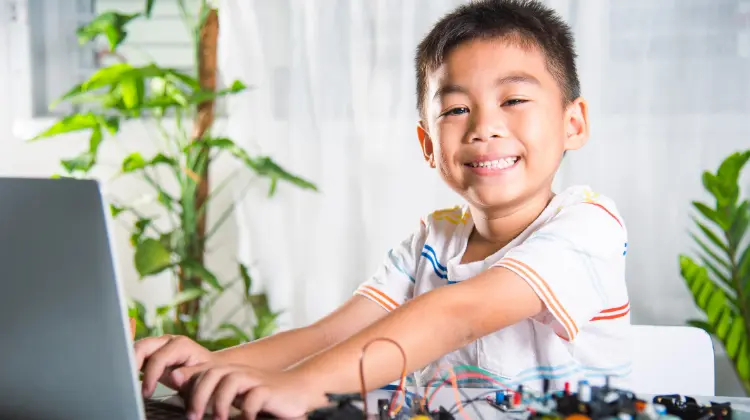
Learning Japanese gives children a real leg up, both at school and further down the line. Here is why so many parents are choosing it as their child’s second language over options like Spanish or French.
It is good for their brain. Bilingual children tend to develop stronger focus, memory, and mental flexibility than children who only speak one language. Language learning from a young age is one of the best things you can do for a child’s development, and the knowledge they build carries into every subject they study. Harvard Graduate School of Education
It brings Japanese culture to life. Japanese culture has a huge following around the world, from anime and manga to food, martial arts, and technology. When kids can speak Japanese, they connect with all of it on a completely different level. They start to understand how Japanese people communicate and express themselves, which no translation fully gets across.
It sets them up for the future. Japan has one of the largest economies in the world, and Japanese speakers are hard to find outside of Japan. Children who grow up with the Japanese language are well placed for careers in tech, business, engineering, and tourism.
It builds real confidence. Being able to speak Japanese, even at a basic level, gives kids access to friendships and experiences that most children never get. Kids who learn languages early also tend to feel more at ease around people from different backgrounds.
It sharpens how they think at school. Japanese has a very different structure from English, and teaching children this language, along with hiragana, katakana, and kanji, trains them to think more carefully. That kind of thinking flows into every other subject they study at school. Teachers consistently report that students who learn a second language perform better across the board.
Want to see the difference for yourself? Book a trial Japanese lesson for kids on italki and let your child give it a go in a relaxed, no-pressure setting.
What is the best age to learn Japanese?
The earlier the better. Most kids do well starting somewhere between ages 3 and 7.
Young children are natural language acquirers, picking up sounds and patterns without the self-consciousness that holds older learners back. Starting before age 10 gives kids the best chance of sounding natural as they get older. British Council
Starting later is still fine. Children aged 8 to 12 pick up Japanese much faster than adults do, especially when it comes to pronunciation and training the ear to catch differences in sound. Even teenagers can reach a high level with regular practice and the right teacher. If you are wondering is Japanese easy to learn, the short answer is that children find it considerably easier than adults do.
The honest truth is that starting age matters less than what happens afterwards. A child who practices for fifteen minutes every day will go much further than one who does one long lesson a week and nothing in between. Consistent Japanese lessons, even just once or twice a week, make a bigger difference to progress than anything else.
Whatever age your child is, italki kids tutors teach at every level. From absolute beginners to kids who already know some basics, you can find teachers who fit your child’s age, pace, and personality.
Start your child’s Japanese journey at any age, find the right tutor today
What is the best way for kids to learn Japanese?
The best way for kids to learn Japanese is through regular conversation with a native-speaking tutor, supported by songs, games, and short daily practice at home.
The approaches that work best all share one thing: they make Japanese feel normal and real, not like extra school work. Good teaching keeps things fun, and fun is what keeps kids coming back. Here are three approaches that genuinely move things forward.
1. Immersion and natural conversation (The most effective approach)
The single best thing you can do for your child is get them talking in Japanese regularly. Not reading about it. Not watching videos passively. Speaking it with someone who responds, gently corrects them, and keeps the conversation going.
Private Japanese lessons with a native speaker who knows how to teach children are the closest thing to being surrounded by the language every day. A good tutor builds interactive lessons around what your child already loves, whether that’s games, animals, cooking, or anime, so Japanese naturally becomes part of real conversation.
This kind of consistent speaking practice builds vocabulary and confidence far faster than sitting in school classes working through textbooks. If you’re curious about why conversation speeds progress, we break it down in our guide on how to learn Japanese fast.
italki makes it easy to find these kinds of teachers. Over 10 million learners worldwide have connected with 30,000+ professional teachers and tutors across 150+ languages, many of them native speakers who specialise in teaching young kids through activities that feel fun and natural rather than classroom-style. italki
You can learn Japanese online with a tutor who fits your family’s schedule, budget, and what your child responds to best. The price of lessons varies to suit different budgets, and many teachers offer a first lesson at a reduced rate so you can find the right fit before committing.
Make Japanese Fun for Your Child
Start Japanese lessons that use games, songs, and stories to keep kids engaged and speaking with confidence.
Book a trial lesson
2. Songs, games, and stories
Kids do not learn well when they are bored, and stories, songs, and games are three of the best ways to keep teaching fun and children engaged. Japanese songs are great for getting pronunciation right because the Japanese language has a musical, regular rhythm that children pick up quickly.
Unlike French or Spanish, where students often rely on textbooks and grammar drills, Japanese songs and games give kids a far more natural route into the language. Japanese games that involve counting, naming things, or listening for instructions help new words and various words from earlier lessons stick without it ever feeling like study.
Stories are equally useful. Children’s stories in Japanese introduce new words in a context that makes sense, which is far more memorable than drilling vocabulary from a list. Reading Japanese children’s books together, even if neither of you can read much yet, gets kids used to hearing the language and seeing the characters on the page.
Japanese children’s books written for preschool age in Japan are a solid starting point for beginners of any age. You do not need to understand every word. Sitting together with a Japanese book sends a clear message to your child that this language is worth their time. As your child’s reading progress grows, you can introduce Japanese books with more words, longer sentences, and kanji alongside furigana.
Japanese videos and animated shows are another easy way to keep the language alive between classes. If your child loves anime, that enthusiasm is a genuine learning tool. Check out this guide on how to learn Japanese with anime for tips on making screen time count. Watching Japanese videos for even fifteen minutes a day helps children get used to how the language sounds at natural speed, which makes speaking feel far less daunting.
3. Short, consistent practice
Children do not need to sit down for an hour to make progress. Fifteen to twenty minutes of Japanese every day will take a child much further than a two-hour session once a week.
The goal is to make Japanese part of normal life rather than something that only happens on lesson days. This kind of informal teaching outside a course is what makes the language stick for children.
Using Japanese greetings in the morning, counting out loud on walks, naming things around the house, or playing a quick Japanese game before bed all keep the language ticking over. Small habits like these add up faster than you would expect, and they make language learning genuinely fun rather than a chore.
Give your child the gift of real conversation. Find a tutor who makes Japanese second nature.
Make Japanese Fun for Your Child
Start Japanese lessons that use games, songs, and stories to keep kids engaged and speaking with confidence.
Book a trial lesson
Best ways to teach kids Japanese at home
You do not need to speak Japanese yourself to support your child’s learning. Teaching Japanese for kids at home does not require fluency. It requires consistency. Here are five practical things parents can do, starting today.
1. Get a Japanese tutor for kids
This is the one thing that makes the biggest difference in learning Japanese for kids. Teaching through one-on-one interaction is simply more efficient than group classes or self-study, because every lesson is shaped around your child.
A good Japanese tutor for kids gives your child regular speaking practice, catches mistakes early, and shapes each lesson around how your child is doing. On italki, you can filter tutors by specialization, availability, and price. Price is transparent, so you can compare teachers and find someone who fits your budget. Many offer a trial lesson at a reduced rate, so your child gets to find someone they enjoy learning with before committing to a full course.
Not sure where to start? This guide on where to learn Japanese covers your options clearly.
Make Japanese Fun for Your Child
Start Japanese lessons that use games, songs, and stories to keep kids engaged and speaking with confidence.
Book a trial lesson
2. Add Japanese apps and games to the mix
A good language learning app turns Japanese vocabulary and basic phrases into something that feels more like play than a lesson. The best ones are far more engaging than traditional textbooks, using games and interactive activities to make practicing hiragana or picking up new vocabulary feel natural and fun between classes.
Most Japanese learning apps also let parents track progress over time, so you can see vocabulary and reading developing week by week. That said, apps to learn Japanese work best as a complement to formal Japanese lessons rather than a replacement for them. Used alongside regular classes, they keep the language alive on the days your child isn’t with a tutor, and the difference in vocabulary retention shows up quickly.
For a broader look at tools that work, see a roundup of the best Japanese learning resources.
3. Watch Japanese videos and shows together
Putting on Japanese videos is one of the simplest things you can do at home. Shows like Domo-kun, Shirokuma Cafe, and Doraemon are made for young audiences and are genuinely entertaining.
Turning Japanese subtitles on rather than English helps children start connecting what they hear with what the words look like written down. Even fifteen minutes of Japanese videos a day makes a noticeable difference to listening and reading over a few months. It is an easy way to study Japanese without it feeling like studying at all.
You can track your child’s progress simply by noticing how many words they recognise without help. Many parents use video time as a way to write Japanese characters on a whiteboard alongside what their child hears, turning it into a mini lesson.
4. Read Japanese books together
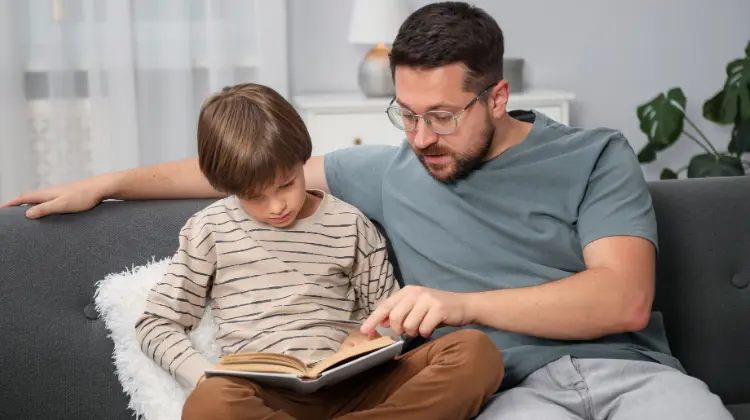
Japanese children’s books are one of the best resources for building vocabulary and getting comfortable with the script. Start with bilingual editions or simple picture books. Stories told in Japanese children’s books are full of repeated phrases and everyday vocabulary, which makes them one of the most natural teaching tools available.
As your child’s reading grows, you can introduce more complex sentences and kanji alongside furigana, which are the small hiragana characters above kanji that show the reading. Sitting down with a Japanese book together makes the whole thing feel like quality time rather than a lesson. Good teachers often recommend practice writing hiragana alongside reading, as the two skills reinforce each other.
5. Speak simple Japanese at home
You do not need to be fluent to make a difference. A child’s native language is always their comfort zone, so giving Japanese greetings a regular place at home helps them step out of it in a low-key, natural way.
Learning phrases like konnichiwa (hello), arigatou (thank you), and oyasumi (goodnight), and using them consistently between Japanese lessons reinforces what your child picks up in class. Kids find it fun when parents give it a go alongside them. It also shows your child that Japanese is a real, living language, not something that only exists in a classroom or on a screen.
For Japanese kids growing up outside Japan, this kind of home practice is especially valuable for keeping the language alive between lessons and classes.
Give your child the opportunity to learn Japanese faster with personal guidance from expert Japanese tutors trusted by over 10 million learners worldwide. Book a trial lesson today.
Give Your Child the Gift of Bilingualism
Fun, interactive lessons with friendly tutors help your child gain confidence, speak naturally, and fall in love with Japanese!
Book a trial lesson
FAQ
How do kids learn Japanese fast?
The fastest route is daily speaking practice combined with Japanese classes for kids from a good tutor. Talking with a native Japanese speaker regularly moves things forward far more than apps or self-study, because feedback is immediate and each lesson targets what your child specifically needs to work on.
How to learn Japanese for kids free
There are some solid free resources to get started with. YouTube has beginner-friendly Japanese channels aimed at new learners, and several websites offer free structured courses built specifically for people starting from scratch. Japanese children’s shows and songs on YouTube are also genuinely useful for getting an ear for the language early on.
For a full breakdown of what is out there, see italki’s guide to the best Japanese learning websites.
What age is best to start Japanese lessons for kids?
Before the age of 10 is the best window for learning Japanese for kids, but children of any age make real progress with the right support. Young kids in that range pick up pronunciation and sentence patterns without thinking much about it.
Is Japanese hard for kids to learn?
No, Japanese is not hard for kids to learn, and children pick it up far more naturally than adults do. Spoken Japanese has a regular, consistent sound system that young children absorb without much effort. The writing systems, hiragana, katakana, and kanji, do take time, but most teachers and beginner classes start with speaking and listening.
Do kids need to learn hiragana and kanji?
Not right away. For beginners, speaking and listening always come first. Good teaching of Japanese for kids follows that order. Hiragana is usually introduced first because it covers every sound in the Japanese language and appears throughout children’s books and learning resources. Katakana follows, and then kanji as the child’s reading grows.
Want to learn a language at italki?
Here are the best resources for you!