Key takeaways
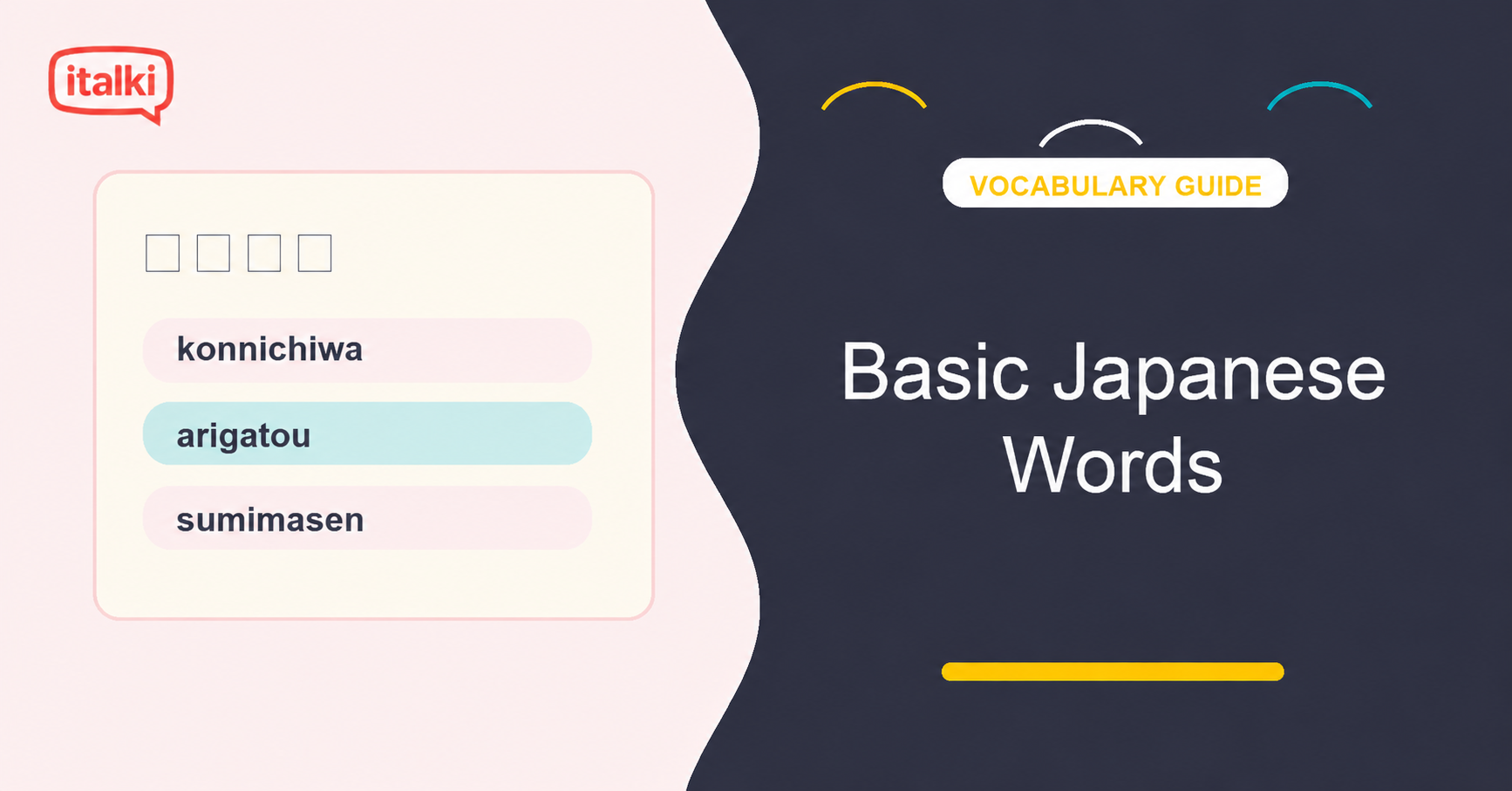
- The most useful basic Japanese words are survival phrases: はい (yes), いいえ (no), すみません (excuse me), ありがとうございます (thank you), お願いします (please), and わかりません (I do not understand).
- Politeness shapes every word choice from the start. です, ます, and ございます signal respect and make beginner speech sound appropriate in every social setting.
- Learn words inside short exchanges, not as isolated flashcards. A phrase like これをください (this, please) teaches vocabulary, grammar, and social context at once.
- Practicing pitch accent and politeness shifts with a Japanese tutor catches errors that word lists and apps cannot detect.
Basic Japanese words give beginners the phrases needed for greetings, thanks, requests, food orders, directions, and simple self-introductions, but self-study tools rarely catch a flat pitch accent or the wrong politeness level before it becomes a habit.
Start with はい (hai, yes), すみません (sumimasen, excuse me), ありがとうございます (arigatō gozaimasu, thank you), お願いします (onegai shimasu, please), and わかりません (wakarimasen, I do not understand), since these words appear in nearly every daily interaction in Japan.
italki connects learners with 30,000+ teachers across 150+ languages and has helped over 10 million people get live pronunciation correction on exactly these first words.
Practice greetings, polite phrases, and survival Japanese out loud with a Japanese tutor before using them in real conversations.

Find Your Perfect Teacher
Practice basic japanese words with a Japanese tutor who can correct pronunciation, phrasing, listening speed, and natural replies in real time.

What basic Japanese words should beginners learn first?
The best basic Japanese words keep a conversation going even when everything else breaks down: yes, no, excuse me, please, thank you, and I do not understand. These words work in shops, train stations, restaurants, and first meetings.
| Japanese | Romaji | English | When to say it |
|---|---|---|---|
| はい | hai | yes | Answering yes, confirming |
| いいえ | iie | no | Answering no politely |
| すみません | sumimasen | excuse me, sorry | Getting attention, light apologies |
| ありがとうございます | arigatō gozaimasu | thank you very much | Polite thanks to staff, teachers, strangers |
| お願いします | onegai shimasu | please | Requests, ordering, asking a favor |
| ください | kudasai | please give me | Ordering or asking for a specific item |
| 大丈夫です | daijōbu desu | it is okay, no thank you | Declining politely, reassuring someone |
| わかりません | wakarimasen | I do not understand | When speech is too fast or unclear |
| もう一度お願いします | mō ichido onegai shimasu | one more time, please | Asking someone to repeat |
Notice how すみません works as “excuse me,” “sorry,” and even “thank you” depending on context. That flexibility is why it ranks among the most frequent words in spoken Japanese. Two patterns make these words productive immediately: すみません plus a request (すみません、もう一度お願いします, “excuse me, one more time please”), and noun plus お願いします (コーヒーお願いします, “coffee, please”).
Every word in this table sits at the JLPT N5 vocabulary level, the most foundational tier, so prioritizing it gives beginners the highest return per word studied.
How do Japanese scripts affect basic words?
Japanese uses three scripts at once, so the same word can look different depending on where you read it: ありがとう on a textbook page, アリガトウ on a sign, 有難う in a formal letter.
Hiragana carries native Japanese words and grammatical particles. It is the first script to learn since it represents every sound in Japanese with 46 base characters. ありがとう, すみません, and ください all appear in hiragana, and reading Japanese hiragana early builds faster word recognition than relying on romaji alone.
Katakana appears in loanwords, menus, and station signs. コーヒー (kōhī, coffee), タクシー (takushī, taxi), and ホテル (hoteru, hotel) are katakana words you will see on day one. Japanese katakana becomes practical as soon as you need to read a menu.
Kanji gives meaning at a glance: 駅 (station), 水 (water), 人 (person), 出口 (exit). Beginners do not need hundreds of kanji right away, but recognizing 10 to 15 high-frequency characters makes signs and receipts far less intimidating.
A practical approach: learn your first 20 words in spoken form and hiragana, add katakana for loanwords, and pick up kanji one sign at a time.
Find Your Perfect Teacher
Practice basic japanese words with a Japanese tutor who can correct pronunciation, phrasing, listening speed, and natural replies in real time.
Which Japanese greetings change by time and relationship?
Japanese greetings shift based on time of day, familiarity, and social context. Beginners should learn the polite forms first because they work safely in every situation.
| Japanese | Romaji | English | When to use it |
|---|---|---|---|
| おはようございます | ohayō gozaimasu | good morning | Polite, before roughly noon |
| こんにちは | konnichiwa | hello, good afternoon | Neutral, safe for anyone during the day |
| こんばんは | konbanwa | good evening | Neutral, from late afternoon onward |
| おやすみなさい | oyasumi nasai | good night | Polite, when parting for the night |
| さようなら | sayōnara | goodbye | Formal or semi-final feeling |
| じゃあね | jā ne | see you | Casual, among friends |
| 失礼します | shitsurei shimasu | excuse me, pardon | Entering or leaving a room, office, or meeting politely |
A common mistake is using さようなら for every goodbye. It carries weight and sounds final or formal. For daily goodbyes among friends, じゃあね sounds more natural, and 失礼します is the standard exit phrase at work or school.
The standard first-meeting sequence appears in every Japanese textbook: はじめまして (hajimemashite, nice to meet you), then [name] です ([name] desu, this is [name]), then よろしくお願いします (yoroshiku onegai shimasu). The last phrase does not translate neatly into English; it means something close to “I look forward to working with you,” and its pitch and delivery carry social meaning a translation misses. The full list of Japanese greetings adds classroom, workplace, and seasonal greeting situations beyond the basics here.
How does politeness work in beginner Japanese?
Politeness in Japanese is built into verb forms, sentence endings, and word choices from the ground up, not added on at the end of a sentence. Beginners who use です (desu) and ます (masu) forms from day one sound respectful without memorizing complex grammar.
です turns a noun phrase into a polite statement: 学生です means “I am a student,” appropriate for strangers and teachers. ます makes verbs polite: 行く (iku, to go) becomes 行きます (ikimasu), and beginners should default to ます until they develop a feel for when plain form is socially safe.
すみません serves three roles: getting attention, softening a mild apology, and even expressing gratitude for an unexpected favor. Tone and facial expression signal which meaning you intend.
ありがとう works with friends, while ありがとうございます is safer with shop staff, teachers, strangers, and anyone you do not know well. The longer form is never wrong; the short form with the wrong person sounds blunt. A short restaurant exchange shows the pieces together: すみません (excuse me), メニューをお願いします (the menu, please), ありがとうございます (thank you very much).
Choosing between ありがとう and ありがとうございます based on who is in front of you requires judgment that only forms through real exchanges. This register shifting is one of the hardest things for self-study learners to develop, because apps and textbooks do not react to mismatched politeness the way a Japanese language teacher does.
Which question words and pronouns build real sentences?
Question words and pronouns turn vocabulary into actual communication. Japanese sorts “this,” “that,” and “that over there” by distance: これ (kore, near the speaker), それ (sore, near the listener), あれ (are, away from both). これは何ですか means “What is this?” and それをください means “That one, please.”
| Japanese | Romaji | English | Example sentence |
|---|---|---|---|
| 何 | nani / nan | what | これは何ですか (What is this?) |
| どこ | doko | where | 駅はどこですか (Where is the station?) |
| いつ | itsu | when | いつですか (When is it?) |
| 誰 | dare | who | 誰ですか (Who is it?) |
| いくら | ikura | how much | いくらですか (How much is it?) |
The question particle か (ka) turns any です statement into a question with no word order change: 駅です means “It is the station,” and 駅ですか means “Is it the station?”
Japanese drops pronouns frequently. 私 (watashi, I) is stated once at the start of a conversation, then omitted once context makes the subject obvious, since overusing it sounds redundant. あなた (anata, you) is even more restricted and can sound distant or rude, so use the person’s name plus さん instead in almost every case. The full set of Japanese honorifics explains when to use さん, さま, くん, and ちゃん.
Find Your Perfect Teacher
Practice basic japanese words with a Japanese tutor who can correct pronunciation, phrasing, listening speed, and natural replies in real time.
What should beginners say in restaurants, cafés, and shops?
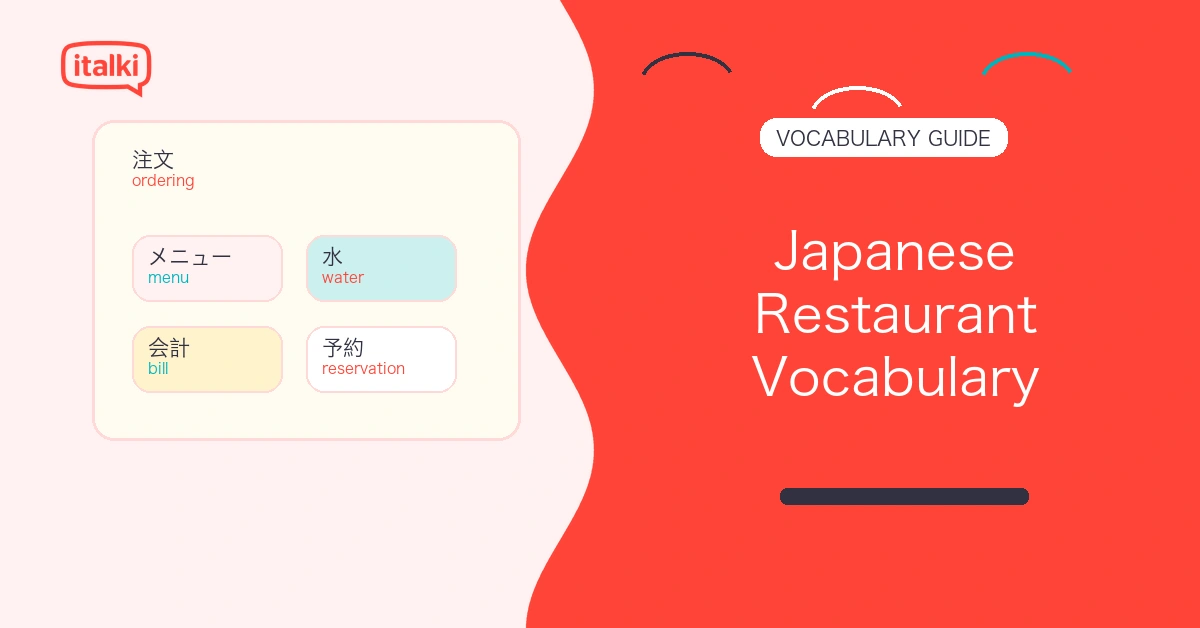
Ordering food and paying are often the first real Japanese conversations beginners have. Useful early vocabulary: 水 (mizu, water), コーヒー (kōhī, coffee), ご飯 (gohan, rice or meal), ラーメン (rāmen, ramen).
Ordering follows one structure: item plus をください or をお願いします. これをください (this, please) sounds direct, while ラーメンをお願いします (ramen, please) sounds softer, and both work in any restaurant. For paying, いくらですか (how much is it?) and カードでお願いします (by card, please) cover most situations. Japanese numbers covers counting and prices for these moments.
Convenience stores often ask questions beginners do not expect, such as 袋は要りますか (fukuro wa irimasu ka, do you need a bag?), and 大丈夫です (daijōbu desu, no thank you) works as a polite decline. The article on how to order food in Japanese walks through menu reading and dietary restriction phrases in more depth, and these exchanges are ideal for a first lesson with an Japanese language tutor, since the patterns are short enough to memorize in one session but realistic enough to use the next day.
Which travel and direction words help in Japan?
Travel Japanese focuses on stations, directions, and asking for help, where short clear phrases work better than complex sentences when you are lost or in a hurry. Location words: 駅 (eki, station), タクシー (takushī, taxi), トイレ (toire, restroom), 出口 (deguchi, exit). Direction words: 右 (migi, right), 左 (hidari, left), まっすぐ (massugu, straight ahead).
One pattern, [place] はどこですか, covers most navigation needs: 駅はどこですか (where is the station?), トイレはどこですか (where is the restroom?). For emergencies, 助けてください (tasukete kudasai, please help me) and 病院はどこですか (where is the hospital?) are worth memorizing before you need them.
Learning basic Japanese for travel adds airport check-in, hotel check-in, and emergency phrases for trip planning.
How should beginners practice basic Japanese words?
Memorizing a word list is not the same as producing those words when someone speaks to you. Flashcards teach recognition, but spoken Japanese demands producing the right phrase at the right moment, with the correct pitch and politeness level, and that skill only comes from speaking aloud.
Japanese pitch accent adds another layer flashcards ignore: 箸 (hashi) with a high-low pitch means “chopsticks,” while 橋 (hashi) with a low-high pitch means “bridge,” same sounds, different meaning, invisible on a flashcard.
A simple weekly structure works well: one day on greetings and their pitch, one on すみません and ありがとうございます across scenarios, one on ordering, one on question words, one on directions, one on self-introductions, and a final day combining a greeting, an order, and a goodbye into one short role-play.
Two pronunciation traps change meaning entirely. Long vowels matter: おばさん (obasan, aunt) versus おばあさん (obāsan, grandmother). Double consonants matter too: まっすぐ (massugu, straight) needs a brief pause before す, the same way きって (kitte, stamp) and きて (kite, come) differ only by that stop. Recording yourself and comparing the rhythm against a teacher’s pronunciation catches these traps before they become habits.
Start speaking basic Japanese words with confidence
Basic Japanese words become useful when you say them to a real person: greeting a teacher, thanking restaurant staff, or checking a price. A vocabulary list gives you the raw material, but spoken practice trains your ear, your timing, and your instinct for choosing the right politeness level.
Japanese pronunciation mistakes carry real social consequences. Flattening the pitch on ありがとうございます sounds robotic, and shortening おばあさん into おばさん changes who you are referring to. A teacher who speaks Japanese natively catches these in real time, before they become habits.
With 30,000+ teachers across 150+ languages, italki gives beginners looking for a Japanese teacher who focuses on pitch accent or N5 vocabulary enough options to find a specific match. Book a trial lesson and test whether speaking these words to a real person feels different from reading them on a screen.
Find Your Perfect Teacher
Practice basic japanese words with a Japanese tutor who can correct pronunciation, phrasing, listening speed, and natural replies in real time.
FAQ
What are the most basic Japanese words to learn first?
Start with はい (yes), いいえ (no), すみません (excuse me), ありがとうございます (thank you), お願いします (please), ください (please give me), and わかりません (I do not understand). These cover greetings, requests, and moments of confusion across nearly every daily situation.
Should beginners learn Japanese words in hiragana or romaji?
Use romaji only as a short-term aid during the first week or two, then move basic words into hiragana early. Words like ありがとう and すみません appear so often that reading them in hiragana builds automatic recognition for real signs and menus.
What does すみません mean in Japanese?
すみません means “excuse me,” “sorry,” or sometimes “thank you for the trouble,” depending on tone and context. It works for getting attention, softening mild apologies, and expressing gratitude.
How is Japanese politeness different from English?
English politeness mainly uses words like “please” and “thank you.” Japanese politeness is built into verb forms, sentence endings, and word choices, so the register you pick matters more than the individual words.
How many basic Japanese words does a beginner need?
A practical starting set is 50 to 100 words covering greetings, requests, food, numbers, and question words. Depth matters more than quantity: knowing 30 words well enough to produce in live conversation beats recognizing 200 on a flashcard.
Want to learn a language at italki?
Here are the best resources for you!