Key takeaways
- 花 (hana) means “flower,” while お花 (ohana) sounds softer and more polite in everyday Japanese.
- Common flower words help with travel, captions, small talk, gift shopping, and seasonal signs in Japan.
- A few flower words need care in gifts, especially 菊 (kiku, chrysanthemum), 椿 (tsubaki, camellia), and 彼岸花 (higanbana, red spider lily).
- Practicing with a Japanese tutor helps you say flower names clearly and choose phrases that fit the season or occasion.
If you search for flowers in Japanese, you probably want the usable basics first: how to say 花 (hana), how to pronounce 桜 (sakura), which words appear on signs or in captions, and what to say in a flower shop.
Flower names can be tricky because the kanji often look dense and the same word can feel different in a gift, a travel photo, or seasonal small talk. A online Japanese teacher can help you practice the pronunciation and test simple real-life lines like “What is this flower?” or “Is this okay as a gift?”

Find Your Perfect Teacher
Practice flowers in japanese with a Japanese tutor who can correct pronunciation, phrasing, listening speed, and natural replies in real time.

What is “flower” in Japanese?
The basic word for “flower” in Japanese is 花 (hana). In everyday speech, お花 (ohana) sounds gentler and more polite, especially when talking about flowers in a shop, garden, or classroom.
| Japanese | Pronunciation | Meaning |
|---|---|---|
| 花 | hana | flower |
| お花 | ohana | flower, polite or soft form |
| 花屋 | hanaya | flower shop, florist |
| 花束 | hanataba | bouquet |
| 花瓶 | kabin | vase |
| 花びら | hanabira | petal |
| 満開 | mankai | full bloom |
| 散る | chiru | to fall, to scatter (often petals) |
花 also appears in 花見 (hanami, “flower viewing”). In modern Japanese, 花見 almost always means cherry blossom viewing specifically. 週末、花見に行きます (Shūmatsu, hanami ni ikimasu) means “This weekend, going cherry blossom viewing.”
One early pronunciation trap: 花 (hana, flower) and 鼻 (hana, nose) are homophones. Context resolves the ambiguity. In きれいな花 (kirei na hana, “beautiful flower”), the adjective removes all doubt, but hearing both words in sentences from a native speaker is more reliable than memorizing a pitch rule alone.
What are the most common flowers in Japanese?
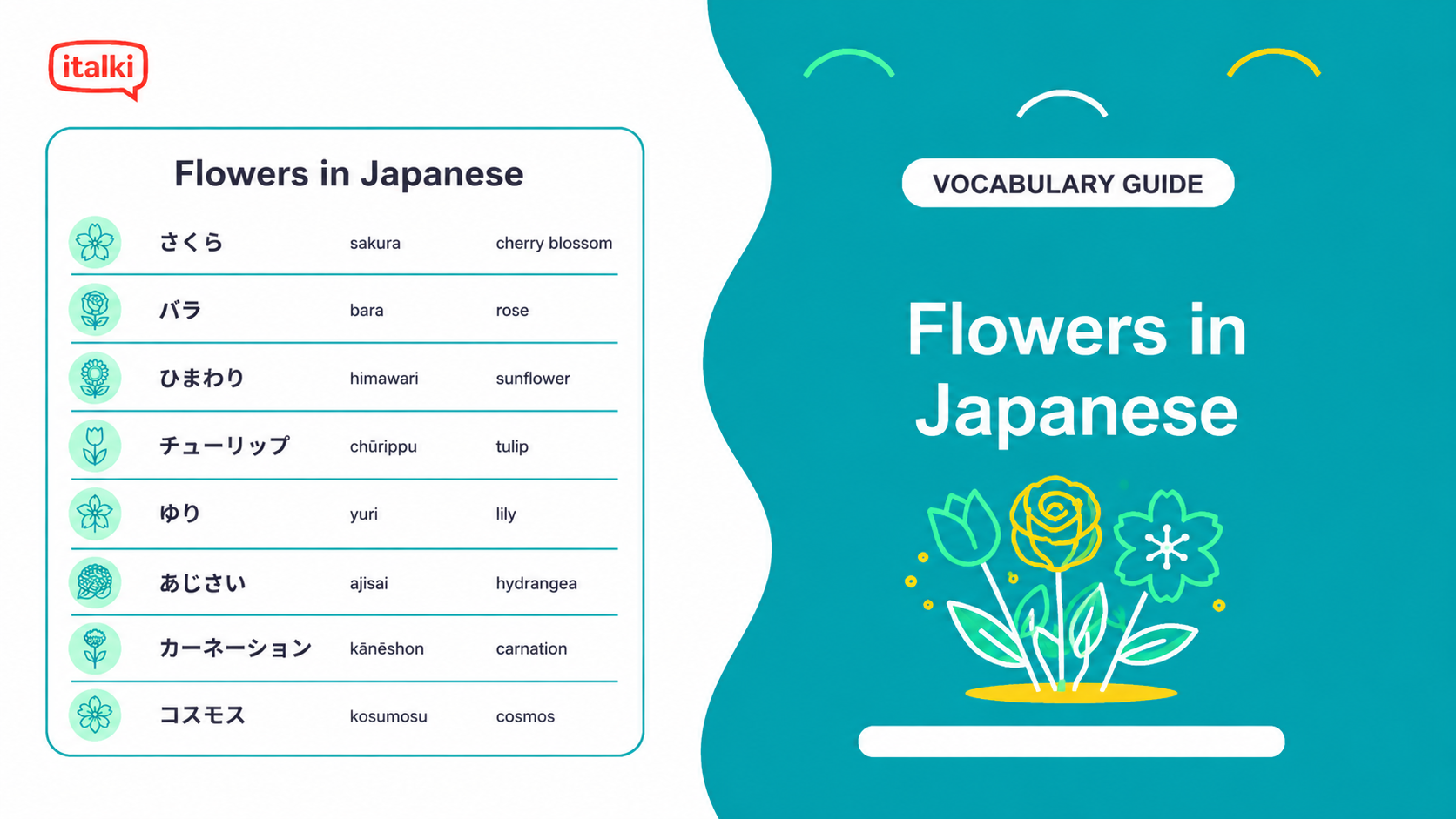
The most useful flowers in Japanese are the ones that appear in seasons, gifts, gardens, anime, and everyday conversation. Start with these before learning rare botanical terms.
| English | Japanese | Pronunciation | Use it for |
|---|---|---|---|
| Cherry blossom | 桜 | sakura | spring travel, photos, small talk |
| Plum blossom | 梅 | ume | early-spring scenery |
| Chrysanthemum | 菊 | kiku | autumn displays, cautious gift use |
| Camellia | 椿 | tsubaki | winter scenery, cautious gift use |
| Wisteria | 藤 | fuji | gardens, parks, photos |
| Hydrangea | 紫陽花 | ajisai | rainy-season scenery |
| Lotus | 蓮 | hasu | ponds, gardens, photos |
| Sunflower | 向日葵 | himawari | summer scenery |
| Iris | 菖蒲 | shōbu | parks, gardens, signs |
| Red spider lily | 彼岸花 | higanbana | autumn scenery, not cheerful gifts |
| Rose | バラ | bara | flower shops, romantic gifts |
| Tulip | チューリップ | chūrippu | spring flowers, casual gifts |
| Carnation | カーネーション | kānēshon | Mother’s Day gifts |
Start with the words you are most likely to say or read. 桜, 紫陽花, バラ, and カーネーション are especially useful for travel photos, flower shops, cards, and everyday conversation.
Notice the writing pattern: older flowers often use dense kanji (紫陽花, 彼岸花, 向日葵), while imported or modern flowers often appear in katakana (バラ, コスモス, カーネーション). This helps when reading signs, labels, and gift tags. Learners building Japanese kanji skills can also look for the grass radical 艹 at the top of many plant-related characters.
Find Your Perfect Teacher
Practice flowers in japanese with a Japanese tutor who can correct pronunciation, phrasing, listening speed, and natural replies in real time.
Which flower words should learners use carefully?
Some flower names are easy to learn but harder to use well. For learners, the practical question is: “Can I use this word safely in this situation?”
| Flower | Learner note | Safer phrase |
|---|---|---|
| 桜 (sakura) | Easy and safe for spring photos, trips, and small talk | 桜がきれいですね |
| 紫陽花 (ajisai) | Useful in rainy-season travel captions | 紫陽花がきれいですね |
| 菊 (kiku) | Be careful with white chrysanthemums as gifts | 誕生日用の花束をお願いします |
| 椿 (tsubaki) | Avoid for hospital gifts unless a florist says it is appropriate | お見舞い用です |
| 彼岸花 (higanbana) | Better for scenery than cheerful gifts | この花は何ですか |
| バラ (bara) | Red roses can sound romantic | 赤いバラをお願いします |
Reading a list only gets you partway. The real learner question is: “Can I say this naturally, and is it okay for this situation?” Working through gift, message, and travel-photo examples with an Japanese tutor for flowers in japanese turns flower vocabulary into something you can actually use.
Which flowers in Japanese are tied to seasons?
Some flower words are seasonal, so they are useful for travel photos, weather talk, and casual comments.
| Season | Flower | Pronunciation | Useful sentence |
|---|---|---|---|
| Late winter to early spring | 梅 | ume | 梅が咲いています |
| Spring | 桜 | sakura | 桜が咲きました |
| Late spring | 藤 | fuji | 藤がきれいですね |
| Rainy season (June-July) | 紫陽花 | ajisai | 紫陽花がきれいですね |
| Summer | 向日葵 | himawari | 向日葵が咲いています |
| Autumn | 菊 | kiku | 菊がたくさんあります |
| Winter to early spring | 椿 | tsubaki | 椿が咲いています |
After learning core Japanese greetings, add one seasonal flower line to make small talk sound warmer. 桜が咲きましたね (Sakura ga sakimashita ne, “The cherry blossoms have bloomed, haven’t they?”) works well in spring. 紫陽花がきれいですね (Ajisai ga kirei desu ne, “The hydrangeas are beautiful, aren’t they?”) works during the rainy season.
Which Japanese flowers are tricky for gifts?
Some Japanese flower words are safe in conversation but need care when buying gifts. The setting matters: birthday, hospital visit, romantic gift, or family event.
| Flower | Gift caution | Better use |
|---|---|---|
| 菊 (kiku) | White chrysanthemums can feel wrong for birthdays | Ask the florist for 誕生日用 |
| 椿 (tsubaki) | Often avoided for hospital visits | Ask for お見舞い用の花 |
| 彼岸花 (higanbana) | Not a cheerful gift flower | Use for scenery, not gifts |
| 赤いバラ (akai bara) | Red roses carry clear romantic weight | Use only with romantic intent |
Here are useful phrases at a flower shop:
- プレゼント用です (Purezento-yō desu), “It’s for a gift.”
- お見舞い用です (Omimai-yō desu), “It’s for a hospital visit.”
- 誕生日用の花束をお願いします (Tanjōbi-yō no hanataba o onegai shimasu), “A birthday bouquet, please.”
- 明るい色でお願いします (Akarui iro de onegai shimasu), “Bright colors, please.”
Flower shops are a good place to practice before you travel because the phrases are short but the situation is easy to mix up. A private Japanese teacher can role-play a florist visit and catch problems like confusing お見舞い (omimai, hospital visit) with お祝い (oiwai, celebration).
Find Your Perfect Teacher
Practice flowers in japanese with a Japanese tutor who can correct pronunciation, phrasing, listening speed, and natural replies in real time.
How do you talk about flowers in Japanese sentences?
The most useful flower verbs are 咲く (saku, to bloom), 散る (chiru, to fall or scatter), and 飾る (kazaru, to decorate). Building sentences around these three verbs covers most of what learners need for travel, captions, and polite conversation.
| Japanese sentence | Pronunciation | English |
|---|---|---|
| 桜が咲きました。 | Sakura ga sakimashita. | The cherry blossoms have bloomed. |
| 花びらが散っています。 | Hanabira ga chitte imasu. | The petals are scattering. |
| 紫陽花が雨に濡れています。 | Ajisai ga ame ni nurete imasu. | The hydrangeas are wet from the rain. |
| 玄関に花を飾りました。 | Genkan ni hana o kazarimashita. | Placed flowers by the entrance. |
| この花は何ですか。 | Kono hana wa nan desu ka. | What is this flower? |
For color descriptions, put the color adjective before the flower name: 赤い花 (akai hana, red flower), 白い菊 (shiroi kiku, white chrysanthemum), 青い紫陽花 (aoi ajisai, blue hydrangea). Notice the grammar difference: い-adjectives (赤い, 白い) attach directly, while katakana color words use の (ピンクの桜, pinku no sakura, pink cherry blossoms). Flower descriptions are a memorable way to internalize this pattern because the visual image helps the grammar stick.
For bloom stages during 桜 season, Japanese has specific vocabulary that appears on weather reports and sakura forecast maps every spring:
- つぼみ (tsubomi), bud
- 五分咲き (gobuzaki), half bloom
- 満開 (mankai), full bloom
- 葉桜 (hazakura), cherry trees after petals fall and leaves appear
Hearing a speaker say 満開です (mankai desu, “full bloom”) on a forecast is a real listening comprehension moment that flashcards alone do not prepare a learner for.
Put flower vocabulary to use
Flower names become useful when you can say them, recognize them, and use them in the right moment. Start with 花, 桜, 梅, 菊, バラ, and 紫陽花. Then add one sentence for each: “The cherry blossoms have bloomed,” “What is this flower?”, or “Is this okay as a gift?”
A teacher helps with the part flashcards miss: pronunciation, timing, and social fit. Choose a Japanese conversation tutor and practice flower names through real tasks: describing a travel photo, choosing a bouquet, writing a short card, or making seasonal small talk.
Find Your Perfect Teacher
Practice flowers in japanese with a Japanese tutor who can correct pronunciation, phrasing, listening speed, and natural replies in real time.
FAQ
What is the Japanese word for flower?
The Japanese word for flower is 花 (hana). お花 (ohana) is a softer, more polite version often used in daily conversation, shops, and classrooms.
What does sakura mean in Japanese?
桜 (sakura) means cherry blossom. Learners use it in spring phrases such as 桜が咲きました (Sakura ga sakimashita, “The cherry blossoms have bloomed”).
Which Japanese flower words are risky as gifts?
Be careful with 菊 (kiku), 椿 (tsubaki), and 彼岸花 (higanbana) in gift situations. If you are buying flowers, say the occasion clearly, such as 誕生日用です (for a birthday) or お見舞い用です (for a hospital visit).
Which flower in Japanese means death or farewell?
彼岸花 (higanbana), the red spider lily, is not a cheerful gift flower. Learn it for reading, photos, and scenery, not for bouquets.
What flower should beginners learn first in Japanese?
Start with 花 (hana), 桜 (sakura), 梅 (ume), 菊 (kiku), バラ (bara), and 紫陽花 (ajisai). These six are useful for signs, gifts, travel photos, and simple conversation.
Want to learn a language at italki?
Here are the best resources for you!