Key takeaways
- Common fruits in Japanese split between native words like りんご (ringo, apple) and katakana loanwords like バナナ (banana, banana), and the script tells you about the word’s origin.
- The counter 個 (ko) covers buying individual fruits, while パック (pakku) handles the strawberry packs and blueberry containers stacked in every Japanese supermarket.
- Long vowels change meaning and mark careful speech: ぶどう (budō, grapes) with a held final vowel sounds correct, while a clipped ぶど sounds wrong.
- Practicing fruit shopping role-plays with a Japanese tutor turns a word list into sentences you use at a depachika counter or konbini checkout.
Japan treats fruit differently than most countries. Strawberry varieties carry brand names like あまおう (amaō, a premium Fukuoka strawberry). Seasonal fruit rotates through convenience stores and school lunches on a strict calendar.
Learning fruits in Japanese means learning the words, the scripts, the counting system, and the cultural weight behind something as simple as a peach.
italki has helped 10M+ learners find the right teacher for exactly this kind of challenge, because pronouncing グレープフルーツ (gurēpufurūtsu, grapefruit) correctly or choosing the right counter at a fruit stand is the kind of thing a real person catches and an app does not.
Search for a Japanese teacher and start turning vocabulary into real spoken practice.

Find Your Perfect Teacher
Build real speaking confidence with personalized lessons from a teacher who matches your goals, schedule, and learning style.

What are the most common fruits in Japanese?
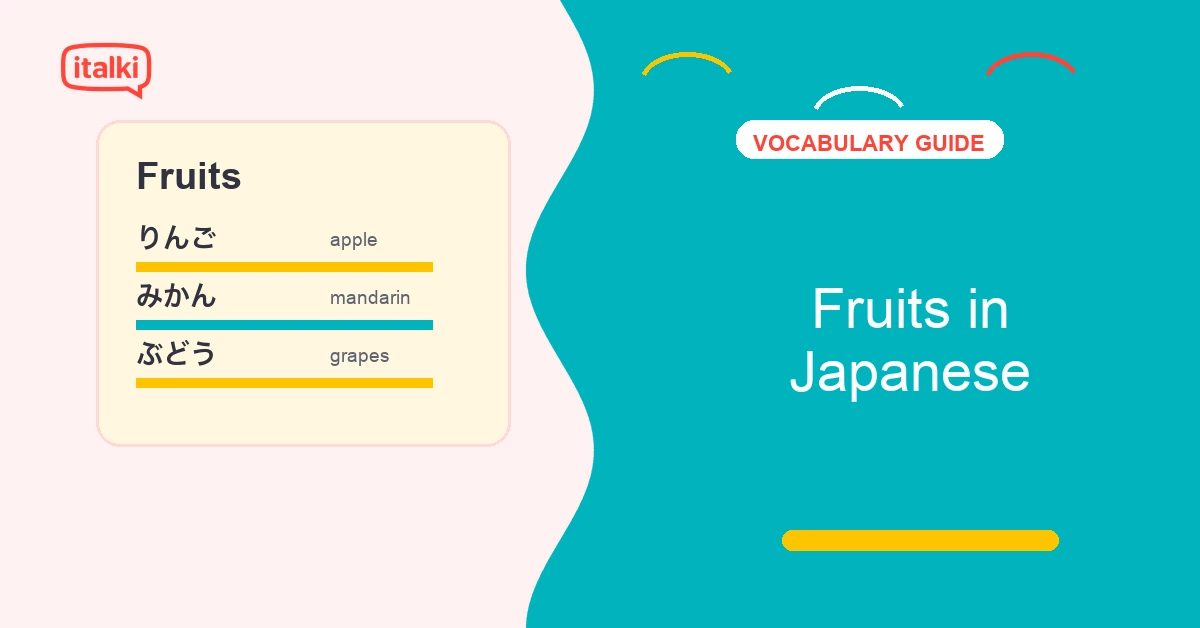
The general word for fruit is 果物 (kudamono). Below are the fruits you will see most often in Japanese grocery stores, menus, and daily conversation.
| English | Japanese (common form) | Romaji | Notes |
|---|---|---|---|
| Fruit | 果物 / くだもの | kudamono | General term |
| Apple | りんご | ringo | Kanji 林檎 exists but is rarely written |
| Banana | バナナ | banana | Katakana loanword |
| Mandarin orange | みかん | mikan | The default winter fruit across Japan |
| Orange | オレンジ | orenji | Refers to navel-type oranges |
| Strawberry | いちご | ichigo | Varieties like あまおう and とちおとめ are famous |
| Grapes | ぶどう | budō | Premium 巨峰 (kyohō) grapes are a gift staple |
| Peach | もも / 桃 | momo | Kanji common on menus and in literature |
| Japanese pear | なし / 梨 | nashi | Crunchy, not soft like Western pears |
| Western pear | 洋梨 | yōnashi | Literally “Western pear” |
| Watermelon | スイカ | suika | Summer icon; kanji 西瓜 appears on signs |
| Melon | メロン | meron | Gift melons like 夕張メロン cost thousands of yen |
| Lemon | レモン | remon | Katakana |
| Pineapple | パイナップル | painappuru | Break into パイ・ナッ・プル for rhythm |
| Cherry | さくらんぼ | sakuranbo | Distinct from 桜 (sakura, cherry blossom tree) |
| Persimmon | 柿 / かき | kaki | Autumn fruit; also dried as 干し柿 (hoshigaki) |
| Plum | 梅 / うめ | ume | Used in 梅干し (umeboshi) and 梅酒 (umeshu) |
| Yuzu | 柚子 / ゆず | yuzu | Citrus used in ponzu, baths, and desserts |
| Kiwi | キウイ | kiui | Katakana |
| Mango | マンゴー | mangō | Long ō at the end |
| Grapefruit | グレープフルーツ | gurēpufurūtsu | Two stretched vowels inside one word |
| Blueberry | ブルーベリー | burūberī | Long ū and long ī |
みかん (mikan) is not the same fruit as オレンジ (orenji). Mikan are the small, easy-peel satsuma mandarins eaten constantly in winter, often under a こたつ (kotatsu, heated table). オレンジ means navel oranges. Mixing them up is like calling a tangerine a grapefruit.
Once you move beyond fruit into full meal vocabulary, Japanese food names covers ingredients, dishes, and drink terms in the same script-and-romaji format used here.
Find Your Perfect Teacher
Build real speaking confidence with personalized lessons from a teacher who matches your goals, schedule, and learning style.
Why does the script change from fruit to fruit?
The script on a fruit label gives you a clue about the word’s history. Native Japanese fruit words appear in hiragana or kanji: りんご (ringo, apple), もも (momo, peach), 柿 (kaki, persimmon). These fruits have grown in Japan for centuries.
Fruits whose names came from English, Portuguese, or Dutch are written in katakana: バナナ (banana), レモン (remon, lemon), マンゴー (mangō, mango). Katakana signals a borrowed word.
Some fruits sit in between. スイカ (suika, watermelon) is usually katakana despite having the old kanji 西瓜. いちご (ichigo, strawberry) is almost always hiragana even though the kanji 苺 exists. Store signage, packaging, and menus each pick their own form, so recognizing a fruit in multiple scripts is genuinely useful.
A practical test: if you can read りんご in hiragana on a recipe blog and 林檎 in kanji on a gift box label, and know both mean apple, you are reading fruit Japanese at a functional level. Building this script flexibility is easier in live practice. A private Japanese tutor can pull up real menus or grocery flyers and walk through which script appears where, correcting misreadings on the spot.
Find Your Perfect Teacher
Build real speaking confidence with personalized lessons from a teacher who matches your goals, schedule, and learning style.
Which pronunciation traps catch learners on fruit words?
Fruit words contain several patterns that trip up English speakers because the mistakes sound small but are immediately noticeable.
Long vowels that get clipped. ぶどう (budō, grapes) ends with a held “o” sound. Saying “budo” with a short final syllable sounds incomplete. マンゴー (mangō, mango) stretches the final “o” the same way. グレープフルーツ (gurēpufurūtsu, grapefruit) has two long vowels: the ー after レ and the ー after ル. Shortening either makes the word hard to parse.
The Japanese r in りんご. The r in ringo is a single tongue tap against the ridge behind the upper teeth, not an English “r” or a full “l.” Practicing りんご, さくらんぼ (sakuranbo, cherry), and ぶどう as a set trains the tap in different word positions.
The っ pause in パイナップル. The small っ before プル creates a brief stop. Skipping it turns painappuru into painapuru, which sounds blurred. Clap the rhythm: パイ・ナッ・プル (pai, nap, puru).
Even beats on katakana fruits. バナナ in Japanese is three even beats: ba-na-na. English speakers stress the second syllable (“buh-NA-nuh”), which sounds off. The same applies to メロン (me-ro-n) and レモン (re-mo-n).
Read this sequence aloud twice, once slowly with deliberate long vowels, once at normal speed:
- もも (momo, peach)
- みかん (mikan, mandarin)
- りんご (ringo, apple)
- ぶどう (budō, grapes)
- マンゴー (mangō, mango)
- グレープフルーツ (gurēpufurūtsu, grapefruit)
If the long vowels collapse at normal speed, that is the exact habit a Japanese language tutor catches and corrects in real time, because hearing your own vowel length accurately is nearly impossible without live feedback.
Find Your Perfect Teacher
Build real speaking confidence with personalized lessons from a teacher who matches your goals, schedule, and learning style.
How do you talk about fruit in Japanese sentences?
Fruit names plug into a small set of particle patterns covering likes, eating, buying, and describing.
Saying you like a fruit: fruit + が好きです (ga suki desu)
- りんごが好きです。(Ringo ga suki desu.) “I like apples.”
- いちごが一番好きです。(Ichigo ga ichiban suki desu.) “Strawberries are my favorite.”
Saying you eat or ate a fruit: fruit + を食べます / 食べました (o tabemasu / tabemashita)
- バナナを食べます。(Banana o tabemasu.) “I eat bananas.”
- 桃を食べました。(Momo o tabemashita.) “I ate a peach.”
Describing a fruit: fruit + は + adjective + です (wa … desu)
- この桃は甘いです。(Kono momo wa amai desu.) “This peach is sweet.”
- レモンは酸っぱいです。(Remon wa suppai desu.) “Lemons are sour.”
Asking about a fruit:
- ぶどうは種がありますか。(Budō wa tane ga arimasu ka.) “Do the grapes have seeds?”
Counting fruit with 個 (ko). 個 covers small, roughly round objects: apples, oranges, peaches, pears, persimmons, lemons. Bananas in a bunch use 房 (fusa), and sliced fruit uses 切れ (kire).
- りんごを一個ください。(Ringo o ikko kudasai.) “One apple, please.”
- みかんを三個買いました。(Mikan o sanko kaimashita.) “I bought three mandarins.”
- スイカを一切れ食べました。(Suika o hitokire tabemashita.) “I ate one slice of watermelon.”
- いちごを一パックください。(Ichigo o ichi pakku kudasai.) “One pack of strawberries, please.”
The counter system is where self-study stalls. Books list counters, but real usage depends on what the fruit looks like in front of you. A bunch of grapes is 一房 (hitofusa); a single grape plucked off is 一粒 (hitotsubu). Getting this right in conversation with an online Japanese tutor saves confusion at a register.
Find Your Perfect Teacher
Build real speaking confidence with personalized lessons from a teacher who matches your goals, schedule, and learning style.
How do you actually buy fruit in a Japanese shop?
The core phrase is [fruit] + を + [counter] + ください (kudasai). Adding すみません (sumimasen, excuse me) at the start keeps the interaction polite everywhere from a depachika counter to a roadside michi no eki stand.
Useful shopping phrases:
- すみません、このりんごはいくらですか。(Sumimasen, kono ringo wa ikura desu ka.) “Excuse me, how much is this apple?”
- りんごを二個ください。(Ringo o niko kudasai.) “Two apples, please.”
- バナナを一房ください。(Banana o hitofusa kudasai.) “One bunch of bananas, please.”
- これは甘いですか。(Kore wa amai desu ka.) “Is this sweet?”
- 袋をお願いします。(Fukuro o onegai shimasu.) “A bag, please.”
- 袋は要りません。(Fukuro wa irimasen.) “I don’t need a bag.”
A realistic shop exchange:
Customer: すみません、この桃はいくらですか。 (Sumimasen, kono momo wa ikura desu ka.) “Excuse me, how much is this peach?”
Staff: 一個三百円です。 (Ikko sanbyaku en desu.) “Three hundred yen each.”
Customer: じゃあ、桃を二個と、みかんを三個ください。 (Jā, momo o niko to, mikan o sanko kudasai.) “Then two peaches and three mandarins, please.”
Staff: はい。袋は要りますか。 (Hai. Fukuro wa irimasu ka.) “Do you need a bag?”
Customer: はい、お願いします。 (Hai, onegai shimasu.) “Yes, please.”
Japanese shoppers often ask これは食べごろですか (kore wa tabegoro desu ka, “is this ready to eat?”) at open displays, especially for peaches, melons, and avocados, so the question sounds natural.
The same polite をください and いくらですか structures work at juice stands, dessert cafés, and restaurants. The shopping dialogue patterns in how to order food in Japanese expand these frames to full meals.
Find Your Perfect Teacher
Build real speaking confidence with personalized lessons from a teacher who matches your goals, schedule, and learning style.
What taste and texture words go with fruit?
Talking about fruit means describing sweetness, sourness, ripeness, and texture. These words turn a vocabulary list into opinions you share over a meal.
| Japanese | Romaji | English | Example context |
|---|---|---|---|
| 甘い | amai | sweet | Ripe strawberries or melons |
| 酸っぱい | suppai | sour | Lemons, unripe plums, some grapefruit |
| おいしい | oishii | delicious | General positive reaction |
| まずい | mazui | bad-tasting | Honest reaction (careful with politeness) |
| 新鮮(な) | shinsen (na) | fresh | Farmers’ market fruit |
| 熟れている | urete iru | ripe | Checking peaches or bananas |
| まだ硬い | mada katai | still firm | Unripe avocados, hard pears |
| 柔らかい | yawarakai | soft | Ripe peaches, overripe bananas |
| みずみずしい | mizumizushii | juicy, fresh | Crisp, hydrating fruit |
| 皮 | kawa | skin, peel | りんごの皮 (apple peel) |
| 種 | tane | seed | ぶどうの種 (grape seeds) |
| むく | muku | to peel | みかんをむく (to peel a mandarin) |
| 切る | kiru | to cut | スイカを切る (to cut watermelon) |
みずみずしい (mizumizushii) deserves special attention. It describes the crisp, hydrated, bursting freshness of fruit like nashi pears or ripe grapes, and Japanese speakers use it constantly when praising fruit. There is no clean one-word English equivalent.
Sample sentences:
- このいちごはすごく甘いです。(Kono ichigo wa sugoku amai desu.) “These strawberries are so sweet.”
- バナナはまだ硬いです。(Banana wa mada katai desu.) “The banana is still firm.”
- この梨はみずみずしいですね。(Kono nashi wa mizumizushii desu ne.) “This pear is so juicy and fresh.”
- りんごの皮をむきますか。(Ringo no kawa o mukimasu ka.) “Do you peel the apple?”
One cultural note: うめ (ume, plum) is rarely eaten raw. It appears mostly in 梅干し (umeboshi, pickled plum), 梅酒 (umeshu, plum wine), and 梅ジャム (ume jamu, plum jam). Describing ume as 甘い would confuse a Japanese listener, because umeboshi is famously sour and salty. Knowing these connections separates a memorized word from a usable one, and a best online Japanese tutor will catch that kind of cultural misfit the moment it happens.
Find Your Perfect Teacher
Build real speaking confidence with personalized lessons from a teacher who matches your goals, schedule, and learning style.
Practice exercises: fruit vocabulary in action
These exercises test recall, particle usage, and sentence building.
Exercise 1: Match the fruit to its meaning
- みかん
- ぶどう
- さくらんぼ
- 桃
- スイカ
- マンゴー
- 柿
- 梨
A. watermelon B. cherry C. mango D. persimmon E. grapes F. mandarin orange G. pear H. peach
Exercise 2: Fill in the particle (が, を, or は)
- バナナ__好きです。
- りんご__食べます。
- この桃__甘いです。
- いちご__買いました。
- レモン__酸っぱいです。
Exercise 3: Translate into Japanese
- One apple, please.
- How much is this melon?
- These grapes are sweet.
- I ate one slice of watermelon.
- Do you peel the peach?
Exercise 4: Read aloud, holding every long vowel
- ぶどう (budō, grapes)
- マンゴー (mangō, mango)
- グレープフルーツ (gurēpufurūtsu, grapefruit)
- 洋梨 (yōnashi, western pear)
- ブルーベリー (burūberī, blueberry)
Answer key
Exercise 1: 1-F, 2-E, 3-B, 4-H, 5-A, 6-C, 7-D, 8-G
Exercise 2: 1 が, 2 を, 3 は, 4 を, 5 は
Exercise 3:
- りんごを一個ください。(Ringo o ikko kudasai.)
- このメロンはいくらですか。(Kono meron wa ikura desu ka.)
- このぶどうは甘いです。(Kono budō wa amai desu.)
- スイカを一切れ食べました。(Suika o hitokire tabemashita.)
- 桃の皮をむきますか。(Momo no kawa o mukimasu ka.)
Check your exercise answers with a tutor who can also test you on counters and adjective usage that go beyond what a written key covers. Japanese tutors for beginners are a good starting point for guided vocabulary practice at this level.
Find Your Perfect Teacher
Build real speaking confidence with personalized lessons from a teacher who matches your goals, schedule, and learning style.
Put fruit vocabulary into real Japanese conversations
Knowing りんご, みかん, and ぶどう is one step. Using りんごを二個ください at a Yokohama fruit stand, describing a 夕張メロン as みずみずしい, or explaining that ume is sour rather than sweet in a conversation about Japanese food, that is when vocabulary becomes real language.
The gap between word lists and spoken ability is where a live tutor makes the difference. A tutor hears your long vowel shorten on ぶどう, catches the wrong counter for a bunch of bananas, and builds on fruit words with seasonal vocabulary, regional varieties, and gift-giving customs that flashcards never cover.
Book a trial lesson with a Japanese tutor and turn this fruit vocabulary into a live shopping role-play, a cooking conversation, or a discussion about which Japanese fruits are worth trying.
Find Your Perfect Teacher
Build real speaking confidence with personalized lessons from a teacher who matches your goals, schedule, and learning style.
FAQ
What is the Japanese word for fruit?
果物 (kudamono). In casual speech and beginner materials, the hiragana くだもの appears more often than the kanji.
Why are banana and lemon written in katakana?
Katakana marks words borrowed from other languages. バナナ (banana) and レモン (remon, lemon) entered Japanese from English and Portuguese, so katakana signals their foreign origin.
What counter do you use for fruit?
個 (ko) works for most individual round fruits like apples, oranges, and peaches. Use パック (pakku) for pre-packaged containers, 房 (fusa) for bunches, and 切れ (kire) for slices.
Is みかん the same as オレンジ?
No. みかん (mikan) refers to the small, easy-peel satsuma mandarin eaten widely in winter. オレンジ (orenji) refers to navel-type oranges. Japanese speakers treat them as different fruits.
How do I practice fruit vocabulary beyond flashcards?
Use the shopping dialogue in this article as a script and practice it aloud. Then run the same dialogue with a tutor who changes the fruits, prices, and questions so the conversation feels unpredictable, the way a real store visit would.
Want to learn a language at italki?
Here are the best resources for you!