Key takeaways
- Japanese speakers regularly shorten words in casual speech: スマートフォン (sumaatofon) is almost always スマホ (sumaho); おつかれさまでした (otsukaresama deshita) becomes おつかれ (otsukare) between colleagues.
- Many contractions follow a predictable pattern: the first two or three mora of a compound are kept and the rest dropped. Knowing the pattern helps you guess new ones.
- Verb forms contract significantly in speech: ている (te iru, progressive) – てる (teru); てしまう (te shimau) – ちゃう (chau).
- Register is critical: loanword contractions like sumaho and baito are fully standard. Greeting shortcuts like otsukare and youth slang like azasu have specific limits.
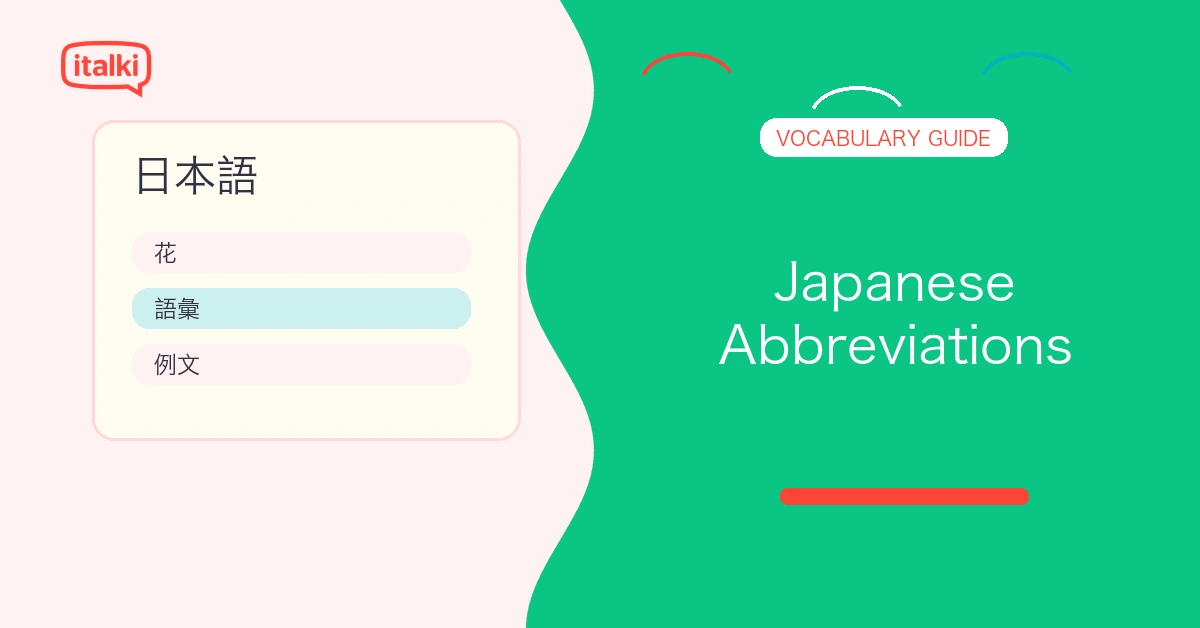
Japanese textbooks teach careful, complete forms of the language. The Japanese that native speakers use with friends, colleagues, and family sounds noticeably different, faster, shorter, and full of contractions that textbooks do not cover. Reaching the point where natural conversation is comprehensible means learning these shortcuts as an active vocabulary set, not just recognizing them by accident.
This guide covers 50 abbreviations organized by type: contracted nouns and loanwords, greeting and courtesy phrase shortcuts, verb contractions in speech, internet and messaging abbreviations, and youth slang. Each comes with the full form and context for when it is appropriate.
Knowing what an abbreviation means is different from knowing which situation it belongs to. italki has connected 10M+ learners with Japanese teachers since 2007, giving learners access to teachers who communicate naturally in casual registers and can demonstrate exactly when a contraction fits and when the full form is required. Find a Japanese tutor and ask for a session in fully informal Japanese to hear how these forms feel in real speech.

Find your perfect teacher
Build real speaking confidence with personalized lessons from a teacher who matches your goals, schedule, and learning style.

Contracted everyday nouns and loanwords
Japanese has a consistent habit of shortening long words, especially katakana loanwords, to two or three mora.
| Full form | Contracted form | Meaning | Notes |
|---|---|---|---|
| スマートフォン (sumaatofon) | スマホ (sumaho) | smartphone | Universal in all contexts |
| パーソナルコンピュータ | パソコン (pasokon) | personal computer | Fully standard |
| アプリケーション (apurikeeshon) | アプリ (apuri) | app, application | |
| コンビニエンスストア | コンビニ (konbini) | convenience store | |
| テレビジョン (terebijon) | テレビ (terebi) | television | Now the standard word |
| デパートメントストア | デパート (depaato) | department store | |
| アルバイト (arubaito) | バイト (baito) | part-time job | From German Arbeit |
| リモートワーク (rimooto waaku) | リモワ (rimowa) | remote work | Post-2020 term |
| ソーシャルネットワーキングサービス | SNS (esu-en-esu) | social media | Pronounced as letters |
| ワンピース (wanpiisu) | ワンピ (wanpi) | one-piece dress | |
| カラオケボックス | カラボ (karabo) | karaoke booth | |
| マクドナルド (Makudonarudo) | マック/マクド | McDonald’s | マック in Tokyo, マクド in Osaka |
The contractions in this section are fully mainstream, they appear in news headlines, business conversation, and everyday speech across all age groups.
Find your perfect teacher
Build real speaking confidence with personalized lessons from a teacher who matches your goals, schedule, and learning style.
Greeting and courtesy phrase shortcuts
Japanese has elaborate courtesy phrases essential to workplace and social life. In casual contexts between peers, shortened versions replace the full forms.
| Full form | Short form | Meaning | Context |
|---|---|---|---|
| おつかれさまでした (otsukaresama deshita) | おつかれ (otsukare) | good work, well done | Between colleagues, same level |
| よろしくおねがいします (yoroshiku onegaishimasu) | よろしく (yoroshiku) | pleased to meet you, thanks in advance | Casual, to peers |
| ありがとうございます (arigatou gozaimasu) | ありがとう (arigatou) | thank you | Neutral-casual |
| ごめんなさい (gomen nasai) | ごめん (gomen) | sorry | Casual apology |
| おはようございます (ohayou gozaimasu) | おはよう (ohayou) | good morning | With friends, close colleagues |
| すみません (sumimasen) | すいません (suimasen) | excuse me / sorry | Very common in spoken Tokyo Japanese |
| ちょっと待ってください (chotto matte kudasai) | ちょっと待って (chotto matte) | wait a moment | Casual request |
| お先に失礼します (osaki ni shitsurei shimasu) | お先に (osaki ni) | leaving before you (end of day) | Casual peers only |
The register boundary matters here. Saying otsukare to a senior colleague or supervisor is a register error. Otsukaresama deshita is required across hierarchy; otsukare belongs among peers.
For the greetings used when first meeting someone or arriving somewhere, and the social contexts that determine which form is appropriate, the guide to how to say hello in Japanese covers the full system of Japanese greetings including time-of-day expressions and the difference between formal and casual registers.
Verb and sentence contractions in speech
Spoken Japanese contracts verb endings and sentence-final forms in ways that beginners are not taught.
| Standard form | Contracted spoken form | Meaning | Example |
|---|---|---|---|
| ている (te iru) | てる (teru) | progressive | 食べている – 食べてる |
| ておく (te oku) | とく (toku) | do in advance | やっておく – やっとく |
| てしまう (te shimau) | ちゃう (chau) | end up doing (regret/completion) | 食べてしまう – 食べちゃう |
| てしまった (te shimatta) | ちゃった (chatta) | ended up doing | 忘れてしまった – 忘れちゃった |
| ではない (de wa nai) | じゃない (ja nai) | is not | Universal in speech |
| のだ / のです (no da/desu) | んだ / んです (n da/desu) | explanatory emphasis | 行くんだ (I’m going, you see) |
| なければならない (nakereba naranai) | なきゃ (nakya) | must, have to | 行かなきゃ (have to go) |
| かもしれない (kamo shirenai) | かも (kamo) | maybe, might | 行くかも (might go) |
| てもいい (te mo ii) | ていい (te ii) | it’s okay to, may | 行っていい? (Can I go?) |
| てはいけない (te wa ikenai) | ちゃいけない (cha ikenai) | must not | 食べちゃいけない (must not eat) |
A Japanese language tutor can run conversation drills entirely in plain-form speech, which is the fastest way to make these contractions feel natural rather than just recognizable. italki has 30,000+ teachers across 150+ languages, including qualified Japanese teachers who model appropriate register use and shift naturally between formal and casual speech within a lesson.
Find your perfect teacher
Build real speaking confidence with personalized lessons from a teacher who matches your goals, schedule, and learning style.
Internet and messaging abbreviations
Japanese digital communication has a distinct set of shortcuts used in chats, comment sections, and social media.
| Form | Full form / meaning | Usage note |
|---|---|---|
| w / www | 笑 (warai, laugh) | More w = more laughter, like LOL |
| 草 (kusa) / ksg | extreme laughter | w looks like grass blades; 草 is the punchline |
| ガチ (gachi) | 本気 (honki, serious) | General use: gachi? (seriously?) |
| kwsk | 詳しく (kuwashiku, in detail) | Tell me more |
| おk / ok | わかった / okay | Cross-script shorthand |
| ちーん | RIP / awkward silence | Onomatopoeia of a temple bell |
| ワロタ (warota) | 笑った (laughed) | Kansai-origin laugh marker |
| m(_ _)m | deep bow emoji | Apologizing or thanking |
| JK | 女子高生 (high school girl) / just kidding | Context determines which meaning |
| バズる (bazuru) | to go viral | buzz + Japanese verb suffix |
| エモい (emoi) | emotional, nostalgic, touching | From English emotional; broadly positive |
| リア充 (riajuu) | someone with a fulfilling real life | Ironic or envious usage online |
Youth slang and recent shortenings
These are current and register-specific to younger speakers and informal peer conversation.
| Slang | Meaning | Origin |
|---|---|---|
| あざす (azasu) | thank you (very casual) | ありがとうございます stripped down |
| りょ (ryo) | understood, got it | 了解 (ryoukai) |
| よきよき (yokiyoki) | very good, nice | Repetition of いい/よい |
| ぴえん (pien) | sad, crying | Onomatopoeia of tearful sound |
| たぴる (tapiru) | to drink boba/tapioca | Noun – verb via Japanese verb suffix |
| パリピ (paripi) | party people | From English party people |
| チル (chiru) | to chill, relax | From English chill |
| うちら (uchira) | us, our group | Casual alternative to 私たち |
| ガチ勢 (gachi-zei) | hardcore fans / serious players | -勢 as collective suffix |
| エモる (emoru) | to feel nostalgic, to feel something | エモ (emo) + verb suffix |
For the adjective grammar behind forms like emoi (adjective) and emoru (verb), including how i-adjectives and na-adjectives are used in casual Japanese, the guide to Japanese adjectives covers the full system.
Find your perfect teacher
Build real speaking confidence with personalized lessons from a teacher who matches your goals, schedule, and learning style.
Register guide: which form fits which context
| Form type | Use with | Avoid with |
|---|---|---|
| Loanword contractions (sumaho, baito, konbini) | Anyone, any register | No restriction, fully standard |
| Contracted verbs (teru, chau, nakya) | Friends, close peers | First meetings, seniors, formal situations |
| Greeting shortcuts (otsukare, yoroshiku, gomen) | Peers, same-level colleagues | Superiors, clients, formal introductions |
| Internet forms (w, ksg, ワロタ) | Online casual messaging | Professional tools, work chat |
| Youth slang (azasu, pien, tapiru) | Friends under ~35 | Anyone you would use keigo with |
The safest rule of thumb: if the situation calls for masu and desu verb endings, use the full form. Plain-form situations are where contractions feel natural.
Book a trial lesson and specifically ask your teacher to conduct part of the session in casual spoken Japanese, hearing these contractions in real conversation from a native speaker, and having your own attempts corrected in context, builds the register intuition that a word list cannot.
Find your perfect teacher
Build real speaking confidence with personalized lessons from a teacher who matches your goals, schedule, and learning style.
FAQ
Are Japanese abbreviations understood by all speakers?
Loanword contractions (sumaho, pasokon, konbini) are universal. Greeting shortcuts (otsukare, yoroshiku) are widely understood but register-dependent. Youth slang is generational, a speaker in their 50s may not know pien or tapiru.
Is it rude to use short forms with a superior?
In most cases, yes. Using otsukare instead of otsukaresama deshita, or gomen instead of gomen nasai, with a senior colleague is a register error. What works with a friend does not work across hierarchy.
Why do Japanese speakers write “w” for laughter online?
W stands for warai (笑, laugh). Multiple w letters (www) indicate stronger laughter. The w shapes visually resemble grass, giving rise to kusa (草, grass) as a slang term for extreme laughter, and then ksg as an abbreviation of that. It is a chain of visual puns specific to Japanese internet culture.
How do verb contractions like chau and teru sound to native speakers?
Completely natural in casual speech. A native speaker using teru instead of te iru is not being careless, it is simply the spoken form. Using the full te iru in informal conversation with friends would sound stiff and over-careful.
Want to learn a language at italki?
Here are the best resources for you!