Key takeaways
- Japanese counters are suffixes attached to numbers that specify what is being counted, so “three books,” “three people,” and “three cups” each use a different counter.
- The 13 highest-frequency counters (個, つ, 人, 枚, 本, 冊, 台, 匹, 頭, 杯, 回, 階, 歳) cover shopping, restaurants, travel, pets, age, and daily conversation.
- The real difficulty is pronunciation: 一本 is ippon, 三杯 is sanbai, and 一匹 is ippiki, not the literal number-plus-counter sound.
- Hearing and correcting these fused sounds in real time with a Japanese tutor prevents fossilized errors that self-study alone tends to miss.
Japanese counters are suffixes placed after numbers to specify the type of thing being counted. Instead of saying “three books” with just a number and a noun, Japanese says 本を3冊 (hon o sansatsu), literally “books, three bound-item-counter.” Counters appear in nearly every sentence involving quantity, and getting them wrong makes otherwise correct Japanese sound incomplete.
For real-time correction on these small endings that reshape entire phrases, italki connects learners with 30,000+ teachers across 150+ languages and has helped over 10 million people get exactly this kind of speaking practice.
Practice counter phrases for shopping, ordering food, buying tickets, and describing your family with a Japanese tutor before those situations happen in real life.

Find Your Perfect Teacher
Practice japanese counters with a Japanese tutor who can correct pronunciation, phrasing, listening speed, and natural replies in real time.

What are Japanese counters and why does Japanese use them?
Japanese counters are grammatical suffixes that pair with numbers to classify what is being counted, telling the listener whether the number refers to a person, a flat object, a long object, a machine, a cup of liquid, or something else. English uses a similar idea in limited cases (“three sheets of paper,” “two cups of tea”), but Japanese applies it far more broadly under the term 助数詞 (josūshi), a system shared with Chinese, Korean, Thai, and Malay.
The basic sentence shapes are number plus counter (3冊, sansatsu, “three bound items”), noun plus particle plus number plus counter (本を3冊, hon o sansatsu, “three books”), and number plus counter plus の plus noun (3冊の本, sansatsu no hon, “three books”). Counters matter because they make sentences sound complete: りんごを3 (ringo o san) sounds unfinished, like saying “three” with no unit, while りんごを3個 (ringo o sanko) sounds natural, “three apples.”
Japanese numbers covers the base counting system that these counters build on.
Find Your Perfect Teacher
Practice japanese counters with a Japanese tutor who can correct pronunciation, phrasing, listening speed, and natural replies in real time.
How do Japanese counters work with numbers?
Japanese counters attach directly after the number, and the noun usually comes first, giving the useful beginner frame noun を number+counter ください (“please give me [number] [item]”), as in 水を1杯ください (mizu o ippai kudasai), “one glass of water, please.” For description rather than ordering, use number+counter plus の plus noun, as in 2人の学生 (futari no gakusei), “two students.” Counters also work without the noun when context is clear: at a café, 2杯ください (nihai kudasai) means “two cups, please.”
Practicing these frames aloud, with the right counter and the right sound change, is where a Japanese language instructor adds the most value. A tutor hears whether “ippai” comes out smoothly or hesitates into “ichi-hai” and corrects it on the spot.
What are the 13 Japanese counters you need to know?
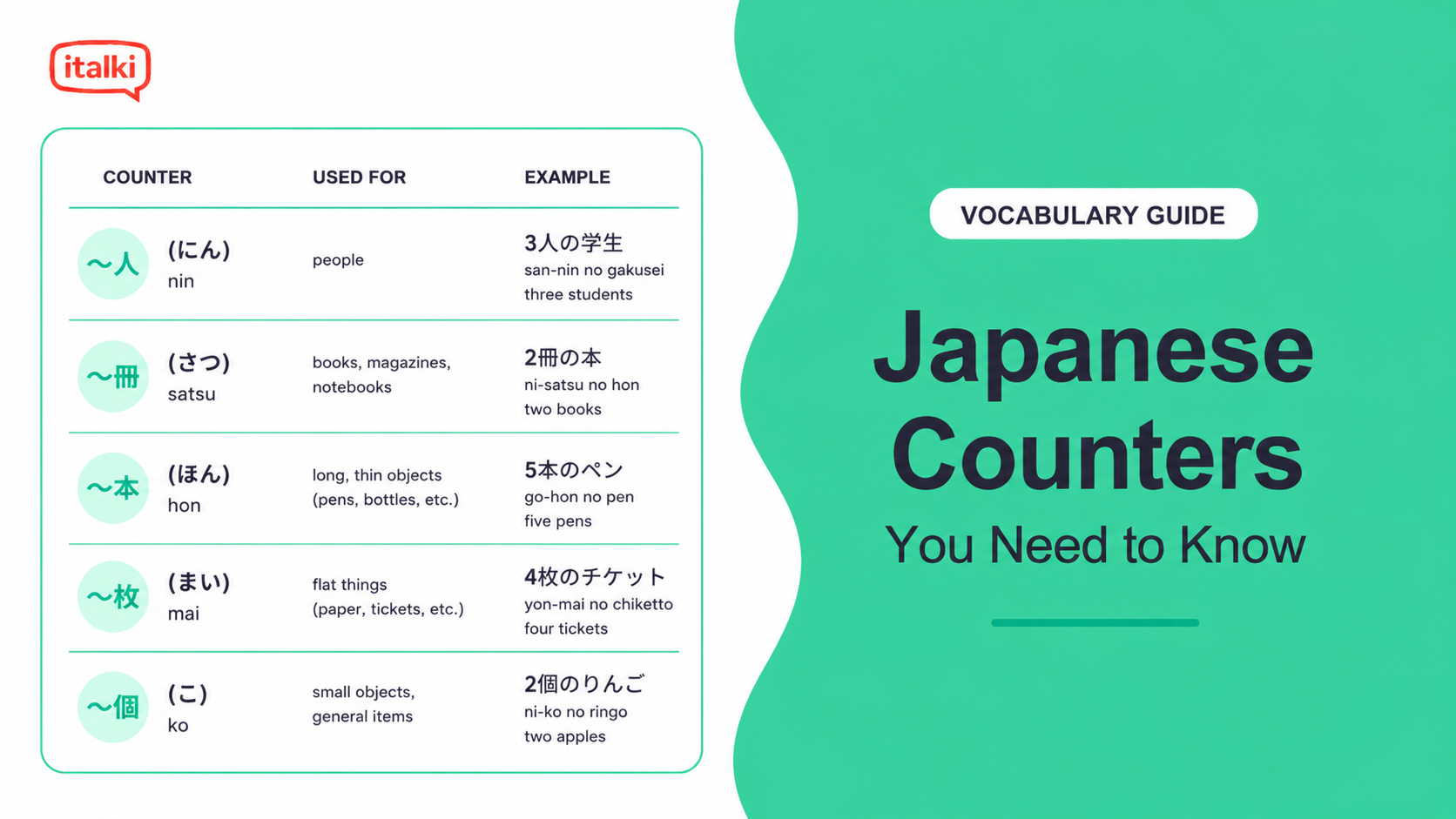
These 13 counters cover the situations learners hit first, people, small objects, flat items, long items, books, vehicles, animals, drinks, events, floors, and age. Learn each with a sample noun rather than as an isolated ending.
| Counter | Reading | Counts | Example | Meaning |
|---|---|---|---|---|
| 個 | こ (ko) | small solid objects, general items | りんごを3個 | three apples |
| つ | つ (tsu) | general items, 1 to 10 only | ケーキを2つ | two cakes |
| 人 | にん (nin) | people | 学生が3人 | three students |
| 枚 | まい (mai) | flat, thin things | 写真を5枚 | five photos |
| 本 | ほん (hon) | long or cylindrical things | ペンを2本 | two pens |
| 冊 | さつ (satsu) | books, magazines, bound items | 本を4冊 | four books |
| 台 | だい (dai) | machines, vehicles, devices | 車が1台 | one car |
| 匹 | ひき (hiki) | small and medium animals | 猫が2匹 | two cats |
| 頭 | とう (tou) | large animals | 馬が3頭 | three horses |
| 杯 | はい (hai) | cups, glasses, bowls | コーヒーを1杯 | one coffee |
| 回 | かい (kai) | times, occurrences | 3回行きました | went three times |
| 階 | かい (kai) | floors of a building | 2階 | second floor |
| 歳 | さい (sai) | age | 20歳 | 20 years old |
1. 個 (ko): small objects and general items
個 is the safest counter for small, solid things, apples, eggs, batteries, erasers, dice, and small snacks, and works as a fallback when no more specific counter comes to mind. 卵を6個買いました (tamago o rokko kaimashita), “bought six eggs,” with the same small っ sound change appearing at 1, 8, and 10.
2. つ (tsu): general counting from one to ten
つ uses native Japanese (wago) readings rather than Sino-Japanese ones: 1つ ひとつ (hitotsu), 2つ ふたつ (futatsu), 3つ みっつ (mittsu), up through 10 とお (too), and stops there. ドーナツを3つください (doonatsu o mittsu kudasai), “three donuts, please.”
3. 人 (nin): people
人 counts people, but one and two are irregular: 1人 ひとり (hitori) and 2人 ふたり (futari). From three onward, Sino-Japanese readings take over: 3人 さんにん (sannin), 4人 よにん (yonin, never しにん, which sounds like “dead person”). 今日は4人です (kyou wa yonin desu), “there are four people today.”
4. 枚 (mai): flat things
枚 counts flat things regardless of material, paper, photos, tickets, plates, shirts, towels, and CDs, since shape matters more than what the item is made of. チケットを2枚持っています (chiketto o nimai motte imasu), “two tickets are on hand.”
5. 本 (hon): long things
本 counts long, thin, or cylindrical things: pens, bottles, umbrellas, bananas, roads, and even phone calls, with heavy sound changes at 1, 3, 6, 8, and 10. 傘を1本持っています (kasa o ippon motte imasu), “one umbrella is on hand.” Context distinguishes 本を2冊 (hon o nisatsu), “two books,” from ペンを2本 (pen o nihon), “two pens,” even though 本 also means “book.”
6. 冊 (satsu): books and bound items
冊 counts anything with pages bound together: books, notebooks, magazines, and dictionaries. If the item has a spine, 冊 is usually right. 日本語の本を1冊読みました (Nihongo no hon o issatsu yomimashita), “read one Japanese book” (1冊 is いっさつ, not いちさつ).
7. 台 (dai): machines and vehicles
台 counts cars, bicycles, computers, smartphones, printers, and similar equipment. パソコンが2台あります (pasokon ga nidai arimasu), “there are two computers.”
8. 匹 (hiki): small and medium animals
匹 counts small and medium animals, dogs, cats, fish, insects, rabbits, and mice, with some of the most dramatic sound changes in the system. 犬が1匹います (inu ga ippiki imasu), “there is one dog.”
9. 頭 (tou): large animals
頭 counts large animals, horses, cows, elephants, and zoo animals, with more stable readings than 匹. 牛が5頭います (ushi ga gotou imasu), “there are five cows,” with the rough boundary being whether a person could carry the animal.
10. 杯 (hai): cups, glasses, and bowls
杯 counts servings in cups, glasses, and bowls of coffee, tea, beer, water, and ramen. お茶を2杯飲みました (ocha o nihai nomimashita), “drank two cups of tea.” Japanese food names gives nouns that pair naturally with 杯, 個, and つ sentences.
11. 回 (kai): times or occurrences
回 counts how many times something happens, visits, lessons, attempts, and trips. 日本に3回行きました (Nihon ni sankai ikimashita), “went to Japan three times.”
12. 階 (kai/gai): building floors
階 counts floors. The main pronunciation trap is 3階, usually さんがい (sangai) in standard speech rather than さんかい, though both are heard. レストランは5階です (resutoran wa gokai desu), “the restaurant is on the fifth floor.”
13. 歳/才 (sai): age
歳 counts age in years (才 is a casual variant). 妹は12歳です (imouto wa juunisai desu), “my younger sister is 12 years old.” Twenty has a special traditional reading, 20歳 はたち (hatachi), still used on official forms and for Japan’s coming-of-age ceremony.
Which Japanese counters have tricky pronunciation changes?
The real difficulty of Japanese counters is not meaning but sound, since certain numbers fuse with certain counter consonants and produce readings that bear little resemblance to the number or counter said alone. Two patterns explain most of these changes: h turns into b or g after certain numbers (さん + はい becomes さんばい, sanbai), and the end of the number compresses into a っ that doubles the following consonant (いち + ほん becomes いっぽん, ippon).
The table below shows the most frequent irregular forms across four counters.
| Counter | 1 | 3 | 6 | 8 | 10 |
|---|---|---|---|---|---|
| 本 (hon) | 一本 ippon | 三本 sanbon | 六本 roppon | 八本 happon | 十本 juppon |
| 杯 (hai) | 一杯 ippai | 三杯 sanbai | 六杯 roppai | 八杯 happai | 十杯 juppai |
| 匹 (hiki) | 一匹 ippiki | 三匹 sanbiki | 六匹 roppiki | 八匹 happiki | 十匹 juppiki |
| 冊 (satsu) | 一冊 issatsu | 三冊 sansatsu | 六冊 rokusatsu | 八冊 hassatsu | 十冊 jussatsu |
The most efficient way to learn these is to memorize each fused form as a single word, like いっぽん or さんばい. Japanese hiragana covers the っ sound and its timing before counter drills, and an online Japanese tutor hears whether that pause is too long, too short, or missing entirely, correcting it before the wrong pronunciation becomes a habit.
Find Your Perfect Teacher
Practice japanese counters with a Japanese tutor who can correct pronunciation, phrasing, listening speed, and natural replies in real time.
How do Japanese counters sound in real phrases?
Japanese counters sound most natural inside short daily phrases, not in isolated lists. At a shop or café: りんごを4個ください (ringo o yonko kudasai), “four apples, please,” and コーヒーを2杯お願いします (koohii o nihai onegai shimasu), “two coffees, please.” Talking about people and travel: 明日は3人で行きます (ashita wa sannin de ikimasu), “three people will go tomorrow,” and 切符を2枚ください (kippu o nimai kudasai), “two tickets, please.” Learn basic Japanese for travel pairs well with the counter knowledge above for tickets, rooms, bags, and meals.
Which counter should you use when you do not know the right one?
Use つ for general counting from one to ten, and 個 for small solid objects when the specific counter does not come to mind, as in これを1つください (kore o hitotsu kudasai), “one of these, please.” These will not cover everything: people always need 人 (友だちが3人, not 友だちを3つ), and コーヒーを2個 sounds like two coffee beans rather than two cups, so 杯 is worth learning early.
Role-playing a shopping or ordering scene is the fastest way to test whether the right counter comes to mind under pressure. A private Japanese tutor can run these drills and catch hesitations that reveal which counters still need work.
How should you practice Japanese counters?
Practice Japanese counters by grouping them by situation and speaking full sentences aloud, not by memorizing lists, since timed spoken sentences build the fluency lists alone cannot.
A 7-day plan works well: a couple of counters each day grouped by theme (snacks, family, tickets, books, animals, drinks and floors), then a mixed review on day seven naming 30 random objects with the right counter in under three seconds each. For each counter, build three sentence types, buying (りんごを3個ください), possession (ペンを2本持っています), and description (3人の学生がいます), then change only the number for repeated practice with the sound changes.
JLPT N5 vocabulary gives nouns that pair naturally with 個, 人, 枚, 本, and 回 for reading practice. A strong drill: bring 20 photos from a phone to a Japanese tutoring session and name each item with the right counter, since a tutor catches mistakes like “ichihon” instead of “ippon” that self-study audio cannot.
Start counting in Japanese with fewer pauses
Japanese counters become automatic when each one connects to a real noun, a real scene, and a phrase spoken aloud many times. Start with the 13 in this guide, then repeat the tricky fused forms until 一本, 一杯, 一匹, and 一冊 feel like single words rather than two pieces glued together. A tutor hears whether the っ is too long, too short, or missing entirely, and fixes it in the moment. With 30,000+ teachers across 150+ languages, italki makes finding a Japanese tutor who focuses on pronunciation and counters straightforward. Book a trial lesson and bring the counter phrases from this article into your first conversation.
Find Your Perfect Teacher
Practice japanese counters with a Japanese tutor who can correct pronunciation, phrasing, listening speed, and natural replies in real time.
FAQ
What are Japanese counters?
Japanese counters (助数詞, josūshi) are suffixes placed after numbers to classify what is being counted, such as 人 for people, 枚 for flat objects, 本 for long objects, and 冊 for books.
What is the most useful Japanese counter for beginners?
つ is the most useful fallback for general items from one to ten, and 個 works well for small solid objects like apples, eggs, and batteries.
Why does 一本 sound like “ippon” instead of “ichihon”?
The end of いち compresses into a っ that doubles the following consonant, so いち + ほん becomes いっぽん. Similar changes happen at 3, 6, 8, and 10 with counters starting in h or s.
What counter do Japanese speakers use for animals?
Use 匹 (hiki) for small and medium animals like cats, dogs, fish, and insects, and 頭 (tou) for large animals like horses, cows, and elephants, with the rough boundary being whether a person could carry it.
Do beginners need to learn every Japanese counter?
No. Start with the 13 counters here, which cover shopping, restaurants, travel, pets, age, and daily conversation, and add specialized counters like 足 (pairs of shoes) or 着 (outfits) as they come up.
Want to learn a language at italki?
Here are the best resources for you!