Key takeaways
- Common animal names in Japanese use a mix of kanji (漢字) and katakana (カタカナ), and knowing which script applies is part of learning the word correctly.
- Japanese uses specific counters for animals (匹 for small ones, 頭 for large ones), and using the wrong counter sounds unnatural even when the name itself is correct.
- Many animal names carry cultural weight in Japan, appearing in idioms and zodiac symbolism in ways a vocabulary list alone does not explain.
- Practicing animal vocabulary with a Japanese tutor turns memorized words into usable speech, especially for counters and pronunciation.
How are animal names written in Japanese?
Japanese uses three scripts, and animal names do not follow a single rule for which script applies.
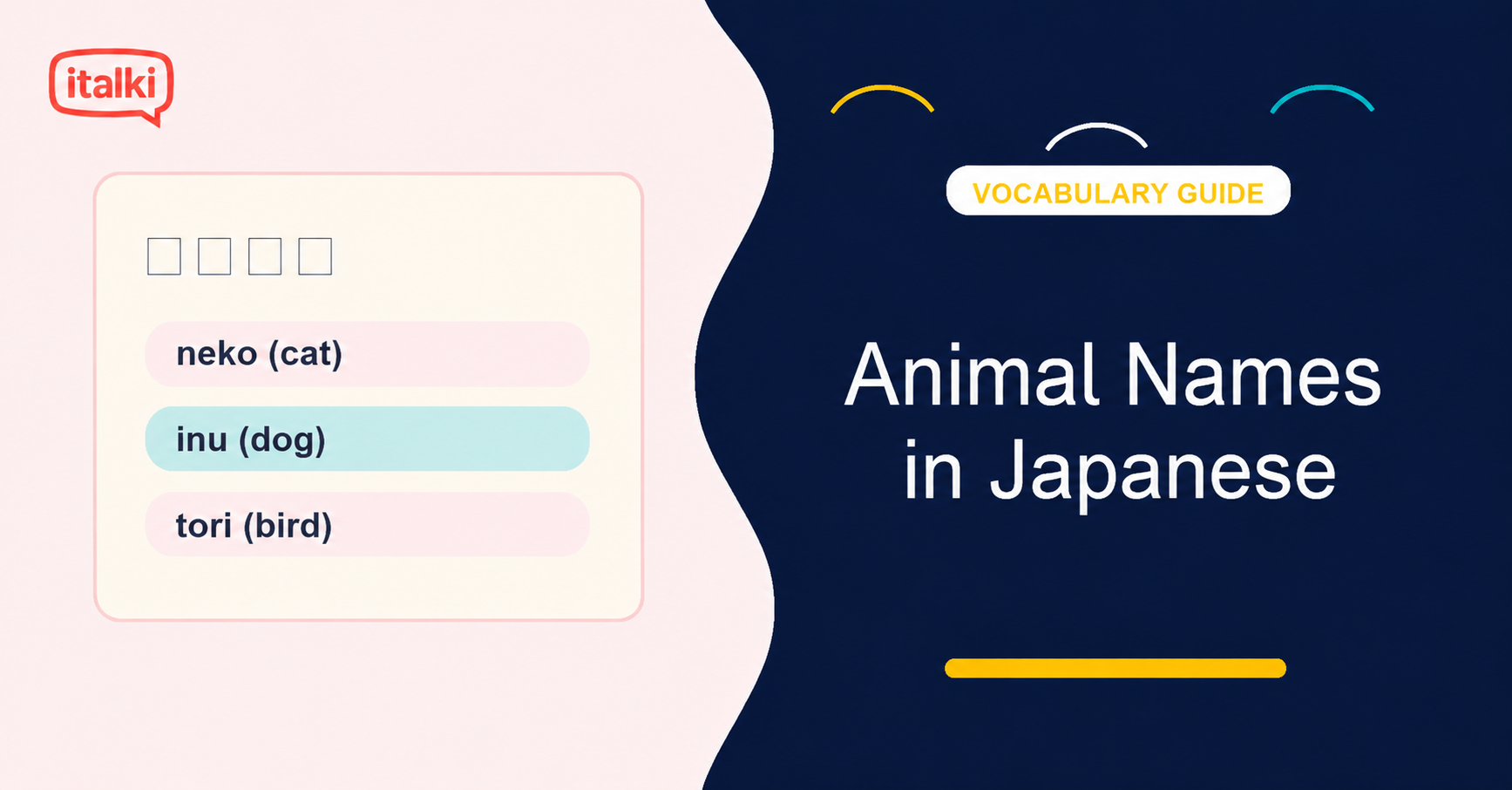
Kanji animals are the most common native Japanese animals. 犬 (いぬ, inu) for dog, 猫 (ねこ, neko) for cat, 馬 (うま, uma) for horse, and 鳥 (とり, tori) for bird all have dedicated kanji, since these animals have been part of Japanese life for centuries.
Katakana animals tend to be foreign-origin words or animals that entered daily vocabulary more recently. ライオン (raion, lion), ペンギン (pengin, penguin), and コアラ (koara, koala) are written in katakana since they derive from English. In scientific writing, nearly all animal names shift to katakana regardless of whether a kanji exists.
Hiragana is common in children’s materials. A picture book might write うさぎ (usagi, rabbit) instead of the kanji 兎 because the kanji is complex.
The practical rule: learn the kanji for the 15 to 20 most common animals, recognize that katakana signals a foreign-origin name, and expect hiragana in casual contexts.

Find Your Perfect Teacher
Practice animal names japanese with a Japanese tutor who can correct pronunciation, phrasing, listening speed, and natural replies in real time.

Common pet names in Japanese
Pets are the animals learners talk about first, whether describing their own pet or asking about someone else’s.
| Japanese | Reading | Romaji | English | Notes |
|---|---|---|---|---|
| 犬 | いぬ | inu | dog | Most common kanji; used everywhere |
| 猫 | ねこ | neko | cat | Very high frequency in daily speech |
| 金魚 | きんぎょ | kingyo | goldfish | Literally “gold fish”; common summer festival animal |
| うさぎ | usagi | rabbit | Often written in hiragana; kanji 兎 is rare in daily use | |
| 亀 | かめ | kame | turtle | Symbolizes longevity in Japanese culture |
| インコ | inko | parakeet | Katakana; popular pet bird in Japan |
猫を飼っています (neko o katte imasu) means “keeping a cat.” The verb 飼う (kau, to keep/raise an animal) sounds identical to 買う (kau, to buy), so context does the work in writing, while a tutor catches the mix-up in speech. To ask “Do you have a pet?” say ペットを飼っていますか? (petto o katte imasu ka?), using the katakana loanword ペット.
Find Your Perfect Teacher
Practice animal names japanese with a Japanese tutor who can correct pronunciation, phrasing, listening speed, and natural replies in real time.
Farm animal vocabulary in Japanese
Farm animals appear often in children’s education and food-related conversation. Several have onomatopoeia (animal sounds) that differ completely from English.
| Japanese | Reading | Romaji | English | Japanese animal sound |
|---|---|---|---|---|
| 牛 | うし | ushi | cow | モーモー (moo moo) |
| 豚 | ぶた | buta | pig | ブーブー (buu buu) |
| 馬 | うま | uma | horse | ヒヒーン (hihiin) |
| 鶏 | にわとり | niwatori | chicken | コケコッコー (kokekokkou) |
| 羊 | ひつじ | hitsuji | sheep | メーメー (mee mee) |
| 鹿 | しか | shika | deer |
鶏 (niwatori) is the living chicken, while 鳥 (tori) means “bird” in general; chicken meat on a menu is 鶏肉 (toriniku) or チキン (chikin). Deer (鹿) hold special status in parts of Japan, since deer roaming Nara Park are protected as a natural monument, and saying 鹿 often triggers a reference to Nara.
Japanese animal sounds are worth learning because they come up in everyday speech, songs, and idioms. A rooster does not say “cock-a-doodle-doo” in Japanese; it says コケコッコー.
Sea creatures and fish names in Japanese
Japan’s deep connection to seafood means sea creature vocabulary is more developed than in most languages, and knowing these names is practical for restaurants, fish markets, and menus.
| Japanese | Reading | Romaji | English |
|---|---|---|---|
| 魚 | さかな | sakana | fish (general) |
| 鯛 | たい | tai | sea bream |
| 鮭 | さけ / しゃけ | sake / shake | salmon |
| 鮪 | まぐろ | maguro | tuna |
| 海老 | えび | ebi | shrimp/prawn |
| 蛸 | たこ | tako | octopus |
| イルカ | iruka | dolphin |
鮭 has two accepted readings, さけ and しゃけ, both widely used. Many fish kanji share the radical 魚, as in 鯛 (tai, sea bream) and 鮪 (maguro, tuna), a reliable signal of fish-related meaning; building this pattern recognition with Japanese hiragana foundations first makes kanji acquisition faster.
Bird names in Japanese
Birds appear across Japanese poetry, art, and everyday life. The general word for bird is 鳥 (とり, tori), but specific birds have their own kanji or katakana forms.
| Japanese | Reading | Romaji | English |
|---|---|---|---|
| 鳥 | とり | tori | bird (general) |
| 雀 | すずめ | suzume | sparrow |
| 鳩 | はと | hato | pigeon/dove |
| 鶴 | つる | tsuru | crane |
| カラス | karasu | crow | |
| 白鳥 | はくちょう | hakuchou | swan |
The crane (鶴, tsuru) is culturally significant: folding 1,000 paper cranes (千羽鶴, senbazuru) is tied to wishes for healing and peace. カラス (karasu, crow) is written in katakana despite the kanji 烏 existing, and Japanese speakers associate crows with cleverness rather than bad omens.
Find Your Perfect Teacher
Practice animal names japanese with a Japanese tutor who can correct pronunciation, phrasing, listening speed, and natural replies in real time.
Insect and bug names in Japanese
Insect collecting (昆虫採集, konchuu saishu) is a beloved childhood activity in Japan, and beetle and dragonfly vocabulary carries a nostalgic, summery association for most adults. The general word for insect is 虫 (むし, mushi).
| Japanese | Reading | Romaji | English |
|---|---|---|---|
| 虫 | むし | mushi | insect/bug |
| 蝶 | ちょう | chou | butterfly |
| 蜂 | はち | hachi | bee |
| 蚊 | か | ka | mosquito |
| カブトムシ | kabutomushi | rhinoceros beetle | |
| セミ | semi | cicada | |
| ホタル | hotaru | firefly |
カブトムシ (kabutomushi, rhinoceros beetle), literally “helmet bug,” is arguably the most iconic insect in Japanese childhood culture, and セミ (semi, cicada) defines the sound of Japanese summer, with its buzzing used in anime and film as shorthand for the season. Exploring Japanese culture alongside vocabulary like this makes both stick.
Wild animal and zoo animal names in Japanese
Zoo visits and nature documentaries are common conversation topics, and wild animal names tend to use katakana for non-native species and kanji for animals historically present in Japan.
| Japanese | Reading | Romaji | English |
|---|---|---|---|
| ライオン | raion | lion | |
| トラ / 虎 | とら | tora | tiger |
| ゾウ / 象 | ぞう | zou | elephant |
| パンダ | panda | panda | |
| 熊 | くま | kuma | bear |
| 狐 | きつね | kitsune | fox |
| 猿 | さる | saru | monkey |
虎 (tora, tiger) and 熊 (kuma, bear) have kanji because both have historical and mythological significance in Japan. 狐 (kitsune, fox) is one of the most culturally loaded animal names: in folklore, foxes are shape-shifters and messengers of the Shinto deity Inari, and the word also appears in food, since きつねうどん (kitsune udon) is udon topped with fried tofu, which foxes are said to love.
猿 (saru, monkey) connects to the “three wise monkeys” (三猿, sanzaru) at Nikko’s Toshogu Shrine: 見ざる、聞かざる、言わざる (mizaru, kikazaru, iwazaru), “see no evil, hear no evil, speak no evil.” A Japanese language tutor can explain folklore references like this.
How to count animals in Japanese
Counting animals in Japanese requires special counter words (助数詞, josushi), and using the wrong one is a common mistake that native speakers notice immediately.
匹 (hiki) is for small to medium animals: cats, dogs, fish, insects, rabbits. 猫が三匹います (neko ga sanbiki imasu) means “There are three cats.” Note the sound change: 匹 becomes びき after さん (three) and ぴき after いち (one), a pattern (連濁, rendaku) that takes practice.
頭 (tou) is for large animals: horses, cows, elephants, bears. 象が二頭います (zou ga nitou imasu) means “There are two elephants.”
羽 (wa) is for birds and, by convention, rabbits. 鳥が五羽います (tori ga gowa imasu) means “There are five birds.” Including rabbits under 羽 is a well-known quirk, and the exact historical reason is debated among Japanese linguists.
| Counter | Used for | Example |
|---|---|---|
| 匹 (hiki) | Small/medium animals (cats, dogs, fish, insects) | 犬が一匹 (ippiki) |
| 頭 (tou) | Large animals (horses, cows, elephants) | 馬が三頭 (santou) |
| 羽 (wa) | Birds and rabbits | 鶴が二羽 (niwa) |
Getting counters right is one of the markers that separates a textbook learner from someone who sounds comfortable. Reviewing Japanese numbers and their sound-change rules before tackling counters makes the process smoother.
Animals in Japanese culture, idioms, and the zodiac
Animal names in Japanese go far beyond vocabulary labels, appearing in proverbs, zodiac signs, and cultural references that shape daily conversation.
The Japanese zodiac (十二支, juunishi) uses 12 animals in a cycle adapted from the Chinese zodiac tradition. Each year is associated with one animal, and Japanese people commonly know their zodiac animal the way English speakers know their astrological sign. One difference: where Chinese tradition uses the domestic pig, the Japanese cycle uses the wild boar (猪, いのしし, inoshishi).
| Year animal | Japanese | Reading | Romaji |
|---|---|---|---|
| Rat | 子 | ね | ne |
| Ox | 丑 | うし | ushi |
| Tiger | 寅 | とら | tora |
| Rabbit | 卯 | う | u |
| Dragon | 辰 | たつ | tatsu |
| Snake | 巳 | み | mi |
| Horse | 午 | うま | uma |
| Sheep | 未 | ひつじ | hitsuji |
| Monkey | 申 | さる | saru |
| Rooster | 酉 | とり | tori |
| Dog | 戌 | いぬ | inu |
| Boar | 亥 | い | i |
The zodiac kanji differ from the standard kanji for the same animals: 子 (ne) for rat is not the same as 鼠 (nezumi), since the zodiac uses ancient earthly-branch readings specific to this system.
Common animal idioms:
- 猫の手も借りたい (neko no te mo karitai), “want to borrow even a cat’s paws,” means being so busy that any help would be welcome.
- 馬が合う (uma ga au), “the horses match,” means two people get along well, from horseback riding where rider and horse need compatibility.
- 猿も木から落ちる (saru mo ki kara ochiru), “even monkeys fall from trees,” is the Japanese equivalent of “nobody’s perfect.”
Japanese speakers use these idioms in ordinary conversation, texts, and workplace emails. Recognizing the animal name is the first step; understanding the cultural logic behind it is what makes comprehension feel effortless. Exploring Japanese greetings alongside idiom study builds a fuller sense of how Japanese speakers use language socially.
Work through animal idioms, zodiac references, and counter word drills with a private Japanese teacher who can test your recognition in live conversation.
Practice animal names in Japanese with a tutor
Animal vocabulary touches reading, pronunciation, counting, and cultural literacy at once. A vocabulary list gives you the words; speaking them correctly and understanding references like kitsune or senbazuru requires live practice with someone who corrects your mistakes in real time.
italki connects learners with 30,000+ teachers across 150+ languages, and Japanese tutors specialize in everything from beginner vocabulary drills to advanced cultural discussion. A productive lesson might include describing zoo animals with counters, ordering seafood in a restaurant role-play, or discussing your zodiac animal year.
Book a trial lesson with a Japanese teacher and put your animal vocabulary to use in a real conversation.
Find Your Perfect Teacher
Practice animal names japanese with a Japanese tutor who can correct pronunciation, phrasing, listening speed, and natural replies in real time.
FAQ
What is the Japanese word for “animal”?
The general word is 動物 (どうぶつ, doubutsu). It covers all animals and is the word used on zoo signs (動物園, doubutsuen means “zoo,” literally “animal garden”).
What counter do you use for fish?
Small fish use 匹 (hiki). At a sushi restaurant, individual pieces use 貫 (kan) or 個 (ko) instead of a fish counter.
How do you say “I like cats” in Japanese?
猫が好きです (neko ga suki desu). The particle が marks the object of liking here, not を.
Want to learn a language at italki?
Here are the best resources for you!