Key takeaways
- French transition words (connecteurs logiques) mark relationships between ideas: sequence, addition, contrast, cause, consequence, and clarification.
- Most intermediate learners overuse et and mais. Even swapping two per conversation with donc, en revanche, or en fait makes your French sound noticeably more organized.
- Spoken French and written French often use different transitions for the same meaning, so register awareness matters as much as vocabulary.
- A French tutor catches register mismatches that dictionaries miss, like using néanmoins in a casual text or par contre in a formal essay.
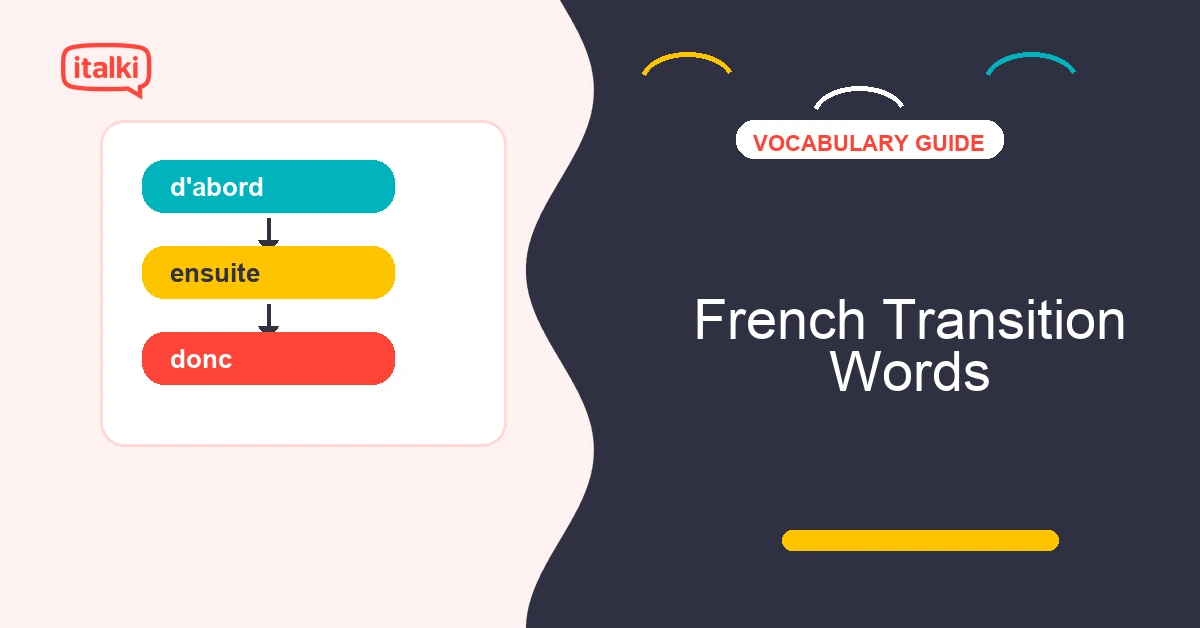
French transition words are the linking words that hold your ideas together: d’abord, ensuite, donc, cependant, par exemple, and dozens more. Without them, even grammatically correct French sounds choppy, like a list of disconnected statements instead of a real thought.
A French tutor can help you hear the difference between textbook connectors and the ones people actually use. That matters here, because choosing the right transition word is less about memorization and more about register, tone, and context. Book a trial lesson.

Find Your Perfect Teacher
Your French doesn’t have to sound like a textbook. Get personalized lessons from native tutors who’ll help you speak naturally, not just correctly.
Book a trial lesson
What are French transition words and why do they matter?
French transition words are the small words and phrases that tell the listener what your next sentence is doing. Is it agreeing with the last point? Contradicting it? Giving a reason? Showing a result? The connector answers that question before the listener even processes the content.
Consider these two versions of the same mini-argument:
- Without connectors: J’aime Paris. Lyon est plus calme. Je préfère Lyon. (“I like Paris. Lyon is calmer. I prefer Lyon.”)
- With connectors: J’aime Paris. Cependant, Lyon est plus calme. C’est pourquoi je préfère Lyon. (“I like Paris. However, Lyon is calmer. That’s why I prefer Lyon.”)
The second version is the same three ideas, but the listener never has to guess the relationship. That is what transition words do. They eliminate guesswork.
The six categories you need cover almost every conversational and written situation: order/time, addition, contrast, cause, consequence, and example/clarification. The sections below walk through each one with the register differences and common mistakes that textbooks usually skip.
If you are already working on French conversation practice, transition words are the logical next layer. They turn one-sentence answers into organized, connected responses.
Sequencing and time: telling stories and explaining steps
Sequence transitions are the first category most learners pick up because every day gives you a story to tell. These are the words that answer “what happened next?”
D’abord (dah-bor) means “first” or “first of all.” It signals the beginning of a list or process.
Ensuite (ahn-sweet) means “then” or “next” and sits naturally after d’abord.
Puis (pwee) also means “then,” but it sounds slightly more clipped and conversational than ensuite. You hear puis more often in casual speech: J’ai pris un café, puis je suis parti. “I had a coffee, then I left.”
Après (ah-preh) means “after” or “afterward.” It works both as a preposition (après le dîner, “after dinner”) and as a standalone adverb (Après, on verra, “Afterward, we’ll see”).
Enfin (ahn-fan) means “finally” or “lastly” and closes a sequence. But enfin has a second life in spoken French as a filler word, close to “well” or “I mean,” especially when correcting yourself: Il a trente ans. Enfin, trente-deux. “He’s thirty. Well, thirty-two.” This double meaning trips up learners who hear enfin mid-sentence and assume the speaker is wrapping up.
Finalement (fee-nahl-mahn) also means “finally,” but it carries a stronger sense of resolution or unexpected outcome. Finalement, tout s’est bien passé means “In the end, everything went well,” with a hint that the speaker expected worse.
Pendant ce temps (pahn-dahn suh tahn) means “meanwhile” and lets you describe two things happening at the same time. Je préparais le repas. Pendant ce temps, il mettait la table. “I was preparing the meal. Meanwhile, he was setting the table.”
Here is where these words feel real: describe something you did yesterday. Start with d’abord, move through ensuite or puis, and close with enfin. Even three sentences in that pattern sound dramatically more organized than the same facts connected by et.
Practice telling a short anecdote to a French teachers online and ask them to flag every place where you could swap et for a sequence word. That single correction loop builds the habit faster than memorizing lists.
Find Your Perfect Teacher
Your French doesn’t have to sound like a textbook. Get personalized lessons from native tutors who’ll help you speak naturally, not just correctly.
Book a trial lesson
Adding information without repeating yourself
Addition transitions solve a specific problem: you have a second point that supports the first, and you need something better than et to connect them. The question is which word fits the register.
Aussi (oh-see) means “also” or “too.” In spoken French, moi aussi (“me too”) is one of the most frequent phrases you hear. When aussi begins a sentence in formal writing, it triggers subject-verb inversion: Aussi faut-il agir vite. This inversion does not happen in everyday speech, where aussi sits inside the sentence instead.
En plus (ahn ploo) means “on top of that” or “plus.” This is the conversational go-to for adding a point with a little emphasis: Il est sympa. En plus, il parle anglais. “He’s nice. Plus, he speaks English.” You can hear en plus in almost any casual French conversation.
De plus (duh ploo) means “in addition.” It does the same job as en plus but with a more formal tone. Use de plus in emails, reports, and academic writing. In a conversation with friends, it sounds a bit stiff.
Également (ay-gahl-mahn) means “also” or “equally.” It is more neutral in register than de plus and works in both spoken and written French: Elle parle également espagnol. “She also speaks Spanish.”
Par ailleurs (par ah-yur) means “besides” or “moreover.” It introduces a point that is related but slightly separate, like switching lanes. Par ailleurs, le projet avance bien. “Besides that, the project is going well.” This one lives almost entirely in writing and formal speech.
En outre (ahn nootr) means “in addition” or “furthermore.” This is the most formal addition word on the list. You see it in essays, legal documents, and academic papers. Using en outre in a text to a friend would sound like quoting a contract.
The key distinction is register. If you are writing a work email, de plus and par ailleurs make you sound professional. If you are chatting over coffee, en plus does the job. Learning how to write an email in French naturally reinforces these distinctions because French emails demand cleaner connectors than conversation does.
Contrast and opposition: disagreeing, qualifying, and surprising
Contrast transitions are where register mistakes become most noticeable. A learner who drops néanmoins into a casual text sounds strange. A learner who uses only mais in a formal essay sounds underprepared. The words below are organized from most casual to most formal so you can pick the right one for the situation.
Mais (meh) is “but.” It is the most common contrast word in spoken and written French, and it is fine in any register. Je veux venir, mais je travaille. “I want to come, but I’m working.”
Par contre (par kontr) means “on the other hand” or “however.” French grammar purists have debated par contre for over a century, with some style guides discouraging it in formal writing. In practice, it is everywhere in spoken French: J’aime le film. Par contre, la fin est trop longue. “I like the movie. But the ending is too long.” Use it freely in conversation. Consider en revanche instead when writing formally.
En revanche (ahn ruh-vahnsh) means “on the other hand” and is the formal cousin of par contre. It directly compares two sides: Le billet est cher. En revanche, l’hôtel est gratuit. “The ticket is expensive. On the other hand, the hotel is free.” This is a strong choice for weighing pros and cons in writing.
Pourtant (poor-tahn) means “yet” or “nevertheless.” It often introduces a surprise: Il pleut. Pourtant, elle sort. “It’s raining. Yet she’s going out.” Pourtant works in both speech and writing.
Cependant (suh-pahn-dahn) means “however.” This is a workhorse for formal writing and presentations. C’est intéressant. Cependant, c’est cher. “It’s interesting. However, it’s expensive.”
Toutefois (toot-fwah) also means “however” or “nevertheless.” It sits at the same formality level as cependant but often sounds slightly more deliberate, as though you are introducing a considered reservation.
Néanmoins (nay-ahn-mwan) means “nevertheless.” This is the most formal contrast word on the list. It works in essays, published articles, and formal speeches. C’est difficile. Néanmoins, c’est possible. “It’s difficult. Nevertheless, it’s possible.”
Au contraire (oh kon-trair) means “on the contrary.” Use it to directly deny the previous claim, not just contrast with it: Ce n’est pas un problème. Au contraire, c’est une chance. “It’s not a problem. On the contrary, it’s an opportunity.”
If you are preparing for the DELF B2 exam, you need at least three distinct contrast words in your active vocabulary. Build a short for-and-against paragraph: use cependant for the pivot sentence, en revanche for the direct comparison, and néanmoins for the final concession. Then bring that paragraph to a French tutoring session and have your tutor evaluate whether each connector sounds right for the register you chose.
Find Your Perfect Teacher
Your French doesn’t have to sound like a textbook. Get personalized lessons from native tutors who’ll help you speak naturally, not just correctly.
Book a trial lesson
Cause and consequence: giving reasons and showing results
Cause and consequence transitions are the backbone of any argument, explanation, or story that answers “why?” and “so what happened?”
Cause words explain the reason:
Parce que (pars kuh) is “because.” This is the safest, most neutral way to give a reason in any context: Je reste ici parce qu’il pleut. “I’m staying here because it’s raining.”
Car (kar) also means “because” or “for.” It leans formal and written. Car does not usually begin a sentence. You see it after a comma: Je pars tôt, car j’ai un train. “I’m leaving early, because I have a train.”
Puisque (pwees-kuh) means “since.” The important difference: puisque implies the reason is already obvious to the listener. It often carries a slightly impatient or logical tone. Puisque tu es là, aide-moi. “Since you’re here, help me.” The subtext is “you’re clearly here, so the reason is obvious.”
Comme (kum) also means “since” or “as.” Unlike puisque, comme is neutral and begins the sentence: Comme il fait froid, je prends une veste. “Since it’s cold, I’m taking a jacket.”
À cause de (ah koz duh) means “because of” and takes a noun, not a clause. It points to a negative cause: Le vol est annulé à cause de la neige. “The flight is canceled because of the snow.”
Grâce à (grah-sah) means “thanks to” and is the positive mirror of à cause de. J’ai réussi grâce à toi. “I succeeded thanks to you.” Mixing these two up (saying grâce à la pluie when rain ruined your picnic) sounds wrong to native ears, because grâce à implies the outcome was good.
Consequence words show the result:
Donc (donk) is “so” or “therefore.” It is the most common consequence word, equally at home in speech and writing.
Alors (ah-lor) also means “so” or “then.” Alors overlaps with donc but is softer and more conversational. It also serves as a filler (“so, anyway”) that moves the conversation forward.
C’est pourquoi (seh poor-kwah) means “that is why.” It is slightly more formal than donc and often closes a line of reasoning: Il a plu. C’est pourquoi la route est fermée.
Par conséquent (par kon-say-kahn) means “consequently.” This is formal. Use it in reports, presentations, and essays. In a casual conversation, it sounds heavy.
A practical way to drill these: have someone ask you a string of pourquoi questions. Answer each one with a different cause word. Then flip the exercise and turn each answer into a consequence: J’ai raté le bus parce que je me suis réveillé tard. Donc, j’ai pris un taxi. If sentence structure still feels shaky when you chain clauses, targeted French grammar practice helps build the underlying patterns.
For a live version of the exercise, work with a French language tutor who can push you to alternate between parce que, puisque, and comme until you feel the tone difference without translating.
Examples and clarification: making a vague point concrete
These transitions do something different from the categories above. Instead of moving the argument forward, they zoom in. They take something general and make it specific, or they restate a confusing point in clearer words.
Par exemple (par eg-zahmpl) is “for example.” The most straightforward way to introduce an illustration. J’aime les films français, par exemple les comédies. “I like French films, for example comedies.”
Notamment (no-tah-mahn) means “especially” or “notably.” It narrows a broad category to a specific member: Plusieurs pays participent, notamment la France. “Several countries are taking part, notably France.” Notamment works in both speech and writing.
En particulier (ahn par-tee-kyoo-lyay) means “in particular.” It does the same job as notamment but sounds slightly more formal.
C’est-à-dire (seh-tah-deer) means “that is to say” or “meaning.” This is the word you reach for when your first sentence was too broad and you want to pin it down: Il travaille à temps partiel, c’est-à-dire trois jours par semaine. “He works part time, meaning three days a week.” In work situations, c’est-à-dire is indispensable. It clarifies numbers, deadlines, and scope in a single phrase.
Autrement dit (oh-truh-mahn dee) means “in other words.” Autrement dit, nous devons recommencer. “In other words, we need to start again.” This one restates an idea from a different angle rather than simply narrowing it.
En effet (ahn nay-feh) means “indeed” or “in fact.” It confirms and reinforces a previous statement. C’est une bonne idée. En effet, elle est simple et rapide. “It’s a good idea. Indeed, it is simple and quick.” Learners sometimes confuse en effet with en fait (“actually”), which is closer to a correction or a reveal, while en effet confirms.
D’ailleurs (dah-yur) means “besides” or “by the way.” D’ailleurs is one of the most useful spoken transitions in French. It lets you pivot to a loosely related point without stopping the conversation: On va chez Pierre ce soir. D’ailleurs, il t’a appelé ? “We’re going to Pierre’s tonight. By the way, did he call you?” If you listen to French podcasts or watch interviews, you will hear d’ailleurs constantly.
Building this toolkit also helps your comprehension. Once you can identify these markers in spoken French, you stop losing the thread of a conversation because you know a par exemple is about to illustrate, a c’est-à-dire is about to clarify, and a d’ailleurs is about to pivot. If you are still growing your overall vocabulary, working through basic French words and then layering in these connectors gives you a strong foundation.
Putting it together: building real paragraphs and spoken answers
Knowing 35+ connectors is useless if you sprinkle them randomly. The skill is choosing the right one for the moment and knowing when to leave a sentence unconnected. Two principles help.
Principle 1: One connector per job. A single paragraph typically needs one sequence word, one reason or contrast word, and one result word. Here is a four-sentence opinion paragraph built that way:
Je préfère travailler le matin parce que je me concentre mieux. Cependant, je garde les réunions pour l’après-midi. Donc, mon emploi du temps est plus équilibré. En fait, c’est le seul système qui fonctionne pour moi.
“I prefer working in the morning because I focus better. However, I keep meetings for the afternoon. So, my schedule is more balanced. In fact, it’s the only system that works for me.”
Four sentences, three connectors (parce que, cependant, donc), and one bonus (en fait). No connector in the first sentence because it stands on its own as the claim.
Principle 2: Replace one et per paragraph. Take something you have already written or said in French. Find every et. For each one, ask: does the second clause agree (use de plus), contradict (use mais or cependant), or follow from the first (use donc or alors)? Replacing even one et per paragraph immediately sharpens your writing.
Here is a storytelling example using the sequence chain:
D’abord, je suis allé à la gare. Ensuite, j’ai acheté un billet. Le train avait du retard. Finalement, il est arrivé avec vingt minutes de retard, mais j’étais tellement soulagé que je n’ai rien dit.
“First, I went to the station. Next, I bought a ticket. The train was delayed. In the end, it arrived twenty minutes late, but I was so relieved I didn’t say anything.”
Notice the third sentence has no connector at all. That is fine. If every single sentence starts with a transition word, your French sounds like a fill-in-the-blank exercise rather than natural speech. Aim for two or three connectors per four to five sentences.
A useful weekly exercise: tell a short story about your day to an online French tutor and ask them to count your transitions. If you used zero, your French sounds flat. If you used one in every sentence, it sounds mechanical. The sweet spot is in between, and a tutor can tell you instantly where a pourtant would land better than a mais, or where a donc would sound more natural than a par conséquent.
If you want structured weekly goals for grammar, listening, and speaking, a focused French study plan keeps your practice organized around objectives like this.
Make your French sound connected
French transition words give your speaking and writing clear direction. D’abord for order, cependant for contrast, parce que for reasons, donc for results, c’est-à-dire for clarity. Knowing them is step one. Using the right one for the right register is step two, and that is where a real person across the screen makes the difference.
Choose a tutor who matches your level, your goals, and the kind of French you want to produce.
Learn French faster with personalized guidance from qualified French tutors trusted by over 10 million learners worldwide. Book a trial lesson and start speaking French like natives.
Find Your Perfect Teacher
Your French doesn’t have to sound like a textbook. Get personalized lessons from native tutors who’ll help you speak naturally, not just correctly.
Book a trial lesson
FAQ
What are the most useful French transition words for beginners?
D’abord, ensuite, mais, parce que, donc, alors, aussi, and par exemple. These eight words cover sequence, contrast, cause, consequence, and examples in everyday conversation.
Is there a difference between donc and alors?
Donc points to a logical result: “It’s raining, so I’m taking an umbrella.” Alors is softer and more conversational, often working as a filler similar to “so, anyway” to push the conversation forward. Both are common in speech, but donc sounds slightly sharper.
When should I use cependant instead of mais?
Use cependant in writing, presentations, and formal situations where mais feels too casual. In a text to a friend, stick with mais. In a DELF essay, alternate between cependant, toutefois, and en revanche to show range.
What is the difference between à cause de and grâce à?
Both introduce a cause, but à cause de points to a negative cause (the flight was canceled because of the snow), while grâce à points to a positive one (I passed thanks to my tutor). Using grâce à for something bad sounds awkward to native speakers.
How many transitions should I use per paragraph?
Two or three per four to five sentences is a good target. Zero makes your French flat. One per sentence makes it sound like a textbook exercise.
Want to learn a language at italki?
Here are the best resources for you!