Key takeaways
- Japanese has one of the richest onomatopoeic vocabularies in the world: thousands of words that express sounds, states, movements, emotions, and textures, not just animal sounds or crashes.
- Japanese onomatopoeia divides into three categories: giongo (actual sounds, wan wan for dog barking), gitaigo (states and conditions with no actual sound, fura fura for feeling dizzy), and giseigo (human and animal voices).
- Most Japanese onomatopoeia follow a reduplication pattern (the same syllable or syllables repeated): pika pika (sparkly/gleaming), furi furi (swinging), doki doki (heart pounding with excitement).
- These words are extremely common in everyday Japanese speech, manga, and anime. Native speakers use them naturally and frequently; missing them in conversation or not understanding them in text leaves significant gaps in comprehension.
Japanese learners often encounter onomatopoeia in anime or manga and assume these words are informal, exaggerated, or limited to those genres. In reality, Japanese onomatopoeia is a core part of the language used in everyday conversation, advertising, news, literature, and everyday description.
Anime still makes these words easy to notice, which is why they fit well into the active-viewing method in how to learn Japanese with anime. Pika pika does not just appear in Pokémon; it describes a clean, gleaming surface.
Fura fura does not just appear in cartoons; it describes how someone walks when exhausted or dizzy.
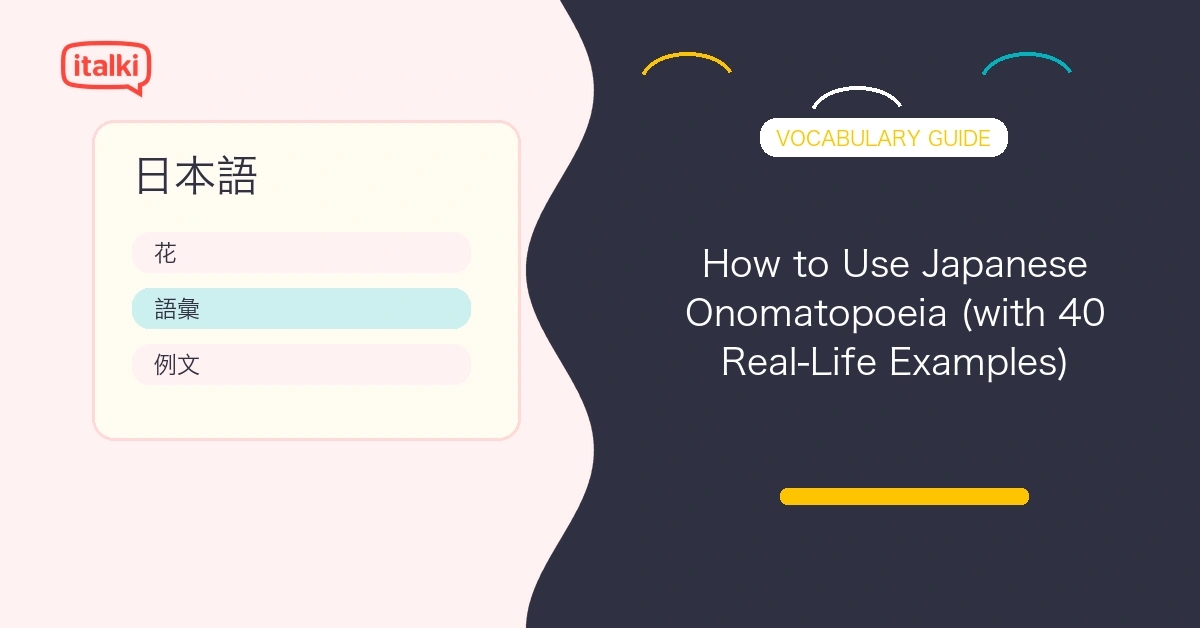
This guide covers 40 Japanese onomatopoeia across five practical categories with example sentences, the three types of onomatopoeia, and how to start using these words naturally.
italki has been connecting learners with teachers since 2007, with 10M+ learners matched to teachers across 150+ languages. Japanese teachers on the platform regularly use onomatopoeia in conversation because native speakers use them constantly, and learning them with a teacher means hearing the natural tone, length, and emphasis these words carry.
Find a Japanese tutor and ask to hear these words in real sentences.

Find your perfect teacher
Build real speaking confidence with personalized lessons from a teacher who matches your goals, schedule, and learning style.

The three types of Japanese onomatopoeia
Japanese linguists distinguish between three types, though the lines between them can blur:
| Type | Japanese name | What it represents | Example |
|---|---|---|---|
| Giongo | 擬音語 | Actual sounds from objects and environment | gatan (clatter), zawazawa (rustling crowd) |
| Giseigo | 擬声語 | Sounds from living creatures (voices, animal sounds) | wan wan (dog bark), nyan nyan (cat meow) |
| Gitaigo | 擬態語 | States and conditions with no literal sound | fura fura (dizzy, unsteady), pika pika (gleaming) |
Gitaigo is the category that surprises most learners: these are words that describe states, textures, movements, and conditions mimetically, as if they had sounds, even when the thing described makes no sound. The heart does not literally go doki doki, but the word captures the feeling of a pounding heart with unmistakable vividness.
Category 1: sounds (giongo and giseigo)
These words represent literal sounds and are broadly equivalent to English sound words like crash, splash, buzz.
| Word | Romanisation | Sound / meaning |
|---|---|---|
| ドンドン | don don | heavy knocking or pounding sound |
| ガタン | gatan | clatter of something falling or a train starting |
| ザーザー | zaazaa | sound of heavy rain |
| ピカピカ | pika pika | flash of light; also the sparkle of something clean |
| ガヤガヤ | gayagaya | noisy crowd, chatter |
| コンコン | kon kon | light knocking sound (door, coughing) |
| バタン | batan | bang of a door slamming |
| ゴロゴロ | gorogoro | rumbling (thunder, stomach); also the sound of rolling |
| チクタク | chikutaku | ticking of a clock |
| シーン | shiin | dead silence (a uniquely Japanese onomatopoeia for the absence of sound) |
シーン (shiin) is one of the most interesting items in this category: it represents complete silence, the ringing quiet that fills a room when no one speaks. Japanese has a word for the sound of silence.
Example sentences:
| Japanese | Romanisation | English |
|---|---|---|
| 雨がザーザー降っています。 | Ame ga zaazaa futte imasu. | It is raining heavily. |
| ドアがバタンと閉まった。 | Doa ga batan to shimatta. | The door slammed shut. |
| 部屋がシーンとしている。 | Heya ga shiin to shite iru. | The room is completely silent. |
Find your perfect teacher
Build real speaking confidence with personalized lessons from a teacher who matches your goals, schedule, and learning style.
Category 2: emotions and internal states (gitaigo)
These words express feelings and psychological states. They are among the most distinctive features of Japanese emotional vocabulary.
| Word | Romanisation | Emotional state |
|---|---|---|
| ドキドキ | doki doki | heart pounding with excitement, nervousness, or anticipation |
| ワクワク | waku waku | excited anticipation, eager excitement |
| イライラ | iraira | irritation, frustration, impatience |
| ニヤニヤ | niyaniya | smirking, grinning slyly |
| ソワソワ | sowasowa | restless, fidgety, uneasy |
| ホッ | ho | relief (a single-unit word; often ホッとした) |
| シュン | shun | feeling deflated, crestfallen |
| ウキウキ | ukiuki | feeling light and cheerful, buoyant |
| ビクビク | bikubiku | nervous, jumpy, scared |
| ムズムズ | muzumuzu | an itchy or restless feeling, the urge to do something |
Example sentences:
| Japanese | Romanisation | English |
|---|---|---|
| 試験の前、ドキドキしています。 | Shiken no mae, doki doki shite imasu. | Before the exam, my heart is pounding. |
| 旅行が楽しみでワクワクしている。 | Ryokō ga tanoshimi de waku waku shite iru. | I am excitedly looking forward to the trip. |
| 彼の態度にイライラする。 | Kare no taido ni iraira suru. | His attitude irritates me. |
A private Japanese tutor can model the natural tone and facial expression that accompanies these emotional words, which is part of how they carry meaning in real conversation. Because onomatopoeia depends so much on sound and rhythm, the listening work in Japanese minimal pairs is useful for hearing small contrasts clearly. .
Category 3: movement and physical action (gitaigo)
These words describe the manner of movement or physical action rather than the sound it produces.
| Word | Romanisation | Movement described |
|---|---|---|
| フラフラ | furafura | unsteady, staggering, dizzy movement |
| スタスタ | sutasuta | walking briskly and purposefully |
| ヨチヨチ | yochiyochi | toddling (the movement of a small child learning to walk) |
| グルグル | guruguru | spinning in circles, going around and around |
| ブラブラ | burabura | hanging loosely; also wandering aimlessly |
| パタパタ | patapata | rapid light steps; flapping movement |
| ゴロゴロ | gorogoro | rolling around; also lounging lazily |
| ズカズカ | zukazuka | walking in without invitation, barging in |
| ノロノロ | noronoro | moving very slowly, sluggishly |
| ピョンピョン | pyonpyon | hopping, jumping lightly |
Example sentences:
| Japanese | Romanisation | English |
|---|---|---|
| 疲れてフラフラ歩いている。 | Tsukarete furafura aruite iru. | Walking unsteadily because of exhaustion. |
| 子どもがピョンピョン跳んでいる。 | Kodomo ga pyonpyon tonde iru. | The child is hopping around. |
| 休日は家でゴロゴロしていた。 | Kyuujitsu wa ie de gorogoro shite ita. | I was lounging around at home on the day off. |
Find your perfect teacher
Build real speaking confidence with personalized lessons from a teacher who matches your goals, schedule, and learning style.
Category 4: textures and appearance (gitaigo)
These words describe how things look, feel, or present themselves.
| Word | Romanisation | Texture or appearance |
|---|---|---|
| ピカピカ | pika pika | shiny, gleaming, sparkling clean |
| フワフワ | fuwafuwa | fluffy, soft and light (bread, clouds, fabric) |
| ツルツル | tsurutsuru | smooth, slippery (surface, noodles) |
| ザラザラ | zarazara | rough, gritty (sandpaper, rough skin) |
| モフモフ | mofumofu | soft and fluffy (animals, plush toys) |
| ベタベタ | betabeta | sticky, clingy (both physical and metaphorical) |
| ドロドロ | dorodoro | thick and muddy, gooey |
| キラキラ | kirakira | glittering, sparkling (light on water, stars, jewels) |
| ふわっと | fuwa tto | soft and light, airy (single moment rather than ongoing state) |
| ぐにゃぐにゃ | gunyagunya | soft and flexible, floppy |
Example sentences:
| Japanese | Romanisation | English |
|---|---|---|
| 猫の毛がフワフワで気持ちいい。 | Neko no ke ga fuwafuwa de kimochi ii. | The cat’s fur is fluffy and lovely. |
| 床がピカピカに磨かれている。 | Yuka ga pika pika ni migakarete iru. | The floor has been polished to a shine. |
| このクリームはベタベタする。 | Kono kuriimu wa betabeta suru. | This cream feels sticky. |
These texture words appear constantly in food descriptions, product reviews, and everyday conversation about materials and objects. They are one of the vocabulary areas where anime learning is genuinely useful: texture and appearance words appear in description-heavy slice-of-life scenes.
Category 5: weather and environment
| Word | Romanisation | Weather or environment |
|---|---|---|
| ザーザー | zaazaa | heavy rain |
| パラパラ | parapara | light scattered rain |
| シトシト | shitoshito | steady, light drizzle |
| ぴゅーぴゅー | pyuupyuu | whistling wind |
| ゴーゴー | googoo | roaring wind or rushing sound |
| カラカラ | karakara | dry and parched (weather, throat) |
| ムシムシ | mushimushi | hot and humid, muggy |
| サクサク | sakusaku | crispy (sound of walking on leaves, snow, or crisp food) |
| しんしん | shinshин | quietly and continuously (snow falling) |
| さわさわ | sawasawa | soft rustle (leaves, light wind) |
Example sentences:
| Japanese | Romanisation | English |
|---|---|---|
| 今日はムシムシして暑い。 | Kyō wa mushimushi shite atsui. | Today is hot and humid. |
| 雪がしんしんと降っている。 | Yuki ga shinshін to futte iru. | Snow is falling quietly and steadily. |
| 喉がカラカラだ。 | Nodo ga karakara da. | My throat is parched. |
Find your perfect teacher
Build real speaking confidence with personalized lessons from a teacher who matches your goals, schedule, and learning style.
Grammar: how onomatopoeia function in sentences
Japanese onomatopoeia follow a few consistent grammatical patterns:
1. With する (suru), to do:
Many gitaigo words combine with suru to become verbs:
- ドキドキする (doki doki suru), to feel one’s heart pounding
- イライラする (iraira suru), to feel irritated
- ワクワクする (waku waku suru), to feel excited
2. With と (to) as an adverbial marker:
と connects the onomatopoeia to the verb it modifies:
- バタンと閉まった, slammed shut (with a bang)
- ゆっくりと歩く, to walk slowly
3. As standalone adjectives or descriptions:
Some onomatopoeia stand alone as descriptions, often before a noun or after a form of da/desu:
- フワフワのパン, fluffy bread
- 肌がツルツルだ, the skin is smooth
4. As exclamations:
Short onomatopoeia function as exclamations in their own right:
- ホッ!, (sigh of) relief
- シュン…, feeling deflated
Moving from recognition to natural use
Japanese onomatopoeia are most effectively learned in pairs (what produces them and what they describe), in context (the sentences where they appear), and through speaking (hearing and reproducing the natural tone).
italki has 30,000+ teachers across 150+ languages, including qualified Japanese teachers who use these words in real conversation because they are part of daily Japanese communication. Find an online Japanese tutor and bring this list to a session focused on description, describing how things look, feel, move, and sound in Japanese.
Find your perfect teacher
Build real speaking confidence with personalized lessons from a teacher who matches your goals, schedule, and learning style.
FAQ
What is the difference between giongo, giseigo, and gitaigo?
Giongo represents sounds from the environment (rain, machines, impacts). Giseigo represents sounds from living things (animal sounds, human voice sounds). Gitaigo represents states, conditions, movements, and textures that have no literal sound, the largest and most distinctive category in Japanese.
Are Japanese onomatopoeia only used in manga and anime?
No. They are part of everyday spoken and written Japanese. Native speakers use them in conversation, advertising, food reviews, news, literature, and children’s books. The high frequency of onomatopoeia in manga and anime reflects their prominence in the language, not a restriction to those media.
Why does doki doki mean a pounding heart?
It mimics the perceived sound of a heart beating rapidly due to excitement, fear, or anticipation. Japanese onomatopoeia often capture a subjective felt experience of a sensation rather than its literal acoustic properties. The same reduplication pattern applies across many emotional and physical states.
How are onomatopoeia used in a sentence?
Most commonly with suru (to do/feel): doki doki suru (to have a pounding heart). With the particle to as an adverbial: batan to shimatta (slammed shut). As adjectives before nouns: fuwafuwa no kumo (fluffy clouds). As exclamations or descriptions: shiin (silence).
Can I learn Japanese onomatopoeia from anime?
Yes, though anime tends to lean heavily on emotional and movement onomatopoeia. Texture and weather words appear more in everyday conversation and written description. Anime is a good source for the most common ones but should be supplemented with reading and speaking practice for the full range.
Want to learn a language at italki?
Here are the best resources for you!